Cleopatra's Alexandria: An Egypt Historical Guide Worth Reading
Cleopatra never saw the Pharos lighthouse finished. It was completed after her death. Most of what tourists call 'her city' she would not recognize. Here is what actually survives.

Audio Guide: Cleopatra's Alexandria: An Egypt Historical Guide Worth Reading
Quick Facts
- Best time to visit
- October to April for mild Mediterranean temperatures and fewer domestic tourists. March and November are particularly good months for light and manageability.
- Entrance fee
- Catacombs of Kom el-Shoqafa: EGP 180 (approx $3.50 USD). Pompey's Pillar complex: EGP 150 (approx $3 USD). National Museum of Alexandria: EGP 100 (approx $2 USD). Bibliotheca Alexandrina general access: EGP 70 (approx $1.40 USD).
- Opening hours
- Most archaeological sites daily 8am to 4pm (winter) and 8am to 5pm (summer). Bibliotheca Alexandrina Saturday to Thursday 10am to 7pm. Catacombs close at 5pm in summer months.
- How to get there
- Train from Cairo Ramses to Alexandria Misr: EGP 70 to 250 depending on class, approximately 2 to 2.5 hours. Microbus from Alexandria station to Kom el-Shoqafa: EGP 5 to 10. Uber within the city typically EGP 30 to 60 per trip.
- Time needed
- Minimum two full days to cover the core historical sites meaningfully. Add a third day if including an underwater dive to the submerged Royal Quarter.
- Cost range
- Budget EGP 800 to 1,200 per day covering transport, entry fees, and simple meals. Mid-range EGP 2,000 to 3,500 per day including a waterfront hotel and sit-down fish restaurants.
Quick Facts
Best time to visit: October through April. Alexandria's Mediterranean climate means summer is humid and crowded with Egyptian tourists; spring and autumn give you the best light and tolerable heat.
Entrance fees: Pompey's Pillar complex (including the Serapeum): EGP 150 (approx $3 USD), students EGP 75 Catacombs of Kom el-Shoqafa: EGP 180 (approx $3.50 USD), students EGP 90 Bibliotheca Alexandrina (main building access): EGP 70 (approx $1.40 USD); antiquities museum inside costs extra at EGP 100 Royal Jewelry Museum: EGP 100 (approx $2 USD) National Museum of Alexandria: EGP 100 (approx $2 USD)
Opening hours: Most major sites open daily 8am to 4pm. The Bibliotheca runs Saturday through Thursday, 10am to 7pm. The Catacombs close at 5pm in summer. Always confirm at point of purchase as Egyptian state-site hours shift seasonally without consistent online updates.
How to get there: Trains from Cairo Ramses station to Alexandria Misr station run frequently; intercity trains cost EGP 70 to 250 depending on class, journey about 2 to 2.5 hours. Microbuses from the station to any major site cost EGP 5 to 10. Taxis within the city should not exceed EGP 60 for most trips; use the Uber app to avoid negotiation problems. The site cluster around Kom el-Shoqafa can be walked between in under 20 minutes.
Time needed: Two focused days to do justice to both the ancient and the Ptolemaic layers. One day if you are prioritizing the Cleopatra historical narrative specifically, skipping the Greco-Roman Museum (currently under renovation as of recent reporting) and the Royal Jewelry Museum.
Cost range: Budget EGP 800 to 1,200 per day including food, transport, and entry fees. Mid-range EGP 2,000 to 3,500 including a decent waterfront hotel.
---
Why This Place Matters
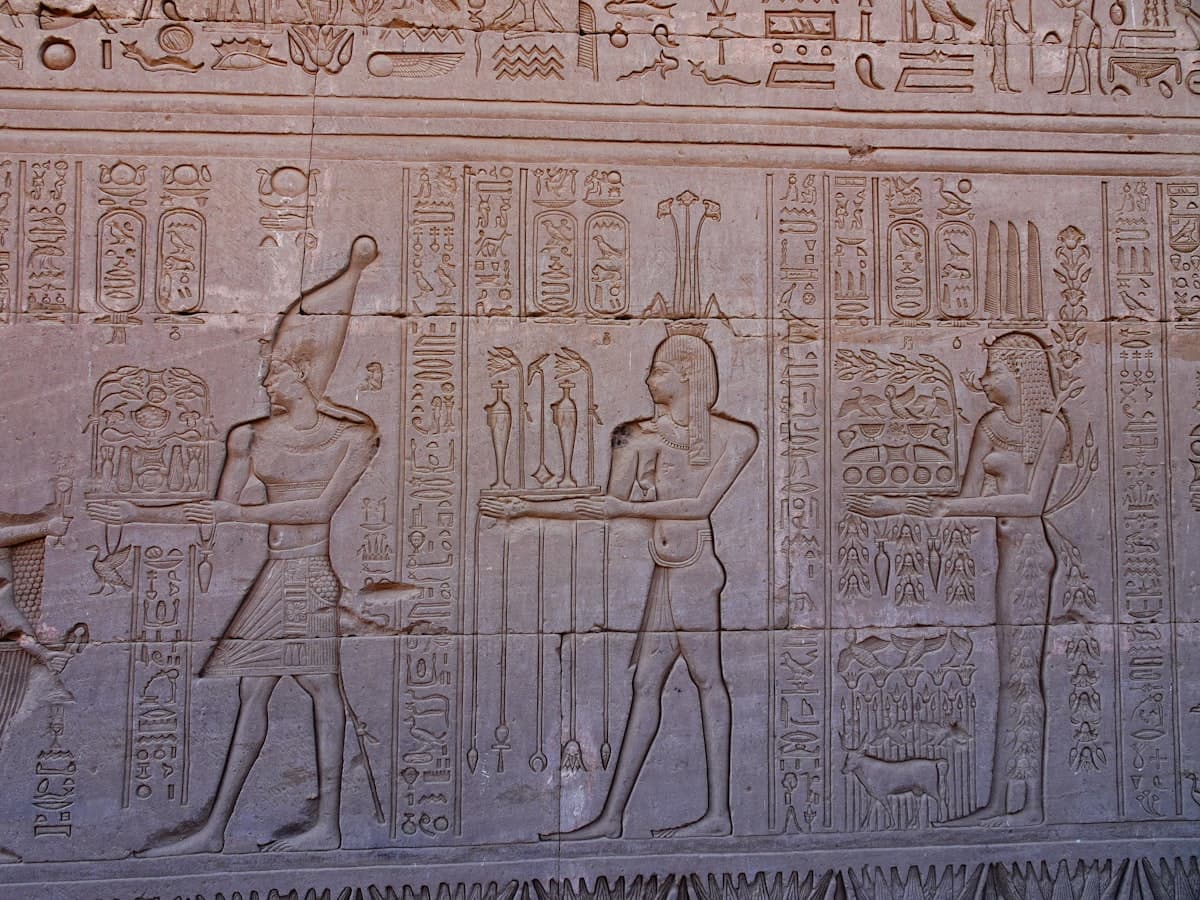
Cleopatra VII, the queen most people picture when they say the name, was not Egyptian by blood. She was Macedonian Greek, a descendant of Ptolemy I, one of Alexander the Great's generals who seized Egypt after Alexander died in 323 BC. What makes her remarkable is that she was the first ruler of her dynasty in nearly 300 years to bother learning the Egyptian language. She also spoke Ethiopian, Hebrew, Aramaic, Syriac, Median, Parthian, and Latin. The court of Alexandria had functioned in Greek for three centuries. She chose, deliberately, to speak to her subjects in their own tongue. That single political act tells you more about Cleopatra's intelligence than any story about her relationships with Roman generals.
This is the framework you need for any honest Cleopatra Alexandria Egypt historical guide: the city she ruled was a Hellenistic mega-city, not a Pharaonic one. Alexandria was founded in 331 BC on a narrow strip of land between the Mediterranean and Lake Mariout. By the first century BC, it was the largest city in the world after Rome, with a population estimated at around 500,000, extraordinary for antiquity. It had running water, a grid street plan, a famous lighthouse that ancient writers ranked among the Seven Wonders of the World, and the greatest library the ancient world had assembled.
The tragedy is that almost none of it is above ground. What you are doing in Alexandria is not sightseeing in the conventional sense. You are reading a palimpsest, a document written over and over on top of itself: Ptolemaic under Roman under Byzantine under Arab under Ottoman. Cleopatra's Alexandria is not missing because of neglect. It is missing because an entire city of six million people has been living on top of it for two thousand years.
---
What Survived and Where to Find It
The Catacombs of Kom el-Shoqafa: Three Religions in One Grave
The catacombs are the most important site in Alexandria that most visitors treat as an afterthought. They were discovered in 1900 when a donkey fell through the ground and exposed the shaft. What the donkey revealed was a burial complex begun in the first or second century AD, used for roughly three centuries, and representing the precise moment when Egyptian, Greek, and Roman religious traditions stopped fighting each other and started fusing.
Descend the spiral staircase and you find a triclinium, a Roman dining room, carved directly into the rock. Families came here to eat funerary banquets with their dead. The main burial chamber has a vestibule guarded by figures that are simultaneously Egyptian gods (Anubis with a jackal head) dressed in Roman legionary armor carrying Greek-style ceremonial shields. This is not confusion. This is a community that had absorbed three visual languages and chose to use all of them at once.
The catacombs were not in use during Cleopatra's lifetime. They post-date her by a century at minimum. But they are the most tangible evidence of what Alexandria actually was: a city where a Greek merchant, an Egyptian priest, and a Roman soldier could share a theology without entirely abandoning their own. Cleopatra's multilingualism was not eccentricity. It was the natural product of this place.
Pompey's Pillar and the Serapeum: What the Library Actually Was
The red granite column standing 27 meters high near the Serapeum hill was never associated with Pompey in antiquity. It was erected in 297 AD in honor of the emperor Diocletian, who suppressed an Alexandrian revolt and then, inexplicably, sent grain to feed the city he had just punished. Medieval Arab travelers saw the pillar, assumed it commemorated Rome's most famous defeat on Egyptian soil, and the wrong name stuck.
Beneath and around the pillar are the remains of the Serapeum, a temple complex dedicated to Serapis, a god invented by Ptolemy I specifically to give Greeks and Egyptians a deity they could worship together. Serapis combined attributes of Osiris, Apis the bull, and the Greek gods Zeus and Asclepius. This was deliberate religious engineering at a state level, and it largely worked. The cult of Serapis spread across the Roman Empire.
Here is what almost every visitor misses: the Serapeum housed a subsidiary collection of the Great Library. The main Library of Alexandria is gone, its exact location still debated, its destruction a slow process over centuries rather than a single dramatic burning. But the Serapeum library persisted longer. When the Christian bishop Theophilus ordered the Serapeum destroyed in 391 AD, there were still scrolls inside. The smashed foundation blocks you are stepping over are as close as you will get to standing on the site of the ancient library.
---
The Underwater City and the Palace Quarter

Cleopatra's actual palace almost certainly lies beneath the Eastern Harbor. Underwater archaeological surveys beginning in 1996, led by the French archaeologist Franck Goddio, have mapped more than 2.5 kilometers of submerged structures including what appear to be temple foundations, sphinxes, and statuary consistent with the Royal Quarter described by ancient writers. Earthquakes in the fourth and eighth centuries AD progressively sank this part of the ancient city.
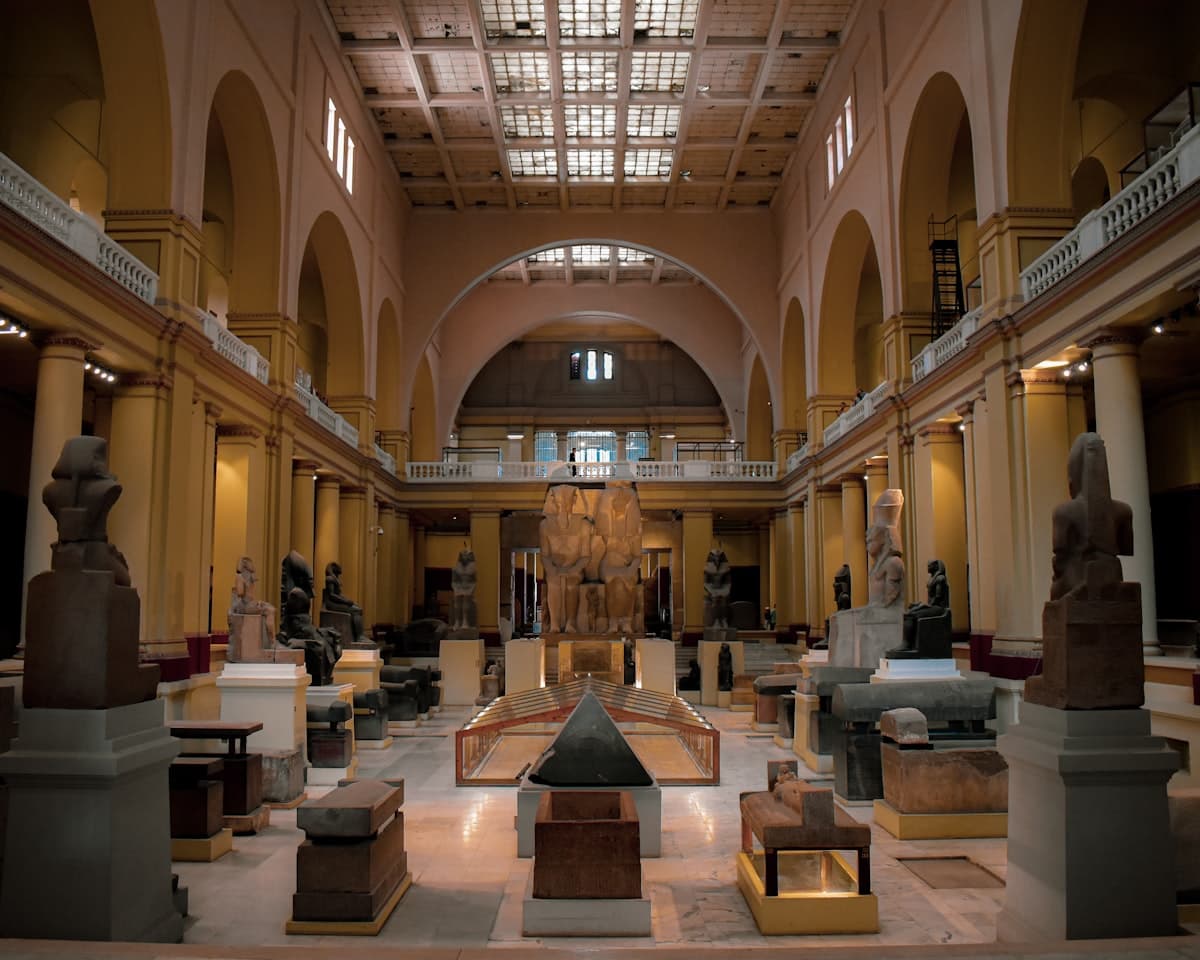
You can see artifacts recovered from these excavations at the National Museum of Alexandria on Tariq al-Hurriyya, which is genuinely worth two hours of your time and almost always uncrowded. The building is a restored Italian-style palace. The basement holds the oldest material, and this is where you will find limestone blocks, statuary fragments, and coins from the Ptolemaic period. There is a granite head of a Ptolemaic queen that may or may not be Cleopatra, purchased in ambiguity like most things in this city.
For those who want to see the underwater site directly: Alexandria Dive operates licensed dives to the submerged Royal Quarter. The dive itself is beginner-accessible, shallow, and covers an area roughly the size of several city blocks. Visibility is variable. What you see are shapes and shadows, broken columns and paving stones, which sounds underwhelming until you are actually floating above what is almost certainly the floor of a Ptolemaic palace, and the reality of it stops your breathing for a moment that has nothing to do with the equipment.
---
The Connections
Alexandria does not exist in isolation from the rest of Egypt, though it is easy to treat it that way. The city was founded on a site that already had a small Egyptian settlement called Rhakotis, whose fishing community was not consulted about the new city being built around them. The hill of Kom el-Shoqafa, where the catacombs sit, was part of this original Egyptian neighborhood. The people who dug those graves and ate those funerary meals were likely descended from those original residents, absorbing Greek and Roman overlayers while maintaining an Egyptian core.
The connection to Islamic Alexandria is equally layered. The Arab general Amr ibn al-As captured the city in 641 AD and reportedly wrote to the caliph Umar describing a city of 4,000 palaces, 400 baths, and 400 theaters. The caliph's response was to order the city's administration moved to a new capital: Fustat, the precursor to Cairo. Alexandria's decline as a political center began at that moment. It spent the next twelve centuries as a provincial port, which is precisely why so much of the ancient city remains underground rather than having been systematically quarried for building material. Obscurity preserved it.
The Bibliotheca Alexandrina, opened in 2002 on the approximate site of the ancient Library, represents an attempt by the Egyptian state to reclaim that symbolic inheritance. The architecture, a tilted disc by the Norwegian firm Snohetta, is genuinely thoughtful, the exterior wall inscribed with characters from 120 world scripts. The library inside functions as a real research library. The antiquities museum in the basement houses material that contextualizes everything else you see in the city.
---
Common Mistakes
Expecting a Pharaonic city. This is the most consequential mistake. Tourists arrive primed by images of hieroglyphs and temple columns and feel confused or disappointed. Alexandria was Greek-speaking, cosmopolitan, and radically different from Luxor or Aswan. Reframe your expectations before you arrive or you will spend two days feeling vaguely cheated.
Visiting the Greco-Roman Museum without checking its status. This should be the centerpiece of any Cleopatra Alexandria Egypt historical guide. It holds extraordinary Ptolemaic material. It has also been under renovation for years and has had inconsistent partial-opening policies. Confirm directly through the Alexandria tourist authority or at your hotel before planning your day around it.
Doing the harbor dinner cruise. Skip it entirely. It costs between EGP 600 and 1,200 per person depending on which operator approaches you, serves mediocre food, and shows you the harbor at night from a slow boat while someone plays amplified pop music. You can sit at any of the fish restaurants on the Corniche for EGP 200 to 300 and see the same water with better food and silence enough to think.
Underestimating the National Museum of Alexandria. Almost every group tour skips it in favor of Pompey's Pillar, which takes twenty minutes to see and is, honestly, a single column in a dusty lot. The National Museum has three floors of genuinely significant material and almost no crowds. This is where you understand the city. The column is where you take a photograph of a column.
Hiring a guide at the site gate. Unofficial guides at Kom el-Shoqafa and the Serapeum range from adequate to actively misleading. The man who told a journalist colleague that Cleopatra was buried in the catacombs (she was not, and the catacombs post-date her by at least a century) was not an outlier. If you want a guided experience, book through the Egyptian Tourist Authority or through Bibliotheca-affiliated programs.
Not allowing time for the Corniche at dawn. This costs nothing and is the most specifically Alexandrian experience available. The light at 6am on the Eastern Harbor, the smell of sea salt and the faint diesel of the fishing boats coming in, the minarets of the Abu al-Abbas al-Mursi mosque catching the first sun: this is the accumulated city, all of its layers at once, and no ticket is required.
Conflating the Cleopatra narrative with the Cleopatra industry. There are Cleopatra-branded perfume shops, Cleopatra-branded papyrus sellers, and Cleopatra-branded everything between the train station and the harbor. None of it has anything to do with history. The actual Cleopatra sold herself as Isis incarnate, dressed accordingly, and was photographed, in the ancient sense, in temple reliefs at Dendera, where there is a famous carving of her. That image is worth finding online before you come. It will recalibrate everything.
---
Practical Tips
Alexandria is best done as a dedicated trip from Cairo rather than a day trip, though day trips are common. If you go for one day, you will see the column, the catacombs, and the outside of the Bibliotheca and feel you have missed something. You have. Two nights in the city allows the morning harbor walk, a proper afternoon in the National Museum, and enough time to eat correctly: fish caught that morning at restaurants like Fish Market on the waterfront (budget EGP 250 to 400 per person for a full meal with mezze).
Wear comfortable shoes. The Kom el-Shoqafa descent is steep and the rock is slick. There is no good handrail for about a third of the staircase.
Bring cash. Several sites have unreliable card facilities. EGP is preferred everywhere; USD is accepted at some tourist sites but at poor rates.
For the underwater Royal Quarter dive, contact Alexandria Dive (they maintain an English-language booking line) at least 48 hours in advance. Bring your certification card if you are a certified diver; introductory dives for non-certified visitors are available but the experience is more limited.
If you are traveling with children under twelve, the catacombs involve a long spiral descent into genuine underground darkness and the imagery is complex. Most children find it interesting rather than frightening, but it is worth discussing beforehand.
Finally: Alexandria is not Cairo. The city is flatter, quieter, more Mediterranean in its pace and its architecture. The people are, in general, somewhat less aggressively entrepreneurial with tourists. Give it time to register as its own place rather than as a failed version of somewhere else.
Frequently Asked Questions
The Weekly Dispatch
More on Egypt, every Friday.
Cultural depth and places most guides never mention.
No spam. Unsubscribe anytime.