Cleopatra's Alexandria: The Historical Guide Egypt Doesn't Tell You
Cleopatra never saw the Pyramids as a tourist. She saw them as a 1,500-year-old monument when she ruled. Alexandria was her world, and almost none of it survived.

Quick Facts
- Best time to visit
- October to April. Mediterranean winters are mild and clear; summer humidity is oppressive and crowds peak during Egyptian school holidays in July and August.
- Entrance fee
- Kom el-Shoqafa: EGP 180 (approx $3.70 USD). Pompey's Pillar: EGP 120 (approx $2.50 USD). Alexandria National Museum: EGP 200 (approx $4.20 USD). Bibliotheca Alexandrina: EGP 70 general entry, EGP 130 with museum access.
- Opening hours
- Most archaeological sites 9am to 5pm daily. Kom el-Shoqafa closes at 4:30pm. Bibliotheca Alexandrina: Saturday to Thursday 10am to 7pm, Friday 3pm to 7pm.
- How to get there
- From Cairo: intercity train from Ramses Station, 2 to 2.5 hours, EGP 65 to 200 depending on class. Superjet bus EGP 100 to 150. Within Alexandria: Uber and Careem ride-share apps, EGP 40 to 70 per cross-city trip.
- Time needed
- Two full days minimum. Three days if including Taposiris Magna and Abu Mena site.
- Cost range
- Budget EGP 600 to 900 per day including entry fees and transport. Mid-range EGP 1,800 to 3,000 per day with private specialist guide and Corniche hotel.
Cleopatra VII did not speak Egyptian when she was born. She learned it. She was the first Ptolemaic ruler in nearly three centuries to bother, which is one reason Egyptians loved her and her dynasty's historians barely mentioned her competence. She spoke nine languages including Ethiopic, Aramaic, and Hebrew, ran a navy, administered a treasury, and negotiated with Rome from a position of genuine power for two decades. The woman your guidebook reduces to a love story was the last independent ruler of a civilization four thousand years old. Alexandria was her capital, her library, her palace complex, her port. Almost none of it exists above ground today. What does exist is stranger, more layered, and more interesting than the myth.
Quick Facts
Best time to visit: October through April. Alexandria's Mediterranean climate means summer humidity sits heavily on the city. Winter light is clean and cool, and the sites are less crowded than during Egyptian school holidays.
Key sites and entrance fees: Kom el-Shoqafa Catacombs: EGP 180 (approx $3.70 USD), students EGP 90 Pompey's Pillar complex: EGP 120 (approx $2.50 USD) Alexandria National Museum: EGP 200 (approx $4.20 USD) Bibliotheca Alexandrina (modern): EGP 70 (approx $1.50 USD) general entry, EGP 130 for museum access Royal Jewelry Museum: EGP 150 (approx $3.10 USD)
Opening hours: Most sites open 9am to 5pm daily. Kom el-Shoqafa closes at 4:30pm. The Bibliotheca opens Saturday to Thursday 10am to 7pm, Friday 3pm to 7pm.
How to get there: From Cairo, the intercity train takes around 2 to 2.5 hours from Ramses Station; tickets run EGP 65 to 200 depending on class. The Superjet bus from Cairo is EGP 100 to 150. Within Alexandria, a taxi between sites should cost EGP 30 to 60; use a metered Uber or agree the price before getting in.
Time needed: The Cleopatra-era historical circuit deserves two full days. One day for the underwater and physical archaeology sites; one day for the museums that hold what the sea gave back.
Cost range: Budget EGP 600 to 900 per day including transport and entry fees. Mid-range EGP 1,800 to 3,000 per day with a private guide and decent hotel on the Corniche.
Why This Place Matters
Alexandria was founded in 331 BC by Alexander the Great, who then promptly left and died before seeing it completed. Within a century it had become the largest city in the world, larger than Rome, with a population historians estimate between 300,000 and 500,000 people. The Library of Alexandria at its height held between 400,000 and 700,000 papyrus scrolls, a figure that represents not just books but the systematic acquisition of every ship's cargo that docked in the harbor. Ships were searched, scrolls confiscated, copied, and the copies returned. The originals stayed.
Cleopatra inherited this city in 51 BC at approximately eighteen years old, was briefly exiled by her brother and co-ruler Ptolemy XIII, and famously re-entered it by having herself rolled in a carpet and delivered to Julius Caesar. That story is probably true, because it appears in sources close to the event and because it is exactly the kind of audacious move she made throughout her career.
The problem for any traveler pursuing a Cleopatra Alexandria Egypt historical guide is that the city she knew is almost entirely gone. Her palace complex sat on the promontory now called Cape Lochias, currently a restricted military zone. The royal quarter that held her court, her zoo, her private harbor, and the tomb she built for herself sank into the sea during a series of earthquakes and tsunamis between the 4th and 8th centuries AD. French underwater archaeologist Franck Goddio began excavating this submerged royal quarter in 1996 and has recovered statues, sphinxes, columns, and the actual outline of the Antirhodos island where Cleopatra's palace stood, at depths of four to eight meters. You cannot dive there as a tourist yet, though proposals for an underwater museum have circulated for two decades.
What you can do is understand what survives above ground, why it survived, and what it tells you about the city she knew.
Pompey's Pillar and What Lies Beneath It
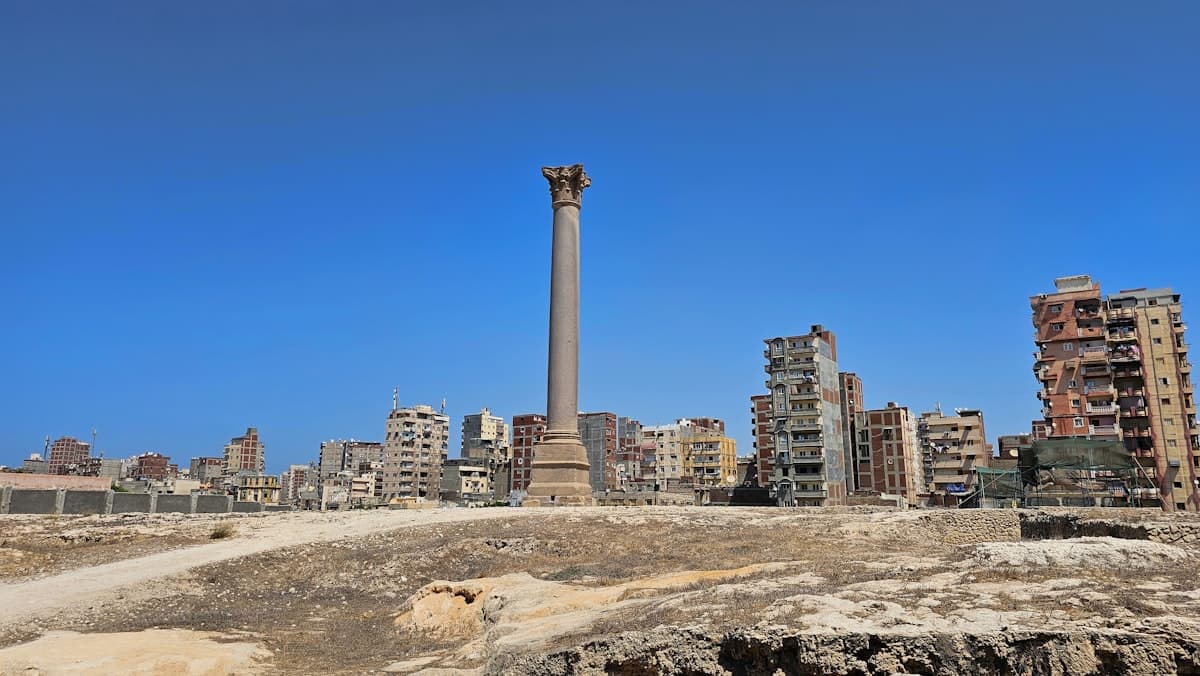
The single standing column on the hill at Kom el-Dikka is called Pompey's Pillar, which is wrong on almost every level. Pompey the Roman general was indeed murdered in Alexandria in 48 BC when he arrived seeking refuge and was killed on the orders of the young Ptolemy XIII, possibly to please Julius Caesar, who was reportedly disgusted by the act. But the pillar has nothing to do with Pompey. It was erected in 297 AD in honor of the Roman Emperor Diocletian, stands 26.85 meters tall, and is made from a single piece of red Aswan granite. It is the largest monolithic column ever erected outside Rome.
The reason to come here is not the pillar. It is what sits below it. The site was the temenos, the sacred enclosure, of the Serapeum: the great temple of Serapis, a deity invented by Ptolemy I specifically to unite his Greek and Egyptian subjects. Serapis combined elements of Osiris and Apis with the Greek gods Zeus and Asclepius. The cult worked. The temple complex held a daughter library of the great Library of Alexandria, estimated at 42,800 scrolls. Christian mobs destroyed both the temple and the library in 391 AD on the orders of Bishop Theophilus, an act that early Christian sources themselves recorded with some discomfort.
The underground Nilometer tunnels and the subterranean galleries beneath the Serapeum are only partially accessible, but you can walk through sections of the storage tunnels where the temple's sacred Apis bull statues were kept. Two headless sphinxes remain at the entrance. They are Ptolemaic period, meaning Cleopatra's ancestors commissioned them or her own court walked past them daily.
Kom el-Shoqafa: The City That Kept Living
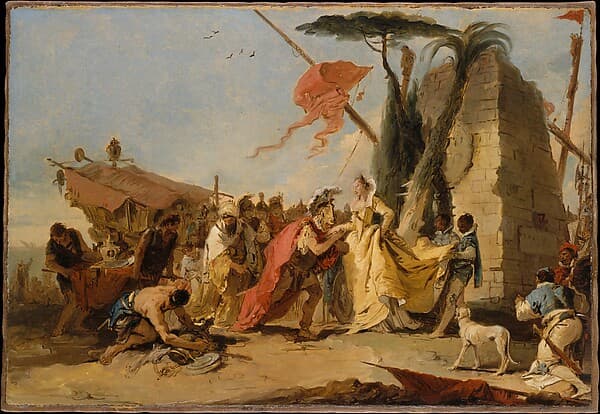
Kom el-Shoqafa was discovered in 1900 when a donkey fell through the ground. The catacombs beneath what is now a residential neighborhood date to the 2nd century AD, which means they are roughly contemporary with early Christian Alexandria, and they are the single best surviving example of what happened when three civilizations tried to bury their dead simultaneously in the same city.
The primary burial chamber shows Egyptian gods rendered in Roman artistic style, wearing Roman armor, carrying Greek symbols. Anubis, the jackal-headed god who guides the dead, appears here wearing a Roman soldier's breastplate. Sobek, the crocodile god, wears a pharaonic double crown but is carved in the blocky Roman sculptural tradition. There is no awkwardness in these images. The people who commissioned them did not experience their world as a collision of cultures. They lived in it as a natural synthesis.
The catacombs descend three stories into the earth and could accommodate roughly 300 bodies. The second level contains the main tomb, a triclinium, a dining room where families ate funerary meals with the dead. This was not morbid by Roman standards. It was a social obligation, a way of keeping the dead within the community of the living.
Kom el-Shoqafa is worth two hours of serious attention. The third level is flooded and inaccessible, which is frustrating but also a reminder that the water table in Alexandria has been rising since antiquity, which is exactly why Cleopatra's palace is now at the bottom of the Eastern Harbor.
The Alexandria National Museum and What the Sea Returned
The Alexandria National Museum occupies a restored Italian-style palace on Tariq al-Hurriya, the main boulevard that follows the line of the ancient Canopic Way, the royal road of Ptolemaic Alexandria. This is the right place to understand what Franck Goddio and Egyptian archaeologist Mohamed Abd el-Samad recovered from the submerged royal quarter.
The ground floor holds Pharaonic material. The first floor holds Greco-Roman pieces, including several items recovered from the harbor excavations: a black granite statue of a Ptolemaic queen with the attributes of Isis, likely dating to Cleopatra's era; sections of obelisks from the sunken Canopus region; a colossal head identified as possibly representing Marc Antony based on physiognomy and context. These labels are honest: the museum cards say "possibly" and "likely" rather than making claims the archaeology cannot support.
The third floor covers Islamic and Coptic Alexandria, and this is where most visitors rush through, which is a mistake. The Coptic section contains materials from the Monastery of Abu Mena, 45 kilometers southwest of Alexandria, one of the most important early Christian pilgrimage sites in the world. It was built over the tomb of the martyr Menas, and at its peak in the 5th and 6th centuries it received pilgrims from across the Roman and Byzantine empires. It is currently a UNESCO World Heritage Site in danger. The water table that destroyed Cleopatra's palace is destroying Abu Mena too.
The Connections: Nothing Ends, Everything Transforms
The Bibliotheca Alexandrina, opened in 2002 on the site believed to be near the original Library, is the city's clearest statement that Alexandria understands itself as a continuum. The building itself, designed by the Norwegian-based firm Snohetta, is a deliberate provocation: a tilted disc of gray Aswan granite engraved with letters from 120 different writing systems, angled toward the sea as though it is always about to slip into the water like its predecessor.
The original Library was not destroyed in a single dramatic fire, despite what is commonly repeated. It declined across several centuries through a combination of reduced funding, a catastrophic fire during Julius Caesar's campaign in 48 BC that destroyed a warehouse of books near the port (not the Library itself, as ancient sources carefully distinguish), the Christian destruction of the Serapeum's daughter library in 391 AD, and the general contraction of the city after the Arab conquest of 641 AD. The Arab general Amr ibn al-As reportedly wrote to Caliph Omar asking what to do with the books. The caliph's answer, if the story is true, was that books agreeing with the Quran were redundant and books disagreeing were dangerous. Either way, burn them. Most modern historians think this story was invented centuries later to justify other agendas. The Library was already gone by 641 AD.
The Corniche you walk today along the Eastern Harbor follows the approximate line of the ancient royal harbor wall. The fort of Qaitbay, built in 1477 by the Mamluk Sultan Qaitbay using stones from the destroyed Lighthouse of Alexandria, one of the Seven Wonders of the Ancient World, sits directly on the lighthouse's foundation. The lighthouse fell in stages due to earthquakes between 956 and 1323 AD. Goddio's team found lighthouse blocks in the harbor, some of them eight meters long. The largest ancient lighthouse ever built, at an estimated 100 to 140 meters tall, is now a 15th-century Islamic fort and one of Alexandria's most pleasant places to stand at sunset, watching the same harbor Cleopatra's warships once used.
Common Mistakes
Skipping the Alexandria National Museum for the Bibliotheca. Most visitors go to the Bibliotheca Alexandrina for its architecture and come away mildly impressed by a modern building. The National Museum holds actual recovered objects from the submerged Ptolemaic city. It is a fraction of the price and has roughly one-tenth of the visitors. Go there first.
Expecting Cleopatra's tomb to be findable. Every few years a new announcement claims that Cleopatra's burial site has been discovered, most recently at Taposiris Magna, 45 kilometers west of Alexandria, where archaeologist Kathleen Martinez has been excavating for over fifteen years. No tomb has been found. The site contains genuine and interesting Ptolemaic material, but the sensational headlines are not supported by the evidence. Do not visit Taposiris Magna expecting a revelation. Visit it if you are interested in a working excavation in a beautiful coastal location.
Taking the Alexandria Day Trip from Cairo and thinking you've seen it. A single day is not enough. Most day-trip itineraries run visitors through Pompey's Pillar, Kom el-Shoqafa, and a seafood lunch. This covers approximately 15 percent of what the city can show you about the Ptolemaic and Cleopatra period.
Paying for a boat tour of the harbor to see the underwater ruins. No commercial boat tour currently offers meaningful visibility of the submerged royal quarter. You will be shown a general area of water and told that Cleopatra's palace is below. This is technically true of most of the Eastern Harbor. Save the money.
Believing the Fort of Qaitbay contains Roman-era material in situ. The fort is built from lighthouse and temple stones, but they were reused as building material. Nothing inside the fort was placed there by Greeks or Romans. The archaeological significance is the stones themselves and their location, not any interior feature.
Missing the Graeco-Roman Museum if it has reopened. The museum has been under renovation for years and its reopening date has shifted repeatedly. If it is open during your visit, prioritize it over almost everything else. It holds the largest collection of Ptolemaic-period sculpture in the world, including portrait busts from Cleopatra's era that have been used to reconstruct what she actually looked like. The results are not what the films suggest.
Practical Tips
Hire a specialist guide rather than a general Egyptologist. Alexandria's archaeology requires someone who knows Ptolemaic history, underwater excavation context, and the layering of Greek, Roman, Jewish, Coptic, and Islamic Alexandria. Ask specifically about their knowledge of the Goddio excavations before booking.
The best light for the Corniche and the Fort of Qaitbay is in the morning, between 8am and 10am, before the haze builds. The afternoon light in Alexandria is whitish and flat. Plan outdoor photography accordingly.
Alexandria's taxi drivers are skilled at quoting tourist prices. Uber and Careem operate in the city and are significantly more reliable for fare transparency. From the train station to the Corniche hotel district, the fare should be EGP 40 to 60 by ride-share app.
The city's seafood is genuinely excellent and underpriced by any comparison. Lunch at a proper fish restaurant on the harbor, where you select your fish by weight and it is grilled to order, will cost EGP 300 to 600 per person with mezze. This is not a tourist attraction. It is lunch. Eat it properly.
Frequently Asked Questions
The Weekly Dispatch
More on Egypt, every Friday.
Cultural depth and places most guides never mention.
No spam. Unsubscribe anytime.