Greeks in Egypt: Alexandria's Living Greek History Guide
Alexandria was founded by a Macedonian who never saw it finished. For 300 years after, Greek was the city's language of power, science, and God. The traces are stranger than you expect.

Quick Facts
- Best time to visit
- October to April. The Mediterranean climate keeps temperatures between 14°C and 22°C, the light is clear and workable for photography, and crowds at sites like the Catacombs are manageable.
- Entrance fee
- Pompey's Pillar and Serapeum: EGP 180 (approx $3.50 USD). Catacombs of Kom el-Shoqafa: EGP 220 (approx $4.50 USD). Bibliotheca Alexandrina exhibitions: EGP 100 (approx $2 USD). Greco-Roman Museum: EGP 200 when open (approx $4 USD, confirm before visiting).
- Opening hours
- Most sites daily 8am to 5pm (winter), 9am to 6pm (summer). Catacombs close at 5pm year-round. Bibliotheca Alexandrina closed Fridays.
- How to get there
- Talgo high-speed train from Cairo Ramses to Alexandria Sidi Gaber: EGP 85 to 160, approximately 2 hours 20 minutes. Within Alexandria, microbuses between major sites cost EGP 3 to 5. Taxi from Sidi Gaber to Catacombs: approximately EGP 60.
- Time needed
- 2 full days minimum for main Greek and Greco-Roman sites. 3 days recommended if combining with Coptic and Islamic Alexandria.
- Cost range
- Budget EGP 600 to 900 per day including accommodation, transport, and entrance fees. Mid-range EGP 1,800 to 3,000 per day including a better hotel and local guide fees.
Quick Facts
Best time to visit: October to April, when the Mediterranean coast stays below 25°C and the light is flat and clear rather than the bleached white of summer.
Key sites and entrance fees: Greco-Roman Museum (currently closed for renovation, reopening expected soon, check locally): EGP 200 (approx $4 USD) when operational Pompey's Pillar and Serapeum: EGP 180 (approx $3.50 USD) Royal Jewelry Museum: EGP 100 (approx $2 USD) Catacombs of Kom el-Shoqafa: EGP 220 (approx $4.50 USD) Bibliotheca Alexandrina permanent exhibitions: EGP 100 (approx $2 USD)
Opening hours: Most sites open daily 8am to 5pm in winter, 9am to 6pm in summer. Catacombs close at 5pm year-round.
Getting there: Alexandria is 220km from Cairo. The Spanish-built high-speed rail (Talgo) runs from Cairo Ramses to Alexandria Sidi Gaber in approximately 2 hours 20 minutes; tickets cost EGP 85 to 160 depending on class. Microbuses connect major sites within the city for EGP 3 to 5. A taxi from Sidi Gaber station to the Catacombs should not cost more than EGP 60.
Time needed: Two full days minimum to cover the Greco-Roman layer seriously. Three days if you want to cross-reference it with Islamic and Coptic Alexandria.
Cost range: Budget EGP 600 to 900 per day including accommodation, transport, and entrance fees. Mid-range EGP 1,800 to 3,000 per day.
---
Alexander the Great visited Egypt once, in 331 BC, spent a few months, sketched a city plan in the sand using grain instead of chalk because his surveyors had no chalk, and left. He never came back. The city that carries his name was completed by his generals, ruled by a dynasty of Macedonians who spoke Greek and married their siblings, and became, within a century of his death, the largest Greek-speaking city on earth, larger than Athens, possibly larger than Rome.
The Greeks in Egypt are not an archaeological footnote. They are the people who gave Egypt the concept of a library as a state institution, who translated the Hebrew Bible into Greek and in doing so made it available to the Roman world that would eventually adopt it, and who fused the crocodile god Sobek with the Greek underworld god and produced an entirely new deity, Serapis, worshipped from Britain to Mesopotamia. Understanding Greeks in Egypt and Alexandria history is not supplementary to understanding Egypt. In many ways it is the point.
---
Why This Place Matters
Alexandria was the world's first genuinely cosmopolitan city, and that is not a promotional phrase. It is a measurable fact. By the first century BC, the city held an estimated population of 500,000, composed of Greeks, Egyptians, Jews, Persians, Syrians, and Nubians, each with their own quarter, their own legal code, and their own temples. The Jewish community in Alexandria was so large that by the third century BC, most of its members could no longer read Hebrew. This is why a group of seventy-two scholars, six from each of the twelve tribes, were commissioned to translate the Torah into Greek. That translation, the Septuagint, became the Old Testament that most early Christians actually read. Alexandria did not just host cultures. It metabolized them.
The Ptolemaic dynasty, the Greek-Macedonian kings who ruled Egypt from 305 BC until Cleopatra's death in 30 BC, understood that you could not govern Egyptians by ignoring what Egyptians believed. So they built temples in the Pharaonic style, had themselves depicted in hieroglyphics, and presented themselves as divine pharaohs while governing in Greek and thinking in Hellenistic political philosophy. The Temple of Horus at Edfu and the Temple of Kom Ombo, sites that most visitors read as straightforwardly ancient Egyptian, are Ptolemaic constructions. They were built by Macedonian kings imitating Egyptian religion with the precision of converts trying to pass.
The Greek presence in Alexandria also created what may be the most consequential single institution in intellectual history: the Mouseion, the research center associated with the Library of Alexandria. Scholars debate whether the Library was destroyed in a single catastrophic event or declined slowly over centuries. What is less debated is what happened there while it functioned. Eratosthenes calculated the circumference of the earth to within 2% accuracy using shadows and geometry. Euclid wrote the Elements here. Herophilos performed the first recorded dissections of human cadavers, identifying the brain, not the heart, as the seat of intelligence. This was happening in Egypt three hundred years before the Common Era.
---
What You Will Actually See: The Sites That Survive
The Greeks in Egypt Alexandria history guide that most tours deliver is essentially this: a twenty-minute stop at Pompey's Pillar, a glance at the Catacombs, and lunch near the Corniche. That itinerary is a reduction.
Pompey's Pillar and the Serapeum
The pillar itself is misnamed. It has nothing to do with Pompey, who was indeed murdered in Egypt in 48 BC when he fled there after his defeat by Caesar, but who has no connection to this column. The pillar is a monolith of Aswan red granite, 27 meters tall, erected in 297 AD in honor of the Emperor Diocletian after he suppressed a rebellion in Alexandria and briefly, in a gesture of generosity unusual for him, cancelled the grain tax. It weighs approximately 285 tons and was quarried, moved, and erected in a single piece. The engineering question of how it was done remains genuinely unresolved.
What matters more is what is underneath it. The Serapeum hill contains the underground galleries of a temple to Serapis, the syncretic deity invented by the Ptolemies to bridge Greek and Egyptian religious sensibilities. Serapis combined Osiris, Apis the sacred bull, and Hades into a god worshipped throughout the Mediterranean world for over six centuries. The temple that stood above was one of the largest religious buildings in the ancient world. A Christian mob demolished it in 391 AD on the orders of the Patriarch Theophilos. Some historians believe a subsidiary library collection was stored here. If so, that destruction, not Caesar's accidental fire near the harbor, is the moment closest to a deliberate erasure of the Alexandrian Library.
The Catacombs of Kom el-Shoqafa
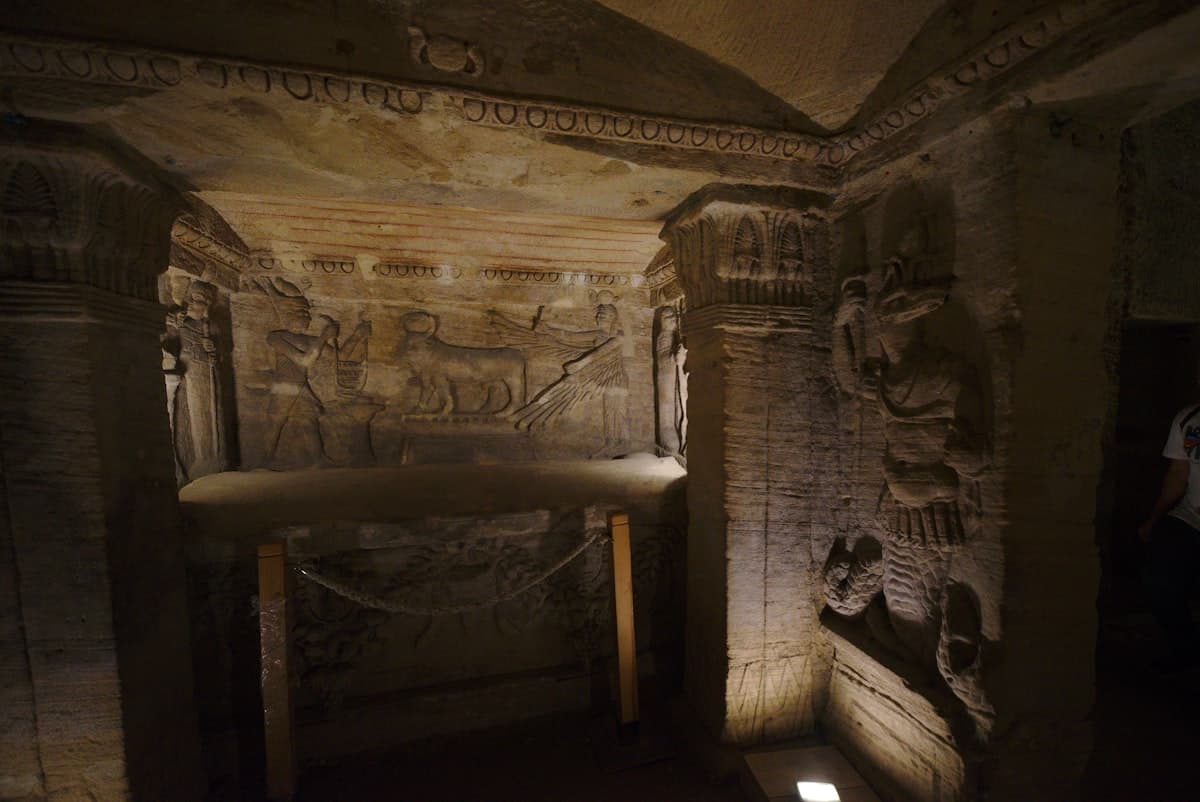
Of everything that survives from Greco-Roman Alexandria, the Catacombs of Kom el-Shoqafa are the site most likely to stop you completely. Discovered in 1900 when a donkey fell through the ground into the uppermost chamber, they were carved in the second century AD as a private family tomb and then expanded into a communal burial site. What makes them unlike any other site in Egypt is their visual argument: the main burial chamber is decorated with figures that are anatomically Greek, wearing Egyptian ritual clothing, depicted in poses from Egyptian funerary art, carved by craftsmen who clearly knew both traditions intimately and chose to combine them.
Anubis, the jackal-headed embalming god, appears wearing Roman armor. The winged sun disk, a Pharaonic symbol of divine protection, frames a doorway designed like a Greek temple facade. Medusa heads appear alongside the cobra goddess Wadjet. This is not confusion. It is a family that identified with three civilizations simultaneously and commissioned art to say so. The catacombs descend three levels into bedrock. The lowest level is partially flooded and inaccessible, which means you are looking at perhaps sixty percent of what exists.
The Greco-Roman Museum
The museum has been under renovation since 2017 and is expected to reopen, though local confirmation is essential before visiting. When it functions, it holds one of the most specific and underappreciated collections in Egypt: 40,000 objects spanning the meeting point of Greek, Roman, and Egyptian culture, including a faience statuette of a Ptolemaic queen in full Egyptian headdress with distinctly Greek facial features, and a series of terracotta figures of Harpocrates, the child Horus transformed by Greek contact into a chubby, finger-to-lips god of silence who became the origin of the European gesture for secrecy. The museum's own building, a neoclassical structure from 1895, is itself a Khedive-era statement about who Alexandria wanted to be.
---
The Connections: Nothing Exists in Isolation
The site of the ancient Library of Alexandria is now occupied by the Bibliotheca Alexandrina, opened in 2002. This is not coincidence. It is a deliberate act of cultural restatement by a post-Nasser Egypt trying to reclaim the city's intellectual identity. The Norwegian architectural firm Snohetta designed it as a tilted disc emerging from the Mediterranean, its exterior walls covered in 120 scripts from world languages. The institution holds four million books. Whether it has successfully inherited the original library's mission to be a universal repository of knowledge is a question Alexandrians argue about with genuine feeling.
The relationship between Greek Alexandria and Coptic Christianity is direct and specific. Origen of Alexandria, born around 185 AD, was the first systematic Christian theologian, and he operated within the Greek intellectual tradition of the city, applying Platonic philosophy to scripture in ways that shaped Christian thought for centuries. His contemporary Clement of Alexandria did the same, arguing that Greek philosophy was a preparatory education for Christian faith. The Coptic Church traces its founding to Saint Mark, but its intellectual formation happened in a Greek-speaking city whose scholars knew both traditions deeply. The Coptic Museum in Cairo holds manuscripts that look Egyptian, contain Coptic script, and preserve ideas that are ultimately Greek. That chain has a clear beginning in Alexandria.
Under the Bibliotheca Alexandrina's grounds, archaeologists discovered remains of what may be a branch of the original Mouseion library. Under the site of the French Cultural Center on Nabi Daniel Street, fragments of Ptolemaic structures appear in every building excavation. The Greek city is not gone. It is underneath everything.
---
Common Mistakes
Visiting Pompey's Pillar expecting the pillar to be the point. Most visitors spend ten minutes here and leave disappointed. The Serapeum galleries beneath the site are far more interesting and require an additional thirty minutes of unhurried walking. Take them.
Skipping the Catacombs because of mild claustrophobia. The entrance tunnel is narrow but the main chambers are fully standing-height and well-lit since a 2019 restoration. Do not let the approach discourage you.
Assuming the Greco-Roman Museum is open. It has been closed for renovation for years. Check directly with your accommodation or the Egyptian Museum Authority website before building an itinerary around it.
Taking the Alexandria Sound and Light Show at Pompey's Pillar. It costs EGP 400, runs approximately forty-five minutes, and covers less historical ground than this article. The Catacombs at the same cost with a knowledgeable local guide is an incomparably better use of that money.
Reading the Ptolemaic temples at Edfu or Kom Ombo as purely ancient Egyptian. These are Ptolemaic structures, built by Macedonian kings in a deliberate imitation of older Pharaonic forms. If you visit them before coming to Alexandria, and most itineraries go south before coming north, knowing this changes what you see in them.
Ignoring the Greek Orthodox Patriarchate of Alexandria. The Patriarchate of Alexandria is one of the five original patriarchates of Christianity and has existed in an unbroken line since the first century. Its cathedral on Nabi Daniel Street is open to visitors and contains icons and documents that connect the Greek community to the city's earliest Christian period. Almost no one visits it.
Spending a day at the Corniche cafes without going underground. Alexandria rewards the visitor who goes beneath the surface, literally. Most of what matters about the Greek city is below street level.
---
Practical Tips
Arrive in Alexandria by the Talgo train from Ramses if you can. It is faster than the road, more comfortable, and drops you at Sidi Gaber station, which is centrally located for the Greek sites. The journey through the Delta is worth watching.
Hire a local guide specifically for the Catacombs and the Serapeum. The sites have minimal on-site interpretation in English. A good guide costs EGP 400 to 600 for a half-day and changes what you understand about both places substantially. Ask your hotel to connect you with a licensed Egyptologist rather than a general city guide.
The Bibliotheca Alexandrina requires a separate entrance fee for its exhibitions and antiquities museum, currently around EGP 100, but the reading rooms and exterior are accessible for free. The antiquities museum in the basement holds 1,600 objects from Pharaonic through Islamic periods and receives a fraction of the attention it deserves.
Alexandria is not Cairo. Accommodation is better value, food is better, and the streets around the Greek sites are walkable without the density that makes Cairo sites exhausting. Budget two nights minimum to avoid the trap of doing everything too quickly.
Bring a small torch or ensure your phone is fully charged for the Catacombs. The lower galleries have functional lighting, but corners are dim and the details of syncretic iconography that make the site extraordinary require close examination.
Frequently Asked Questions
The Weekly Dispatch
More on Egypt, every Friday.
Cultural depth and places most guides never mention.
No spam. Unsubscribe anytime.