Greeks in Egypt: Alexandria's Living History Guide
Alexandria was founded in 331 BC and within a century held a million people, making it the largest city on earth. Most of that story is underwater now.

Audio Guide: Greeks in Egypt: Alexandria's Living History Guide
Quick Facts
- Best time to visit
- October to April. Mediterranean summers are humid and the light is harsh on ruins. Spring and autumn give clear skies without the August crowds.
- Entrance fee
- Kom el-Shoqafa: EGP 300 (approx $6 USD). Pompey's Pillar and Serapeum: EGP 180 (approx $3.50 USD). National Museum: EGP 200 (approx $4 USD). Bibliotheca Alexandrina: EGP 100 (approx $2 USD). Graeco-Roman Museum: EGP 180 when open, verify status before visiting.
- Opening hours
- Most sites 9am to 5pm daily. Bibliotheca Alexandrina 10am to 7pm Saturday through Thursday, closed Friday. Hours can shift in summer; confirm locally.
- How to get there
- Cairo to Alexandria: express train from Ramses Station, EGP 80 to 220 depending on class, approximately 2 hours 20 minutes. Within Alexandria: white taxis EGP 20 to 60 per trip. City tram EGP 2, runs along the Corniche connecting main eastern sites.
- Time needed
- 2 full days for the main Greco-Roman circuit. 3 days if including Taposiris Magna, Cavafy Museum, and proper time at the National Museum.
- Cost range
- Budget EGP 600 to 1,000 per day including basic accommodation near the eastern harbor. Mid-range EGP 2,000 to 3,500 per day with a Corniche hotel and private guide.
Quick Facts
Best time to visit: October to April, when Mediterranean humidity drops and the light on white stone is clear rather than bleached.
Key sites and entrance fees: Bibliotheca Alexandrina: EGP 100 (approx $2 USD) general admission, free on certain days for Egyptian students Graeco-Roman Museum (currently under restoration, check status before visiting): EGP 180 (approx $3.50 USD) when open Kom el-Shoqafa Catacombs: EGP 300 (approx $6 USD) Pompey's Pillar and Serapeum: EGP 180 (approx $3.50 USD) National Museum of Alexandria: EGP 200 (approx $4 USD)
Opening hours: Most sites open 9am to 5pm daily. Bibliotheca Alexandrina keeps longer hours, typically 10am to 7pm Saturday through Thursday, closed Friday.
How to get there: Cairo to Alexandria by air-conditioned train from Ramses Station costs EGP 80 to 220 depending on class, roughly two hours twenty minutes. The Spanish car route takes three hours by private car. Within Alexandria, white taxis run EGP 20 to 60 for most cross-city trips. The tram, Egypt's oldest running tram network, operating since 1860, costs EGP 2 and connects the main seafront sites.
Time needed: The Greek and Roman circuit alone needs two full days minimum. Three days if you want to sit with anything properly.
Cost range: Budget EGP 600 to 1,000 per day including accommodation in the eastern harbor area. Mid-range EGP 2,000 to 3,500 per day.
---
Alexandria was never supposed to last. Alexander chose the site in a matter of days, scratched out the street grid himself in barley flour because he had no chalk, and left for Persia before a single building was finished. He never came back alive. His body arrived thirty years after his death, brought by Ptolemy I, who stole the corpse from the funeral cortege en route to Macedonia and understood, with the cold clarity of a man who had watched Alexander operate, that the dead conqueror was more valuable than any army. The city that grew around that theft became the intellectual capital of the ancient world, home to perhaps 600,000 people at its height, the largest city on earth, and today almost none of it remains above ground.
This is the central fact of any Greeks in Egypt Alexandria history guide: the city you are walking through is built almost entirely on top of the city you came to see. The Ptolemaic royal quarter, the original Library, the Mouseion where Euclid worked out the foundations of geometry and Eratosthenes calculated the circumference of the earth to within 200 kilometers, the Canopic Way that ran from the Sun Gate to the Moon Gate for nine kilometers straight: all of it is either under the Mediterranean, which has swallowed most of the ancient coastline as the land subsided, or under the existing city, which was built with extreme efficiency on ancient foundations. What survives is partial, scattered, and in some cases only recently understood.
This does not make Alexandria a disappointment. It makes it a place that rewards a particular kind of attention.
Why This Place Matters
The Greek presence in Egypt did not begin with Alexander. It began nearly three centuries earlier, when the Pharaoh Psamtik I, fighting to consolidate power in the 660s BC, hired Ionian and Carian mercenaries and rewarded them with land in the Delta. By 600 BC there was already a Greek trading settlement at Naucratis, two hundred kilometers southeast of what would become Alexandria, the first Greek city on African soil and the only city where Greeks were legally permitted to trade in Egypt for nearly two centuries. When Alexander arrived, he was not introducing Greeks to Egypt. He was shifting the center of gravity.
Ptolemy I, who took Egypt as his share of Alexander's empire after the general's death in 323 BC, understood something that the Persians before him had not. He presented himself not as a foreign conqueror but as the successor to the Pharaohs, had himself depicted in Egyptian temples in the traditional style, supported the priesthoods, and built the Serapeum, a temple to a deliberately constructed hybrid god named Serapis who combined Osiris and Apis with elements of Zeus and Dionysus. Serapis was essentially a diplomatic invention, a god designed to be worshipped by both Egyptians and Greeks, and the cult spread from Alexandria across the Mediterranean world. The Romans were still building Serapeum temples in Britain three centuries later.
This layering, Greek forms serving Egyptian purposes built on Pharaonic traditions that were already two thousand years old, is what makes the Ptolemaic period so interesting and what most visitors miss entirely when they treat Alexandria as simply a Greek or Roman city.
What Survives and Where to Find It
Kom el-Shoqafa: The Place Where Three Worlds Meet
The catacombs at Kom el-Shoqafa, discovered in 1900 when a donkey fell through the roof, are the most important Greco-Roman site in Egypt that most visitors spend too little time with. They date to the second century AD, which means they were built when Egypt had been under Roman rule for nearly two centuries, but the community that built them was still thinking in the visual language of three different traditions simultaneously.
The main tomb chamber shows Anubis and Thoth, Egyptian gods of the dead, dressed in Roman legionary armor, performing the embalming rituals prescribed by the Book of the Dead in a space decorated with Greek architectural ornaments. This is not religious confusion. This is a Alexandrian family, almost certainly wealthy, Greek-speaking, Roman-administered, Egyptian in their funerary beliefs, commissioning exactly what they wanted. Nobody was more comfortable with cultural multiplicity than the Alexandrians, and these catacombs are the most physical record that survives of what that comfort actually looked like.
Take the spiral staircase down past the first two levels. Most tour groups stop at the main rotunda. The third level is flooded and inaccessible, but even on the second level there are side halls, the Hall of Caracalla, named for the emperor who had a massacre carried out here for reasons that are still debated, that are worth the extra ten minutes.
Pompey's Pillar: The Column That Has Nothing to Do with Pompey
The 27-meter red Aswan granite column standing in the ruins of the Serapeum has been called Pompey's Pillar since medieval crusaders invented the association. Pompey the Great was indeed murdered near Alexandria in 48 BC, but the column was erected in 297 AD in honor of the emperor Diocletian, who had just suppressed a revolt in the city. The inscription, in Greek, is still readable on the base.
What matters more than the column itself is what it stands over. The Serapeum was one of the great temple complexes of the ancient world, and it contained a daughter library to the main Library of Alexandria, a branch collection that survived after whatever happened to the original Library in the first century BC. That branch library was destroyed when the Christian bishop Theophilus ordered the temple demolished in 391 AD, an event that tends to get less attention than the earlier burnings but was probably more consequential for the actual loss of texts. The sphinx fragments scattered around the site came from the temple. The subterranean tunnels beneath the pillar, which you can walk, held the sacred Apis bulls.
The National Museum: The Shortcut That Works
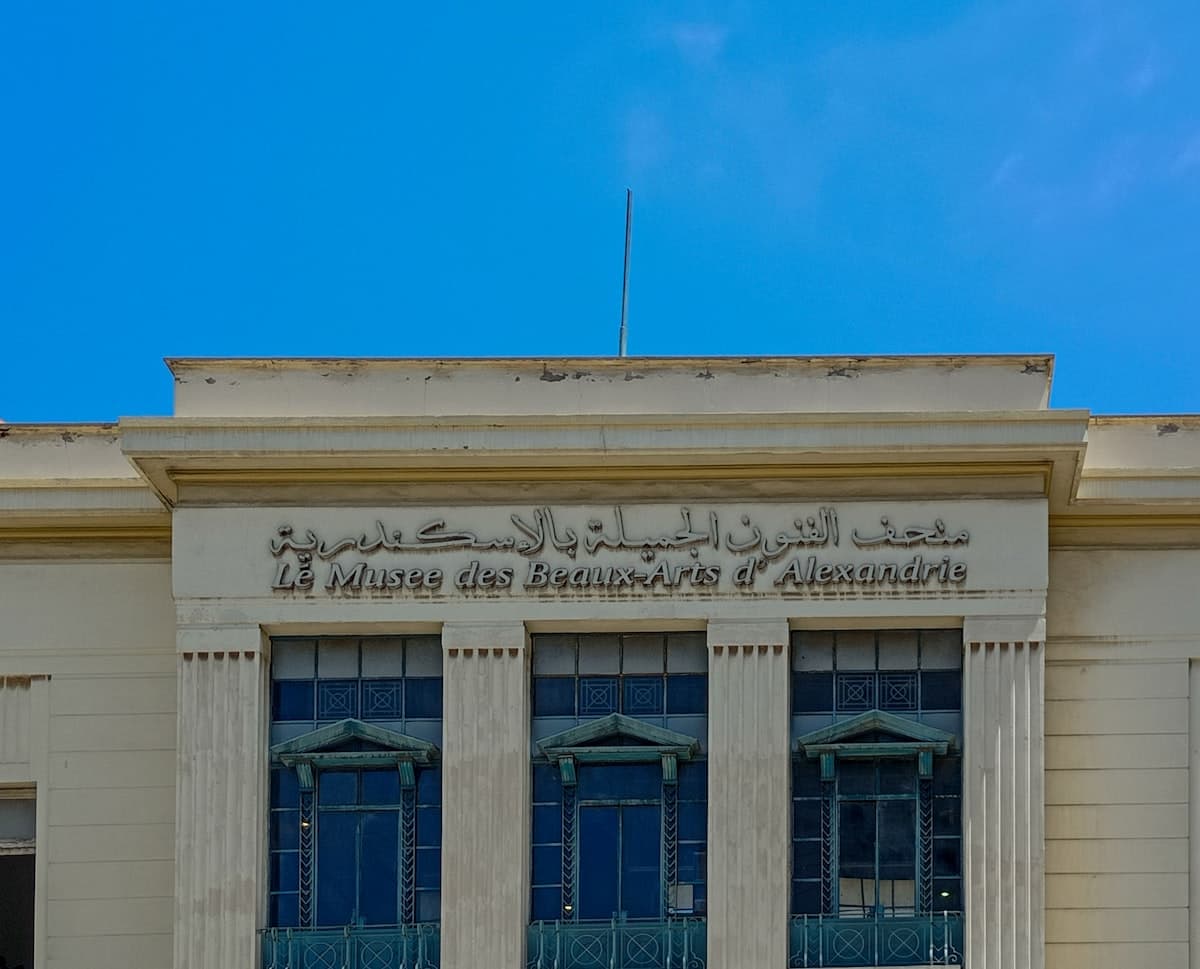
Alexandria's National Museum on Tariq al-Horreya, housed in a restored Italian-style palace that was once the American consulate, covers Pharaonic, Greek, Roman, Coptic, and Islamic periods in three floors. It will not replace visiting the actual sites. But it has genuine pieces, including statues recovered from underwater excavations of the ancient royal quarter, and it gives you the chronological framework before you go looking at scattered ruins and wonder what connected to what.
The underwater archaeology section on the ground floor is where to start. Franck Goddio's excavations off Alexandria's eastern harbor beginning in 1996 recovered royal statuary, sphinxes, architectural elements, and cult objects from the submerged Ptolemaic palace district. The scale of what is down there, located and mapped but mostly unrecoverable, recalibrates what Alexandria was.
The Connections
The Bibliotheca Alexandrina, opened in 2002 on the likely site of the ancient Library, is an obvious modern attempt to invoke the original. What is less obvious is that the ancient Library was not destroyed in a single dramatic fire. Julius Caesar's burning of ships in the harbor in 48 BC may have spread to some storage warehouses containing books. Mark Antony reportedly gave Cleopatra 200,000 scrolls from the Library of Pergamon as a replacement gift. The institution seems to have continued in some form through the Roman period, declining through neglect and the disruption of funding rather than through any single catastrophe. The story of the dramatic burning, which medieval Islamic sources attributed to Caliph Omar's general Amr ibn al-As after the Arab conquest in 641 AD, is almost certainly a later invention. The Library was already functionally gone by then.
The Arab conquest connects Alexandria's Greek history to its Islamic present in a direct line. Amr ibn al-As chose not to make Alexandria the capital of the new province, moving the administrative center to the garrison city of Fustat, which would eventually grow into Cairo. Alexandria declined from a city of perhaps 300,000 to a provincial town. The Ptolemaic infrastructure, the canals, the harbors, the street grid, was still there but no longer maintained. It took until Mohammed Ali's construction projects in the nineteenth century for Alexandria to revive, and the city that revived was Mediterranean and cosmopolitan in a different sense, Greek and Italian and Jewish and Levantine merchants settling alongside Egyptian Muslims and Copts, a community that produced Constantine Cavafy, who lived his adult life in the city and wrote about its ancient Greeks with the intimacy of a neighbor.
Cavafy's apartment, maintained near the site of the old Greek Hospital, is now a small museum. Visiting it after the catacombs and the Serapeum site closes a particular loop.
Common Mistakes
Treating the Graeco-Roman Museum as the main event. The museum has been under restoration for years and access has been intermittent. Verify it is open before building your itinerary around it. The National Museum is a more reliable alternative.
Spending time on the Qaitbay Citadel expecting Greek ruins. The fifteenth-century Mamluk fort is built on the foundation of the Pharos lighthouse, one of the Seven Wonders. The lighthouse stones are literally in the walls. This is worth knowing. But the fort itself is a military museum with modest exhibits, and the view of the harbor, while useful for orientation, does not justify more than forty minutes. Skip the audio guide, which adds nothing.
Taking a guided group tour of the catacombs. Every group tour of Kom el-Shoqafa moves at the pace of its slowest member and skips the side chambers. Buy a ticket independently, go in the late morning after the first tour buses have cleared around 11am, and take your time with the Hall of Caracalla.
Skipping Abusir, twenty-five kilometers south of Alexandria. This is where the ancient Greek town of Taposiris Magna stood, and recent excavations by Kathleen Martinez have generated ongoing debate about whether Cleopatra VII and Mark Antony may be buried in a tunnel complex beneath the temple of Osiris there. Nothing has been confirmed. But the site is largely unvisited, genuinely atmospheric, and the lighthouse ruin on the headland is a direct echo of the Pharos. A taxi there and back from central Alexandria costs around EGP 300.
Believing the sound and light show at any site adds historical context. It does not. Read the scholarship, or at minimum, a serious history of the Ptolemaic period before you arrive. Adrian Goldsworthy's biography of Caesar or Stacy Schiff's biography of Cleopatra will reframe everything you look at.
Underestimating travel time between sites. Alexandria's traffic is serious. The catacombs, Pompey's Pillar, and the National Museum form a logical grouping in the western and central city. The Bibliotheca and Cavafy Museum are eastward. Do not try to combine both clusters in an afternoon.
Practical Tips
Arrive in Alexandria by the first morning train from Cairo. The 8am service from Ramses gets you there by 10:30am with the full day ahead. Accommodation in the Corniche hotels on the eastern harbor gives you the harbor orientation that the ancient city was organized around.
Hire a local guide specifically for the Greco-Roman sites rather than a general Alexandria guide. The difference in depth of knowledge is significant. The Egyptian Tourist Authority office near the Corniche can recommend licensed guides; expect to pay EGP 600 to 1,000 for a half-day.
The Corniche seafood restaurants near the fish market serve fried mullet and calamari for EGP 150 to 250 a person, and this is where you should eat, not at the hotel. Alexandria's food culture is a direct continuation of its Mediterranean identity. The tersa, the local word for the harbor shacks, are not sanitation concerns. They are the point.
Bring a hat and water. The Mediterranean light in summer is merciless on white stone and pale skin alike. October through April, you will not need to think about this.
The Greek community in Alexandria, once numbering in the tens of thousands in the early twentieth century, is now reduced to a few hundred families. The Greek Orthodox Patriarchate on Sharia el-Batros is still active. If you visit on a Sunday morning and the door is open, go in. The liturgy has been conducted in Greek in this city, more or less continuously, for longer than most countries have existed.
Frequently Asked Questions
The Weekly Dispatch
More on Egypt, every Friday.
Cultural depth and places most guides never mention.
No spam. Unsubscribe anytime.