Jewish Alexandria: Egypt's Lost Synagogues and Who Built Them
Alexandria once had 40,000 Jews. Today fewer than a dozen remain. The synagogues still stand. This is who built them and why Egypt erased them from its own story.

Quick Facts
- Best time to visit
- October (High Holy Days, active services) or March to May (mild weather, smaller crowds in Alexandria generally)
- Entrance fee
- Free entry to Eliyahu Hanavi. Tip caretakers EGP 100 to 200 (approx $2 to $4 USD). Jewish cemetery: free, tip caretaker EGP 100.
- Opening hours
- Eliyahu Hanavi by appointment only, typically accessible Saturday mornings and High Holy Days. Contact Egyptian Jewish Community at least two weeks in advance. Cemetery open daily during daylight hours.
- How to get there
- Cairo to Alexandria by Egyptian National Railways from Ramses Station: EGP 90 to 120 second class, EGP 170 to 200 first class (approx $3 to $7 USD). Journey 2 to 2.5 hours. From Misr Station in Alexandria, walk 10 minutes to Eliyahu Hanavi on Nabi Daniel Street or take a tuk-tuk for EGP 20 to 30.
- Time needed
- 2 hours for the synagogue alone. Half-day (4 to 5 hours) to combine synagogue, Attarine quarter walk, and Jewish cemetery. Full day if adding Cavafy Museum and Corniche.
- Cost range
- Budget EGP 400 to 700 per day including accommodation near Raml Station, food at local restaurants, and local transport. Jewish heritage sites themselves cost almost nothing beyond caretaker tips.
At its peak in the first century BCE, Alexandria's Jewish community numbered around 180,000 people, making it the largest Jewish population of any city in the ancient world, larger than Jerusalem itself. They had their own quarter, their own courts, their own fleet of ships, and a synagogue so vast that a system of flag signals was used to relay the cantor's voice to those too far back to hear. That synagogue is gone. The community is essentially gone. But the bones of what they built are still here, if you know where to look.
Quick Facts
Primary site: Eliyahu Hanavi Synagogue, 69 Nabi Daniel Street, central Alexandria Entrance fee: Free entry (donations welcomed), though access requires coordination with the Jewish Community of Alexandria or the Egyptian government's cultural heritage office. Budget EGP 50 to 150 (approx $1 to $5 USD) for tips to caretakers, which is both customary and the reason the place remains in any condition at all. Opening hours: The synagogue is typically open for visits Saturday mornings during High Holy Days and by pre-arranged appointment. Individual travelers who simply show up on a Tuesday afternoon are frequently turned away. Contact the Egyptian Jewish Community representative in Cairo at least two weeks in advance. Best time to visit: October for Rosh Hashanah and Yom Kippur services, when the building actually functions as a synagogue and the atmosphere is something no heritage tour can manufacture. Spring (March to May) for milder temperatures and fewer visitors overall in Alexandria. How to get there: From Cairo, take the Egyptian National Railways express train from Ramses Station to Sidi Gaber or Alexandria's main Misr Station. Second-class costs around EGP 90 to 120 (approx $3 to $4 USD), first-class around EGP 170 to 200. From central Alexandria, the synagogue is a ten-minute walk from Misr Station or a short tuk-tuk ride for EGP 20 to 30. Time needed: Two hours for the synagogue alone. A full half-day if you layer in the Jewish cemetery on Abou Quer Road and a walk through the former Jewish quarter around Attarine. Cost range: Budget EGP 400 to 700 per day in Alexandria (accommodation, food, local transport). The Jewish heritage sites themselves cost almost nothing monetarily.
Why This Place Matters
The Jewish history of Alexandria is not a footnote to Egyptian history. It is a central thread. Jews arrived in Alexandria within a decade of the city's founding by Alexander the Great in 331 BCE. Ptolemy I actively recruited Jewish settlers because he needed administrators, translators, and soldiers who were literate in multiple languages and loyal to a cosmopolitan commercial empire rather than to any single ethnic tradition.
What followed was one of the most consequential cultural collisions in human history. Alexandrian Jewish scholars, working in the great Library, produced the Septuagint, the first Greek translation of the Hebrew Bible, between roughly 285 and 246 BCE. This translation did not simply make Jewish scripture accessible to Greek speakers. It created the linguistic and conceptual vocabulary that early Christianity would use to spread across the Mediterranean world. The New Testament was written in the same Greek register. Augustine read his theology in Latin translation of this Greek text. The Septuagint is a reason Christianity exists in its current form, and it was made in Alexandria by Jews who were so thoroughly bilingual that they apparently forgot their Hebrew.
Philo of Alexandria, born around 20 BCE, developed the synthesis of Jewish theology and Greek philosophy that influenced both Islamic theology and Christian mysticism for the next fifteen centuries. He never appears in Egyptian school curricula. His house no longer exists. His community no longer exists. But the intellectual architecture he built is still inside every monotheistic tradition practiced in Egypt today.
The Synagogues: What Survives and What Was Lost
Alexandria once had more than a dozen active synagogues. The community at its nineteenth and early twentieth century peak, before the catastrophic emigrations of 1948 and 1956, numbered around 40,000 people concentrated primarily in the neighborhoods around Attarine, Ibrahimiyya, and along the seafront of the old European quarter.
Eliyahu Hanavi (the Prophet Elijah Synagogue) is what survives. It was built in its current form in 1354, making it one of the oldest continuously functioning synagogues in the world, though its origins on this site go back further, to a structure mentioned in medieval Arab geographies. The building you enter today is largely the result of a major nineteenth century renovation completed in 1850 under the patronage of community leader Levi Mosseri, whose family also financed the Egyptian railway system alongside the Suez Canal works. The Mosseri family's fingerprints are on the financial infrastructure of modern Egypt, and most Egyptians have never heard their name.
The interior is a revelation if you are expecting a modest community space. The main sanctuary seats 700 people under a ceiling of painted wood panels in blue and gold. The marble columns were imported from Italy. The chandeliers were a gift from the Egyptian Royal Court, a reminder that until 1952, the relationship between the Egyptian monarchy and the Jewish community was often one of genuine mutual interest. King Farouk's family attended events at this synagogue. The photographs documenting this are kept in the community archive, which is partially housed on site.
The synagogue that is not here, and should be, is the Great Synagogue of Alexandria, which once stood near the modern Attarine antique market. Ancient sources describe it as built in the form of a double basilica, so large that according to the Talmud it could hold twice the population of those who left Egypt in the Exodus. Roman authorities destroyed it in 115 CE during the suppression of the Jewish revolt under Trajan, a conflict almost entirely absent from popular understanding of Roman Egypt. Between 115 and 117 CE, Roman legions killed an estimated 200,000 Jews across Egypt, Cyrenaica, and Cyprus. The Alexandrian Jewish community never fully recovered its ancient scale after that event.
The Cemetery and the Silence
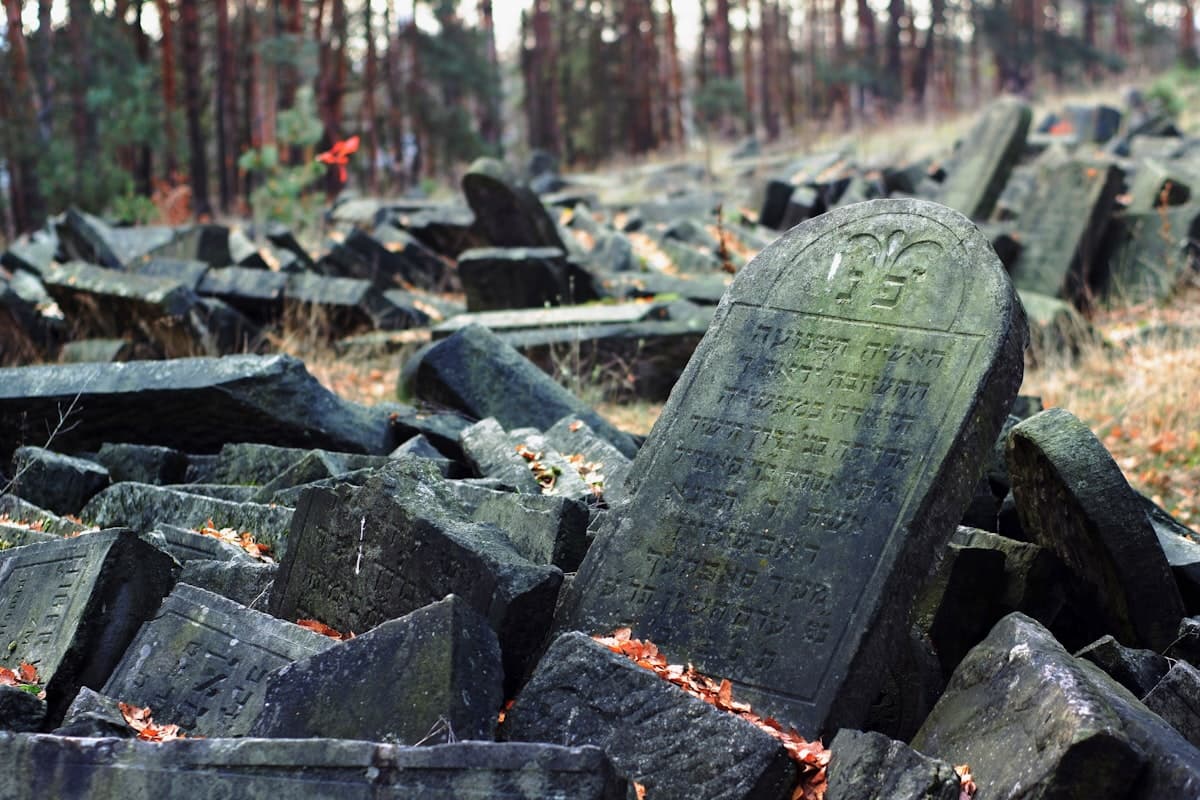
Four kilometers from Eliyahu Hanavi, on the road toward Abu Qir, there is a Jewish cemetery that contains more readable history than any museum panel. The graves run from the mid-eighteenth century to the 1960s and you can trace the entire arc of the community's story in the names: Sephardic families who came from Spain via Livorno in the 1600s, Ashkenazi families from Central Europe who arrived in the 1880s fleeing pogroms, Egyptian-born families whose stones carry Arabic inscriptions alongside Hebrew ones.
The cemetery is managed by a single Muslim caretaker, Ibrahim, whose family has held the position across several generations. He knows where every significant grave is. He will tell you, if you ask, that he considers this his family's responsibility regardless of politics, because the dead have no politics. This is not a sentiment you will find in any official Egyptian narrative about the Jewish community. It is also not unusual. In the neighborhoods around Attarine, older residents casually refer to streets and buildings by their Jewish owners' names from seventy years ago, a form of memory that official history has not yet decided how to categorize.
The Connections
The Jewish history of Alexandria is inseparable from the city's other histories in ways that make isolation of any single thread misleading. The site of Eliyahu Hanavi sits within walking distance of what was once the Ptolemaic Royal Quarter, the Roman administrative center, and the early Christian neighborhoods where the Catechetical School of Alexandria produced Clement and Origen, two of the most important theologians of the first three centuries CE. Clement and Origen both engaged directly with Philo's Jewish-Greek synthesis. You cannot understand Coptic Christianity, which traces its founding to Saint Mark arriving in Alexandria around 42 CE, without understanding that it emerged in a city where Jews had been intellectually and commercially dominant for three centuries before Christianity existed.
The Islamic conquest of Alexandria in 641 CE under Amr ibn al-As did not end the Jewish community. The Arab sources describe a functioning Jewish quarter in the city a century after the conquest. The Geniza documents from the Ben Ezra Synagogue in Cairo (Old Cairo, Fustat) include letters from Alexandrian Jewish merchants dating to the eleventh and twelfth centuries, tracking trade routes from Alexandria to the Maghreb, Sicily, India, and the Sudan. The medieval Jewish commercial network made Alexandria a node in a global trading system that predated European mercantile capitalism by four hundred years.
The expulsions and emigrations of 1948, accelerated by Nasser's nationalization decrees of 1956 and the forced departure orders of 1957, ended something that had existed continuously for 2,300 years. The families went to Israel, France, Brazil, Canada, and the United States. The buildings stayed. Some became government offices. Some became apartment buildings. Some became the antique market at Attarine, where you can occasionally still find Judaica, mezuzot, silver spice boxes, and prayer books, sold by dealers who may or may not know what they have.
Common Mistakes
Assuming you can simply walk in. Eliyahu Hanavi is not a museum with set visiting hours. It is an active house of worship for a community of fewer than twelve elderly people. Arriving without an appointment is disrespectful and usually unsuccessful. Contact the Egyptian Jewish Community in advance.
Skipping the Attarine neighborhood. Most visitors to Jewish Alexandria history go directly to the synagogue and leave. The Attarine district, the former heart of the Jewish commercial quarter, requires nothing but walking and attention. The architecture of the apartment buildings, the street grid, the scale of the spaces, all reflect a nineteenth century urban design shaped partly by Jewish merchant wealth.
Paying for a packaged Jewish heritage tour from Cairo. Several Cairo operators sell day trips combining Eliyahu Hanavi with a general Alexandria tour for EGP 2,500 to 4,000 per person. These tours spend approximately twenty minutes at the synagogue. You learn nothing you could not learn from reading this article, and you spend most of the day on a bus. Take the train yourself, make your own appointment, and allocate real time.
Missing the High Holy Days window. If you have any flexibility, arranging your visit around Rosh Hashanah or Yom Kippur means you will experience the synagogue during actual services. The elderly community who still gathers is fully aware these may be among the last such services this building will ever host. That awareness is present in the room. No heritage tour replicates it.
Photographing without asking. The caretakers at Eliyahu Hanavi have developed a justifiable sensitivity to visitors who treat the building as a photography set. Ask before you photograph, particularly if any community members are present. This is not a legal restriction. It is basic courtesy that most visitors apparently need to be told.
Confusing the historical timeline. Many visitors arrive having conflated ancient Alexandrian Jewish history with the nineteenth and twentieth century community's story. These are related but distinct populations separated by enormous historical disruption. The Jews who built Eliyahu Hanavi in the fourteenth century were not direct descendants of Philo. They were largely Sephardic traders who arrived via the Mediterranean commercial networks. Keep the eras distinct.
Treating this as a purely Jewish story. This is a city story, an Egyptian story. The siloing of Alexandrian Jewish heritage into a separate minority narrative misrepresents how integrated this community was with Coptic, Greek Orthodox, and Muslim Alexandria for most of its existence. The most interesting conversations you will have in this city are with non-Jewish Alexandrians who remember the community from their grandparents' accounts.
Practical Tips
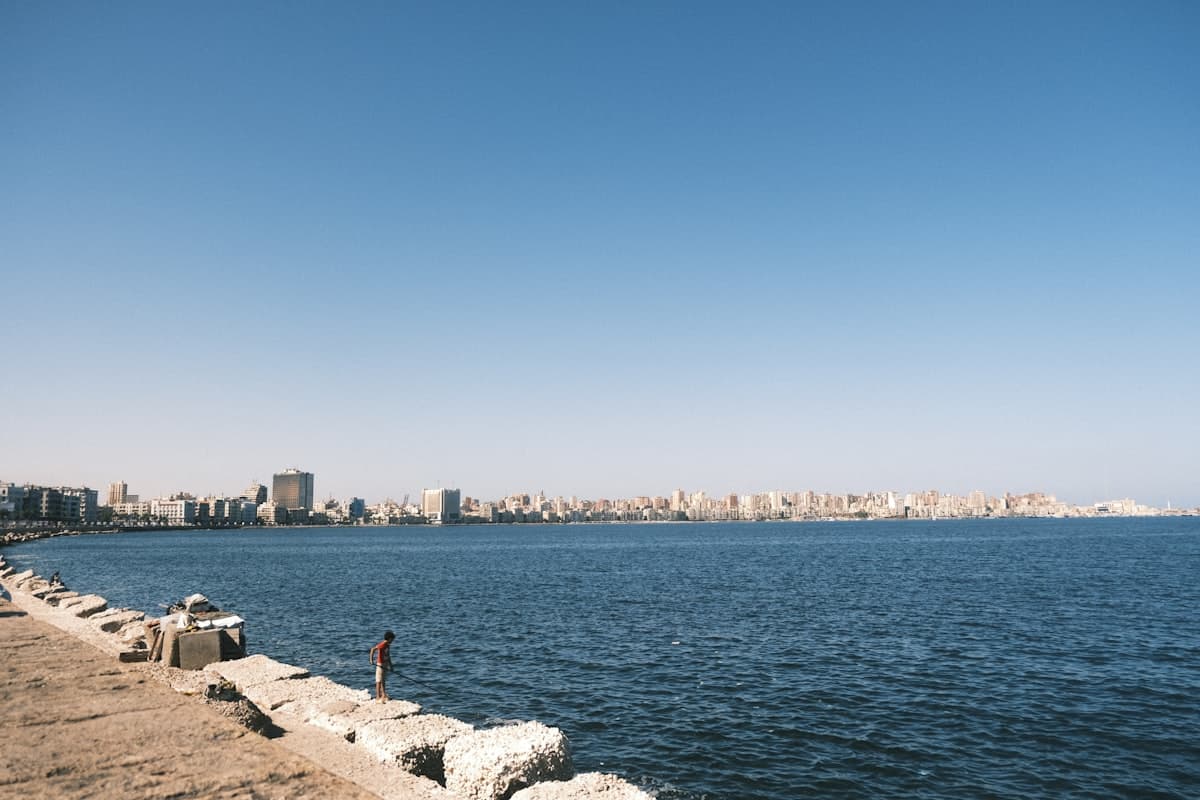
Arrive in Alexandria the evening before and stay overnight. The city operates on a different tempo than Cairo and the quality of Alexandrian morning light along the Corniche, particularly in autumn, is worth the extra night's accommodation. Budget hotels near Raml Station run EGP 400 to 600 per night for a clean double room.
Learn five words of Arabic before you go. This is not optional sentimentality. The caretakers at the synagogue and the cemetery speak limited English. Shukran (thank you), min fadlak (please), and the ability to ask for directions in basic Arabic will materially change your experience of both sites.
Bring cash. There are no ticket machines, no card readers, and no gift shops. Tips to caretakers are the primary income these sites generate and they are how the buildings stay maintained. EGP 100 to 200 per caretaker per visit is appropriate.
Combine the Jewish sites with the Cavafy Museum on Sharm el Sheikh Street, a ten-minute walk from Eliyahu Hanavi. Constantine Cavafy, Alexandria's great poet, lived and wrote about a city of layered communities precisely as the Jewish community was at its early twentieth century height. His poems about Alexandria are a form of documentation that supplements whatever the official archives have chosen to preserve.
Do not expect the Egyptian state to have made this easy. Jewish Alexandria history sits in a politically uncomfortable position within Egyptian national memory, given the events of 1948 to 1957 and the ongoing complexities of Egyptian-Israeli relations. The sites are preserved, sometimes well and sometimes barely, but they are not promoted. Finding them requires initiative. That initiative is repaid.
Frequently Asked Questions
The Weekly Dispatch
More on Egypt, every Friday.
Cultural depth and places most guides never mention.
No spam. Unsubscribe anytime.