Mohamed Ali Mosque: Albanian History That Rebuilt Egypt
An Albanian soldier who couldn't read became Egypt's most transformative ruler. His mosque took 18 years to build and bankrupted three contractors. Here's what most visitors miss.

Quick Facts
- Best time to visit
- October to April, arriving at 8am before tour groups. Winter mornings offer the best alabaster light and manageable crowds.
- Entrance fee
- EGP 450 (approximately $9 USD) for adults, EGP 225 for students. Covers the entire Citadel complex including the mosque.
- Opening hours
- Daily 8am to 5pm. Mosque interior closes briefly during each of the five prayer times (approximately 20 minutes per closure).
- How to get there
- Metro to Sadat Station then taxi EGP 30 to 50. Uber from central Cairo EGP 60 to 90. Bus 951 from Ramses for EGP 5 (slower).
- Time needed
- 2 hours for the mosque alone, 3 to 4 hours to cover the full Citadel complex including Al-Nasir Muhammad Mosque and the terrace.
- Cost range
- Budget EGP 600 to 900 including transport and entry. Mid-range EGP 1,500 to 2,500 with a licensed guide and lunch in Islamic Cairo.
Quick Facts
Best time to visit: October to April, arriving before 9am to beat tour groups. Friday mornings after dawn prayer offer an atmosphere unlike any other time of the week.
Entrance fees: The Citadel complex costs EGP 450 (approximately $9 USD) for adults, EGP 225 for students with valid ID. This includes the Mohamed Ali Mosque, the Military Museum, and the National Police Museum. There is no separate ticket for the mosque.
Opening hours: Daily 8am to 5pm. The mosque itself closes to non-worshippers during prayer times, typically around 20 minutes each session.
How to get there: From Downtown Cairo, take the metro to Sadat Station, then a taxi to the Citadel gate (roughly EGP 30 to 50). Alternatively, bus line 951 from Ramses runs to the Citadel for EGP 5. Uber averages EGP 60 to 90 from central Cairo depending on traffic. Do not let anyone tell you the "only" entrance is on the far side: the main Bab al-Gadid gate on Salah Salem Street is the correct one.
Time needed: Two hours minimum for the mosque and courtyard. Add another hour if you plan to visit the Al-Nasir Muhammad Mosque inside the Citadel, which most visitors walk past entirely and should not.
Cost range: Budget EGP 600 to 900 including transport and entry. Mid-range EGP 1,500 to 2,500 if you add a guide and lunch in the Islamic Cairo area.
---
Why This Place Matters
![[The Citadel and the Mosque of Mohammed Ali, Cairo]](/_next/image?url=https%3A%2F%2Fpub-04554b4ed1074e4a91148d8c5d76943b.r2.dev%2Fimages%2Fmohamed-ali-mosque-albanian-history-that-rebuilt-egypt%2F1.jpg&w=3840&q=75)
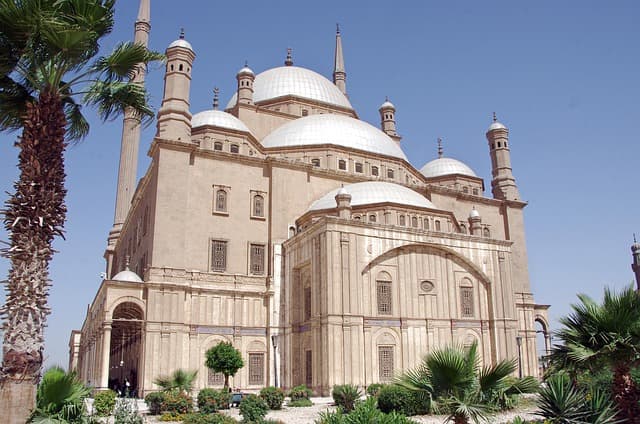
Mohamed Ali Pasha arrived in Egypt in 1801 as a minor commander in an Ottoman Albanian regiment sent to restore order after Napoleon's withdrawal. He could not read or write. Within four years he had outmaneuvered the Ottomans, massacred the Mamluk leadership in a single afternoon inside the Citadel he would later rebuild, and declared himself ruler of Egypt. He is the reason modern Egypt exists as a recognizable political entity, and his mosque, completed in 1848, is the building that announces this fact to anyone arriving from the east or south of Cairo.
The Albanian history Egypt Mohamed Ali connection is not a footnote. It is the entire story. Mohamed Ali spoke Albanian as his first language, thought in the political traditions of the Ottoman Balkans, and modeled his mosque not on any Egyptian precedent but on the Sultan Ahmed Mosque in Istanbul, specifically commissioning a Greek-Egyptian architect named Yusuf Bushnaq to execute something that would signal: this family rules, this city is its capital, and we are players on the Ottoman and European stage simultaneously.
The mosque sits inside the Citadel of Saladin, begun in 1176 by the Kurdish general Salah al-Din al-Ayyubi using stone quarried partly from the outer casing of the smaller Giza pyramids. The Citadel is therefore a building made partly from other buildings, which is as Egyptian a story as any.
---
What You Are Actually Looking At
The mosque's two minarets are 82 meters tall, slender and pencil-shaped in the Ottoman style, which is why Cairenes nicknamed it the Alabaster Mosque: the walls are clad in alabaster from Beni Suef, quarried from the same region that supplied material for Pharaonic temples four thousand years earlier. When the light comes low and eastern in the morning, the entire exterior glows a pale amber that shifts toward white by noon. This is worth factoring into your arrival time.
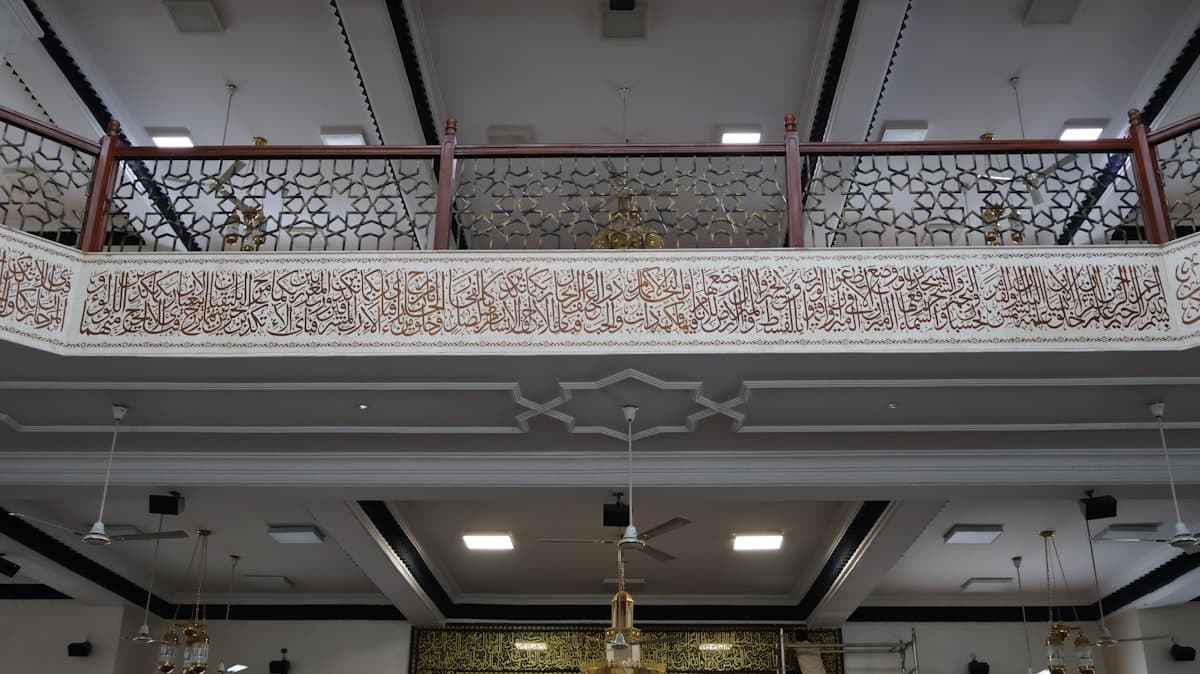
Inside, the dome reaches 52 meters at its apex, resting on four large piers. The interior chandelier system is extraordinary: hundreds of glass globes hung at low levels so the light falls on the worshippers rather than the ceiling, a deliberate inversion of European cathedral logic where height and light combine to direct attention upward. Here, the scale pulls you upward but the light keeps you in the room, present, not transcendent.
On the right side of the courtyard as you enter, there is a clock tower with a French clock that has never worked. It was a gift from King Louis-Philippe of France in 1845, given in exchange for the obelisk that now stands in the Place de la Concorde in Paris. The obelisk came from Luxor Temple and is 3,300 years old. The French clock arrived broken and has remained that way. This is either a metaphor for French-Egyptian relations or simply poor 19th-century packing.
The Tomb You Probably Walked Past
To the right of the main prayer hall, behind an ornate grille, is Mohamed Ali's actual tomb. It is made of Carrara marble and is disproportionately modest given the scale of the man. Most visitors walk past it without stopping because the guides hustle them toward the main dome. Stand here for a moment. This is the man who sent the first Egyptian student missions to Europe, built Egypt's first modern army, established the cotton monoculture that would define Egyptian agriculture and debt for the next 150 years, and killed somewhere between 470 and 500 Mamluk emirs at a single banquet in 1811 in what Egyptians still call the Citadel Massacre. The marble is very clean and very white and says almost nothing about any of this.
---
The Layers Beneath the Citadel
The Albanian history Egypt Mohamed Ali guide version of this site tends to stay on the surface: Albanian soldier becomes Egyptian ruler, builds Ottoman mosque, unifies Egypt. The deeper version is more interesting.
Saladin's Citadel was built on the Muqattam spur specifically because it was the only high ground in Cairo that sat outside the prevailing wind pattern carrying plague miasma from the Nile floodplains. This was 12th-century epidemiology, applied to military architecture. The labor force that built it included Crusader prisoners captured at the Battle of Hattin in 1187, which is why some of the early stonework in the lower Citadel walls shows Crusader mason marks alongside Fatimid Arabic inscriptions.
The Al-Nasir Muhammad Mosque, which stands 200 meters from Mohamed Ali's mosque and dates to 1318, has a specific architectural detail that almost nobody's guide mentions: its Gothic doorway was taken from a Crusader church in Acre (Akko) after the Mamluk sultan razed the city in 1291. The mosque is therefore a trophy, and its doorway is the evidence. You can stand in front of it and read both histories simultaneously if you know what you are looking at.
Mohamed Ali demolished several Mamluk structures inside the Citadel to build his mosque, including a medieval palace. He was not preserving history; he was replacing it with his own. The current restoration efforts, partly funded by the Aga Khan Trust for Culture, are attempting to stabilize what remains of the Mamluk Citadel without either freezing it in amber or handing it over to the tour bus circuit.
---
The Connections
Mohamed Ali's project was not architectural; it was civilizational. He sent his son Ibrahim Pasha to modernize the army in Europe, invited French and Italian engineers to build canals and factories, and created the first state printing press in the Arab world at Bulaq in 1820, 15 years before the Ottoman Empire had one in Istanbul. The printing press produced military manuals, then legal codes, then newspapers. One of the newspapers it eventually produced was Al-Waqa'i al-Misriyya, which is still published today, making it the oldest continuously operating newspaper in the Arab world.
The cotton economy Mohamed Ali built to finance all of this tied Egypt to British financial markets so tightly that by 1882, Britain occupied the country to protect its investments. The occupation lasted 72 years. The mosque, which was his monument to sovereignty, was built by a man whose economic decisions made sovereignty impossible for his descendants. That tension is present in every alabaster stone if you think about it while standing in the courtyard.
For travelers connecting this visit to Islamic Cairo more broadly: the mosque of Ibn Tulun (879 AD), 20 minutes by taxi, is the oldest mosque in Cairo with its original structure largely intact. The Ibn Tulun connection to Mohamed Ali is direct and ironic: Tulun was also a military adventurer of non-Arab origin (Turkic, not Albanian) who built a mosque to establish his legitimacy in a city that had not asked for him. The architectural comparison between the two buildings tells you everything about how Cairo's relationship with power changed across a thousand years.
---
Common Mistakes
Arriving between 10am and 2pm on weekdays. This is when the tour buses park in overlapping rows outside the Citadel gate. The courtyard, which should feel like open sky and stone, feels like a slow-moving queue. Arrive at 8am or after 3pm.
Paying for a guide inside the complex. The Citadel has a rotating population of unofficial guides who will approach you at the gate with reasonable-sounding prices (EGP 150 to 300) and deliver a script that you could read on any tourist board. The Al-Nasir Muhammad Mosque and the Citadel's own plaques provide more accurate information. If you want a genuine guide, book one in advance through Egypt Tailor Made or a licensed agency, and specify that you want someone who knows Mamluk architecture specifically.
Skipping the terrace view. The north-facing terrace of the mosque courtyard looks over central Cairo toward the medieval minarets of Islamic Cairo, the Nile, and on a clear winter day, the Pyramids at Giza. This view is free, is included in your ticket, and is one of the best urban panoramas in Africa. Most visitors photograph the interior dome and leave without finding it.
Doing the sound and light show at the Citadel. It costs EGP 300 and covers less actual history than this article. The show is a succession of colored lights on stone walls with a narration that manages to be both dramatic and uninformative. Skip it without guilt.
Assuming the mosque is the whole point of the Citadel. The Al-Nasir Muhammad Mosque (1318), the Carriage Museum, and the Citadel's medieval water cisterns are all included in your ticket and are visited by perhaps 15% of the people who enter. The cisterns in particular, deep rock-cut chambers that stored water for the garrison during sieges, are worth finding.
Wearing shoes inside. Obvious but regularly ignored: shoes come off at the entrance to the prayer hall. Bring socks. The marble floor is cold in winter and the walk from the shoe rack to the interior is longer than it looks.
Confusing Mohamed Ali the Pasha with Mohamed Ali the boxer. This sounds like a joke. It is not. Several travel bloggers have written genuinely confused content mixing the two. The Pasha died in 1849 in Alexandria, long before Cassius Clay was born.
---
Practical Tips
Dress modestly regardless of gender: shoulders and knees covered. The mosque provides robes for women who need them at the entrance, but they are thin cotton and the Citadel is cold in January and February. Bring your own scarf.
The Citadel sits at an elevation that catches wind even when central Cairo feels still. In summer this is welcome. In winter, from December through February, bring a layer.
Photography is permitted inside the mosque. Flash is considered disrespectful during prayer times, and the guards will ask you to stop. The best light for interior photography is from 9 to 11am when the eastern windows illuminate the alabaster without glare.
For the serious traveler: combine the Citadel with a walk through the medieval bazaar of Khan el-Khalili (15 minutes by taxi) and the Al-Hussein Mosque area, then south to the Ibn Tulun Mosque. This half-day circuit connects Fatimid Cairo, Mamluk Cairo, and Mohamed Ali's Ottoman-Albanian Cairo in a sequence that makes each site more legible than it would be alone.
Taxis from the Citadel tend to overcharge; agree on a price before entering the vehicle. A ride to Khan el-Khalili should be EGP 25 to 40. A ride to Downtown should be EGP 40 to 70. Uber is reliably metered and recommended if you have data.
Frequently Asked Questions
The Weekly Dispatch
More on Egypt, every Friday.
Cultural depth and places most guides never mention.
No spam. Unsubscribe anytime.