Napoleon's Egypt Campaign Sites: The Full Traveler's Guide
Napoleon brought 167 scientists to Egypt in 1798, not just soldiers. The scholarship they produced still shapes how the world reads hieroglyphics. The sites they changed are all still visitable.

Quick Facts
- Best time to visit
- October to February. Cooler temperatures make outdoor sites like Abu Qir and the Rashid fort walkable without heat risk. Summer temperatures in the Delta regularly exceed 35C.
- Entrance fee
- Egyptian Museum: EGP 450 (approx $9.50 USD). Cairo Citadel complex: EGP 180 (approx $3.70 USD). Fort Julien, Rashid: EGP 60 (approx $1.25 USD). Abu Qir bay: no entrance fee.
- Opening hours
- Egyptian Museum: daily 9am to 5pm. Cairo Citadel: daily 8am to 5pm. Fort Julien, Rashid: Saturday to Thursday 9am to 4pm, closed Friday.
- How to get there
- Cairo sites: Metro to Sadat station for the Museum (EGP 10), ride-share to the Citadel (EGP 50 to 80). Rashid from Alexandria: shared microbus from Midan El-Gumhuriyya for EGP 15. Abu Qir from Alexandria: taxi EGP 80 to 100 each way.
- Time needed
- Minimum three days: one in Cairo, one for Abu Qir and Alexandria coast, one for Rashid. Add half a day if including the Institut d'Égypte restoration site.
- Cost range
- Budget EGP 600 to 900 per day including transport and entrance fees. Mid-range EGP 1,800 to 2,800 per day with private car and specialist guide.
Quick Facts
Best time to visit: October to February, when temperatures drop enough to walk the outdoor sites without losing an hour to heat exhaustion.
Entrance fees: The Citadel of Cairo (which contains the Mosque of Muhammad Ali, built directly because of Napoleon's invasion) costs EGP 180 (approx $3.70 USD). The Egyptian Museum, home to the Commission des Sciences et Arts research that Napoleon funded, costs EGP 450 (approx $9.50 USD) for the main collection. The Rosetta Stone's original findspot near Rashid costs EGP 60 (approx $1.25 USD) for the fort. Abu Qir battlefield near Alexandria has no entrance fee; it is an open coastline.
Opening hours: The Egyptian Museum is open daily 9am to 5pm. The Citadel complex opens at 8am and closes at 5pm. The fort at Rashid (Rosetta) keeps hours of 9am to 4pm Saturday through Thursday, closed Friday.
How to get there: Cairo sites are accessible by Metro (Sadat station for the Museum, EGP 10) or ride-share to the Citadel (EGP 50 to 80 from Downtown). Rashid is 65km east of Alexandria; shared microbuses from Alexandria's Midan El-Gumhuriyya run for EGP 15. Abu Qir is 24km east of Alexandria; taxis cost EGP 80 to 100 each way.
Time needed: A serious Napoleon Egypt campaign sites guide requires three days minimum: one in Cairo, one day trip to Abu Qir and Alexandria, one to Rashid.
Cost range: Budget EGP 600 to 900 per day including transport. Mid-range EGP 1,800 to 2,800 per day with a private guide who knows the French period specifically.
---
Napoleon Bonaparte was in Egypt for three years and three months. He left before his army did. The French occupation lasted until 1801, ended not by Egyptian resistance alone but by a British naval blockade and an Ottoman land campaign that squeezed the French from both directions. What Napoleon left behind was not empire. It was something stranger and more durable: a twenty-three-volume scientific survey of every ruin, plant, animal, and social custom in Egypt, published between 1809 and 1828 under the title Description de l'Égypte. That document effectively invented Egyptology as a discipline. It also, less charitably, convinced European powers that Egypt was a country to be studied and administered rather than respected as sovereign. Both things are true simultaneously.
The sites connected to the French campaign of 1798 to 1801 are scattered across northern Egypt. None of them are organized into anything resembling a circuit. That is part of why this is worth doing independently: the connections between the sites are the story, and no single monument tells it.
Why This Place Matters
The conventional reading of Napoleon in Egypt is a military adventure that failed. That reading misses almost everything.
The French force that landed near Alexandria in July 1798 included 38,000 soldiers and 167 members of what Napoleon called the Commission des Sciences et Arts: engineers, mathematicians, chemists, painters, physicians, architects, and orientalists. This was not a standard colonial army. Napoleon had recruited Gaspard Monge, the founder of descriptive geometry, and Étienne Geoffroy Saint-Hilaire, who would go on to shape comparative anatomy. He brought artists who painted the temples at Edfu and Dendera before most European scholars had seen them. He brought a printing press with Arabic type, the first ever used in Egypt, because he genuinely believed he could govern through Arabic public communication.
What the Commission produced, the Description de l'Égypte, contained the first systematic drawings of the Pyramids' interior geometry, the first accurate map of the Nile Delta, and the first European documentation of dozens of temples that would be systematically looted in the decades that followed. Jean-François Champollion, the man who decoded hieroglyphics in 1822, did it using a copy of the Rosetta Stone inscription that Napoleon's soldiers had replicated in the field.
The stone itself, found by French engineer Pierre-François Bouchard at Fort Julien near the town of Rashid in July 1799, was surrendered to the British in 1801 under the terms of the Capitulation of Alexandria. It has been in the British Museum ever since. Egypt has formally requested its return. The British Museum has declined.
The Battle Sites: Abu Qir and the Nile
The French military campaign has two bookend battles, both at Abu Qir on the coast east of Alexandria, and they tell opposite stories.
In August 1798, three weeks after Napoleon's army had taken Cairo following the Battle of the Pyramids (fought, confusingly, not at the Pyramids but near Embaba, several kilometers away), the British Admiral Horatio Nelson destroyed the French fleet in Aboukir Bay. The engagement is known as the Battle of the Nile despite occurring in the Mediterranean. Nelson lost no ships. The French lost eleven of thirteen ships of the line and roughly 5,000 men. Napoleon was effectively trapped in Egypt: he could advance but could not be reinforced or reliably evacuated.
A year later, in July 1799, Napoleon won a land battle at almost exactly the same location, routing an Ottoman force that had landed to retake Egypt. It was a significant tactical victory and it changed nothing strategically. Napoleon left for France six weeks later, citing political necessity in Paris. He told almost no one he was going.
Abou Qir today is a fishing village and a seafood destination for Alexandrians. The bay looks like any other bay on the Mediterranean. There is no monument to either battle. What you find instead is the Fort of Qaitbay nearby, a fifteenth-century Mamluk fortress built on the ruins of the ancient Pharos lighthouse, which is a reminder that this coastline has been militarily contested for roughly 2,500 years. The French battles were one episode in a very long argument about who controls the approach to Egypt from the sea.
If you want to stand on the actual ground of the Battle of the Pyramids, go to the Embaba district of Giza. There is nothing there to mark it. Napoleon reportedly told his troops before the battle, looking toward the pyramids on the horizon: "Soldiers, from the height of these pyramids, forty centuries look down upon you." The Pyramids were nearly 30 kilometers away. He was gesturing at a myth, not a monument.
Cairo: Where the French Left Their Deepest Mark
Napoleon established the Institut d'Égypte in Cairo in August 1798, housed in a confiscated palace in Nasriya. The French scholars met there weekly, working on questions ranging from Nile flood cycles to the feasibility of a canal connecting the Red Sea to the Mediterranean (they concluded, incorrectly, that the Red Sea was nine meters higher than the Mediterranean and that a canal would flood the Delta; Ferdinand de Lesseps corrected this error fifty years later and built Suez). The original Institut building burned in 2011 during post-revolution clashes, destroying thousands of irreplaceable manuscripts. A restoration effort has partially rebuilt it.
The more lasting Cairo consequence of the French invasion is the Citadel. Napoleon's army fortified and modified the Citadel during the occupation. After the French left, the power vacuum produced Muhammad Ali Pasha, an Albanian-born Ottoman military commander who outmaneuvered every rival and founded the dynasty that ruled Egypt until 1952. Muhammad Ali built the mosque that dominates the Citadel skyline today, completed in 1848, as a deliberate statement of Ottoman-Egyptian sovereignty over the city Napoleon had occupied. He modeled it on Istanbul's mosques, specifically the Sultan Ahmed Mosque, as a way of aligning himself with Ottoman prestige while making clear that Egypt now had its own modernizing ruler.
Muhammad Ali's rise was enabled, indirectly, by Napoleon. The French invasion shattered the Mamluk military class that had governed Egypt for centuries. The Mamluks had already been weakened by the French; Muhammad Ali finished them at the Citadel Massacre of 1811, inviting Mamluk leaders to a celebration and having them killed. The mosque you visit today was built by the man who benefited most from the disruption Napoleon caused.
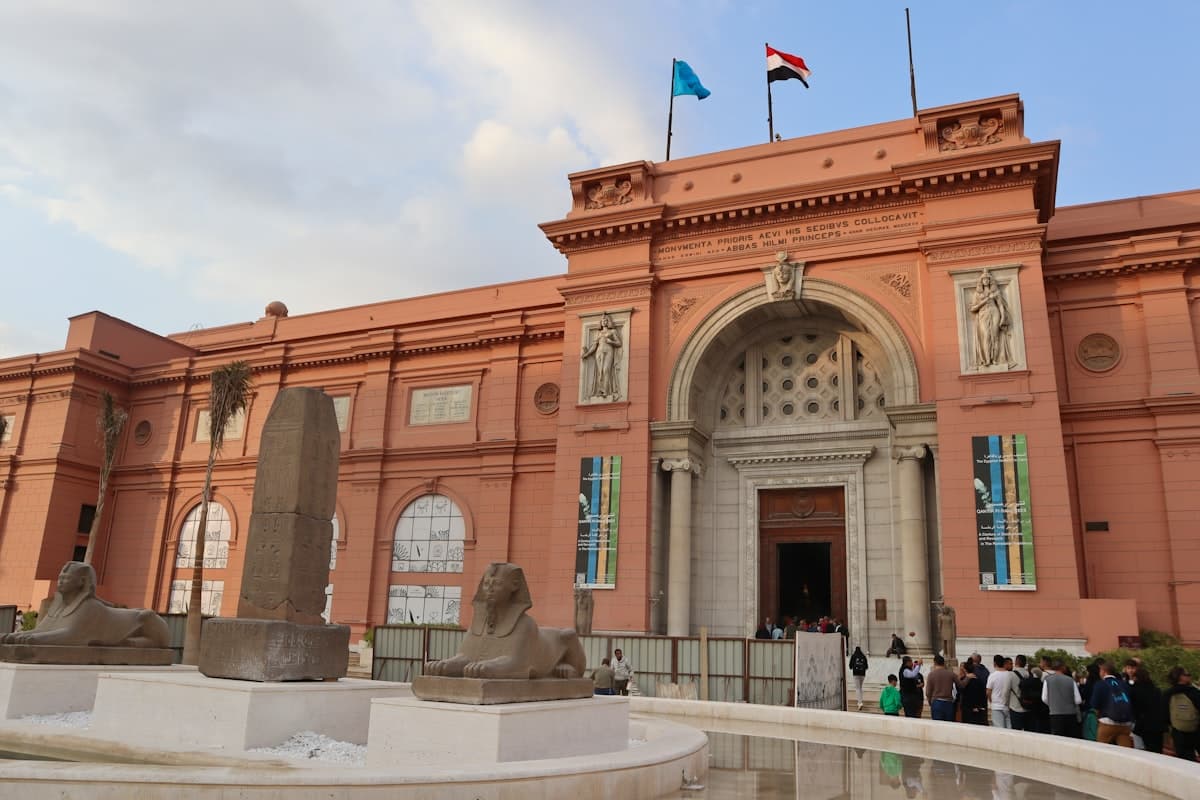
The Egyptian Museum on Tahrir Square holds the direct output of Napoleon's Commission: the original Description plates and instruments are gone (they went to France), but the museum's Egyptological framework, the way objects are categorized, dated, and interpreted, descends directly from the methodologies the French scholars developed in Cairo between 1798 and 1801.
Rashid (Rosetta): The Town That Named a Stone
Rashid is a four-hour trip from Cairo or ninety minutes from Alexandria, and most travelers skip it. This is a mistake, though a forgivable one: the town markets itself poorly and the fort where the Rosetta Stone was found is not dramatically impressive. What is impressive is the town itself.
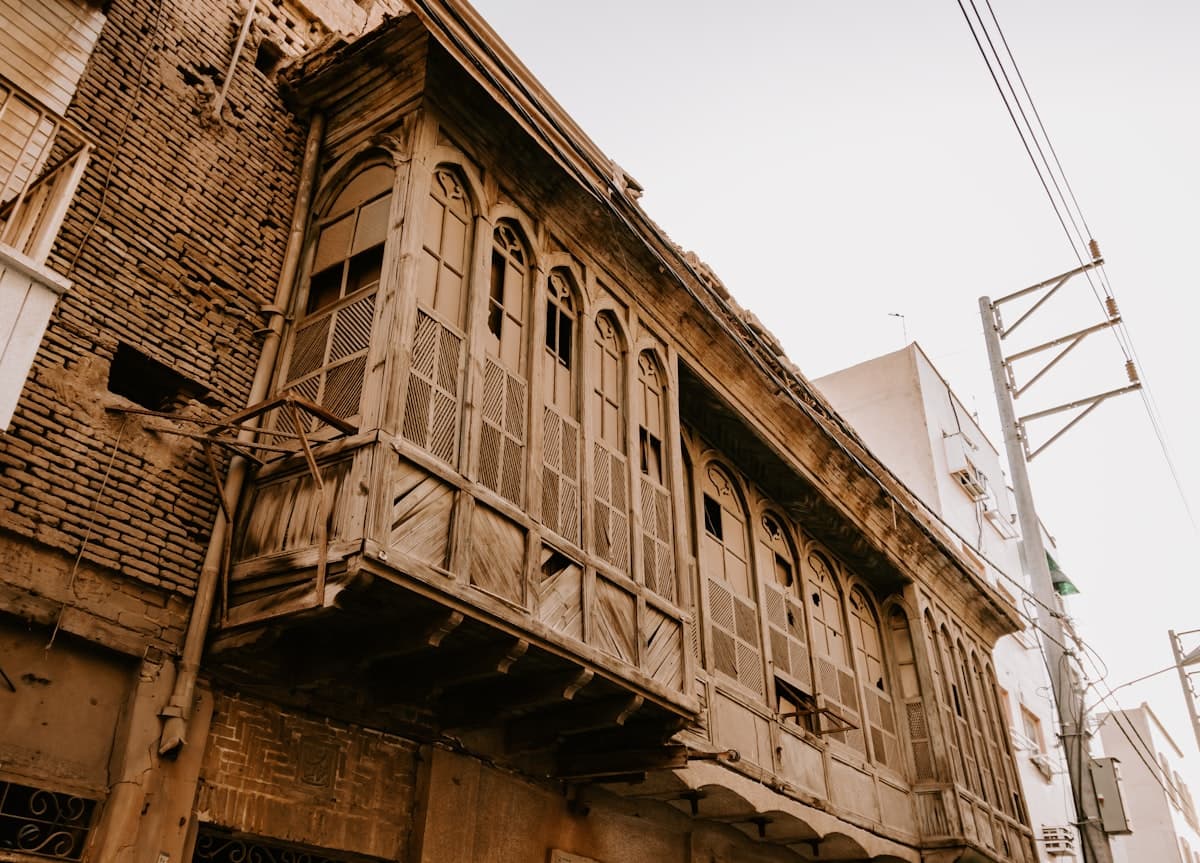
Rashid was one of the wealthiest ports in Egypt during the Ottoman period, a rival to Alexandria until the nineteenth century. Its merchants built multi-story townhouses with intricate mashrabiyya woodwork and polychrome brick facades that have no parallel anywhere else in the Delta. Around twenty of these houses survive. The House of Amasyali, now a museum, was built in 1808, seven years after the French left, on money that had been accumulating through the French period trade disruptions. Walking through it is a reminder that while European powers were fighting over Egypt, Egyptian merchants were building townhouses with income from spice and textile trade that had been continuous for centuries.
Fort Julien, where Bouchard found the stone, is a low Ottoman fortification a short walk from the town center. The stone itself is represented by a replica in the fort's small museum. The British Museum replica is better quality. What you come to Rashid for is the context: the Delta landscape, the Ottoman merchant architecture, the specific ordinariness of the place where one of the most consequential archaeological finds in history happened because a French soldier was digging a foundation.
The Connections
The French campaign sits exactly at the hinge between Ottoman Egypt and modern Egypt. The Mamluks who opposed Napoleon at the Battle of the Pyramids were the same military class that had been theoretically subordinate to the Ottomans since 1517 but had operated Egypt as a semi-autonomous fief for centuries. Napoleon defeated them in forty-five minutes. The Ottoman response to the French invasion was to send Muhammad Ali as part of an Albanian regiment, a man whose ambition and organizational intelligence the Ottomans had not fully reckoned with. By 1805 Muhammad Ali was governor of Egypt. By 1811 the Mamluks were gone. By 1830 he was industrializing Egypt, building textile mills in the Delta that used the same raw cotton his soldiers had grown in fields the French Commission had surveyed and mapped.
The Suez Canal, which opened in 1869, was first proposed seriously by Napoleon's engineers at the Institut d'Égypte. The British occupation of Egypt from 1882 onward was justified in part by British financial interests in that canal. The canal exists because the French scholars got the engineering question wrong but asked it seriously enough that it stayed on the agenda for fifty years until someone got it right.
Nothing in Egypt exists in isolation. The French campaign is not a footnote between the Pharaonic and Islamic chapters. It is the event that closed the Ottoman chapter and opened the modern one.
Common Mistakes
Treating this as a single-site itinerary. There is no "Napoleon site" in Egypt the way there is a Karnak or a Valley of the Kings. The French campaign is threaded through Cairo, Alexandria, the Delta, and the coast. Plan for movement.
Going to Abu Qir expecting anything. The bay is a bay. Unless you are a naval historian who can reconstruct fleet positions from coastal geography, the site offers almost nothing visually. Go for the seafood at one of the restaurants on the waterfront, read the battle accounts before you arrive, and let the Mediterranean do the rest.
Skipping Rashid because it's inconvenient. The Ottoman merchant architecture alone justifies the trip, and the fort is honest about what it is. The Rosetta Stone context is genuinely moving when you understand what was found here and where it went.
Paying for a Napoleon-themed tour in Cairo. Every tour operator in Cairo offers a "French Quarter" walking tour. Most are thin on specifics and heavy on atmosphere. The Institut d'Égypte restoration site and the relevant Cairo buildings are all walkable with a good map. Save the guide budget for Rashid, where local knowledge about the Ottoman houses is genuinely valuable.
Skipping the Description de l'Égypte entirely. The physical volumes are in the Egyptian Museum's rare books collection and not on general display, but digital facsimiles are freely available online. Spend two hours with them before you travel. The drawings of temples, people, and landscapes from 1798 will reframe everything you see.
Spending money on the Cairo sound and light show. It covers Pharaonic history, costs EGP 350, and has no meaningful French period content. Read this article instead.
Missing the Battle of the Pyramids actual location. Every tourist goes to Giza. Almost none go to Embaba, which is a few kilometers north of the Pyramids on the west bank of the Nile. There is nothing to see at Embaba either, but knowing you are standing on the actual ground of July 21, 1798 is a different experience from standing at the Pyramids imagining Napoleon's speech, which he almost certainly never gave in those exact words.
Practical Tips
Hire a private car for the Abu Qir and Rashid days. Shared transport gets you there but leaves you with the logistics of moving between multiple sites on someone else's schedule. Negotiate a full-day rate in Alexandria: EGP 400 to 600 is standard for a car and driver willing to go to both Abu Qir and Rashid in a single day, though the day will be long.
Bring the PDF of Nina Burleigh's "Mirage: Napoleon's Scientists and the Unveiling of Egypt" or Paul Strathern's "Napoleon in Egypt" on your phone. Neither is a guidebook, but both give the human detail that makes the sites make sense.
The Egyptian Museum is poorly lit and the labeling is inconsistent. Go early, before 10am, when the tour groups from cruise ships haven't yet arrived. The Greco-Roman room and the objects connected to the French period's documentation work are on the ground floor, east wing.
The house museums in Rashid keep unpredictable hours outside of the official schedule. If you arrive and the House of Amasyali is closed, ask at the fort: the staff there can often reach the caretaker by phone.
Cairo's Citadel is worth a full morning. The Muhammad Ali Mosque interior, with its Ottoman chandelier system and alabaster lower walls, is the most direct architectural evidence of how Egypt rebuilt its identity after the French. Go on a weekday. Fridays bring large local crowds after prayers.
Frequently Asked Questions
The Weekly Dispatch
More on Egypt, every Friday.
Cultural depth and places most guides never mention.
No spam. Unsubscribe anytime.