Syrian Community Egypt History Guide: Cairo's Living Quarter
Cairo's Syrian quarter in Sayeda Zeinab has absorbed refugee waves since the Mamluk era. The newest arrivals share streets with families who came 700 years ago.

Quick Facts
- Best time to visit
- October to April for comfortable temperatures. Ramadan evenings (date varies by year) for the most atmospheric street food and late-night dining.
- Entrance fee
- No entrance fee for the neighborhood. Ibn Tulun Mosque: EGP 100 (approx $3.25 USD). Coptic Museum nearby: EGP 200 (approx $6.50 USD). Mosque donations: EGP 20-50 customary.
- Opening hours
- Neighborhood active daily from around 9am to midnight or later. Syrian restaurants typically open 11am to 1am. Friday mornings are significantly quieter before noon prayers.
- How to get there
- Metro Line 1 to Sayeda Zeinab station (EGP 8, approx $0.25 USD). Uber or Careem from central Cairo to Dokki: EGP 40-80. Microbus from Tahrir Square: EGP 5.
- Time needed
- Half-day for Sayeda Zeinab market and Ibn Tulun Mosque. Full day if combining with Dokki restaurant lunch and Coptic Museum.
- Cost range
- Budget EGP 300-500 per person including food and transport. Syrian lunch for two at a mid-range Dokki restaurant: EGP 400-700.
Quick Facts
Best time to visit: October to April, when the heat is manageable and the streets are at their most animated. Ramadan evenings are a separate category entirely: the Syrian restaurants in Sayeda Zeinab and Dokki stay open past 2am and the food is better than at any other time of year.
Entrance fees: No admission fees apply. This is a living neighborhood, not a museum. Mosque visits are free; a small donation of EGP 20-50 (under $1 USD) is customary.
Opening hours: The neighborhood operates around the clock. Syrian-owned businesses typically open by 10am and stay open until midnight or later. Friday mornings are quieter; Friday evenings are the opposite.
How to get there: Metro Line 1 to Sayeda Zeinab station (EGP 8, about $0.25 USD). From central Cairo, a Uber or Careem to Dokki's Syrian restaurant corridor costs EGP 40-80 depending on traffic. A microbus from Tahrir to Sayeda Zeinab runs for EGP 5.
Time needed: A half-day for a focused walk through Sayeda Zeinab. A full day if you combine it with the Coptic Museum, the Ibn Tulun Mosque, and lunch at one of the Syrian-run restaurants near Midan el-Sayed Hassan.
Cost range: Budget EGP 300-500 per person for a full day including food, transport, and coffee. A proper sit-down Syrian lunch for two at a mid-range restaurant in Dokki runs EGP 400-700.
---
Syria has been sending people to Egypt since before the concept of a border existed between them. The oldest Syrian family currently living in Cairo's Sayeda Zeinab district can trace continuous residence to the early sixteenth century, when Ottoman conquest reshuffled the entire eastern Mediterranean. The newest arrived after 2011, fleeing a war that is still not over. Between those two dates, Cairo absorbed Syrian merchants, scholars, Sufi orders, political exiles, textile traders, confectioners, and now, in the largest single wave, more than 1.5 million displaced people who have remade entire Cairo neighborhoods in ways that are visible, audible, and edible.
This is the Syrian community Egypt history guide that starts not with a tragedy but with a trade route.
Why This Place Matters
The relationship between Syria and Egypt runs so deep that separating one civilization from the other at any given historical moment is partly artificial. The Fatimid caliphs who built Cairo in 969 CE governed both Syria and Egypt from the same throne. The Mamluk sultans who ruled Egypt from 1250 to 1517 were themselves largely Syrian and Circassian in origin, enslaved as boys and trained as soldiers in a system that turned them into the most effective military force of the medieval Islamic world. When they built the great mosques and madrasas of medieval Cairo, they brought Syrian craftsmen with them: the ablaq stonework, the alternating courses of black and white or red and cream stone that you see on buildings like the Sultan Hassan Mosque and the Barquq complex, is a Syrian architectural technique transplanted to Egypt and never fully replaced.
The food connection is just as old. The word "mulukhiyya," the green leaf stew that Egyptians consider their national dish, appears in medieval Arab cookbooks from Damascus. The Ayyubid dynasty that preceded the Mamluks, founded by Saladin in 1174, was Kurdish and Syrian in origin and governed Egypt for less than a century but left a culinary and architectural imprint that persists. The Citadel that dominates Cairo's eastern skyline was begun by Saladin, a man who was born in Tikrit in what is now Iraq, grew up in Syria, and built his empire's administrative center in Egypt.
This is the context into which the modern Syrian displacement fits. It is a new chapter in a very long story.
Sayeda Zeinab: The Quarter That Kept Absorbing
Sayeda Zeinab is named for the granddaughter of the Prophet Muhammad, whose shrine sits at the heart of the district and draws pilgrims from across the Shia and Sunni worlds alike. The neighborhood has been absorbing outsiders for centuries, and Syrian presence here predates the current crisis by generations. Walk down Sharia Port Said toward the mosque and you will pass shops selling Syrian sweets, specifically the pistachio-filled mamoul and the shredded-wheat basbousa variants that differ enough from Egyptian versions to start an argument at any table.
The Syrians who arrived after 2011 settled in Sayeda Zeinab partly because it was affordable and partly because earlier Syrian families were already there, running textile workshops and wholesale fabric businesses that had operated since at least the nineteenth century. Cairo's garment industry, concentrated in the nearby districts of Wekalet el-Balah and the wholesale markets of downtown, had long relied on Syrian weaving expertise. The Damascus brocade trade, which peaked in the eighteenth century, sent agents and eventually whole families to Cairo's Khan el-Khalili bazaar. Some of those family names are still above shop doors.
The new arrivals brought their own trades. Walk through Sayeda Zeinab on any weekday morning and you will find Syrian-run barbershops, phone repair stalls, and bakeries producing ka'ak bi anise and sesame rings that taste specifically of Aleppo and Homs, not of Cairo. The bread is the tell. Egyptian bread is aish baladi, round, puffy, and made with coarse flour. Syrian bread from a Syrian-run oven in Sayeda Zeinab is flatter, crispier at the edges, and carries the particular char of a wood-fired or very hot stone oven. The two breads coexist on the same street within twenty meters of each other, and nobody considers this remarkable.
Dokki and the Restaurant Belt: Where Displacement Became Cuisine
If Sayeda Zeinab is where the Syrian community Egypt history is most densely layered, Dokki is where it is most immediately legible to an outsider. Beginning around 2013, Syrian-owned restaurants began opening along and around Sharia Tahrir in Dokki and its side streets. By 2017, the concentration was dense enough that Egyptian food writers began calling it a Syrian restaurant quarter without irony.
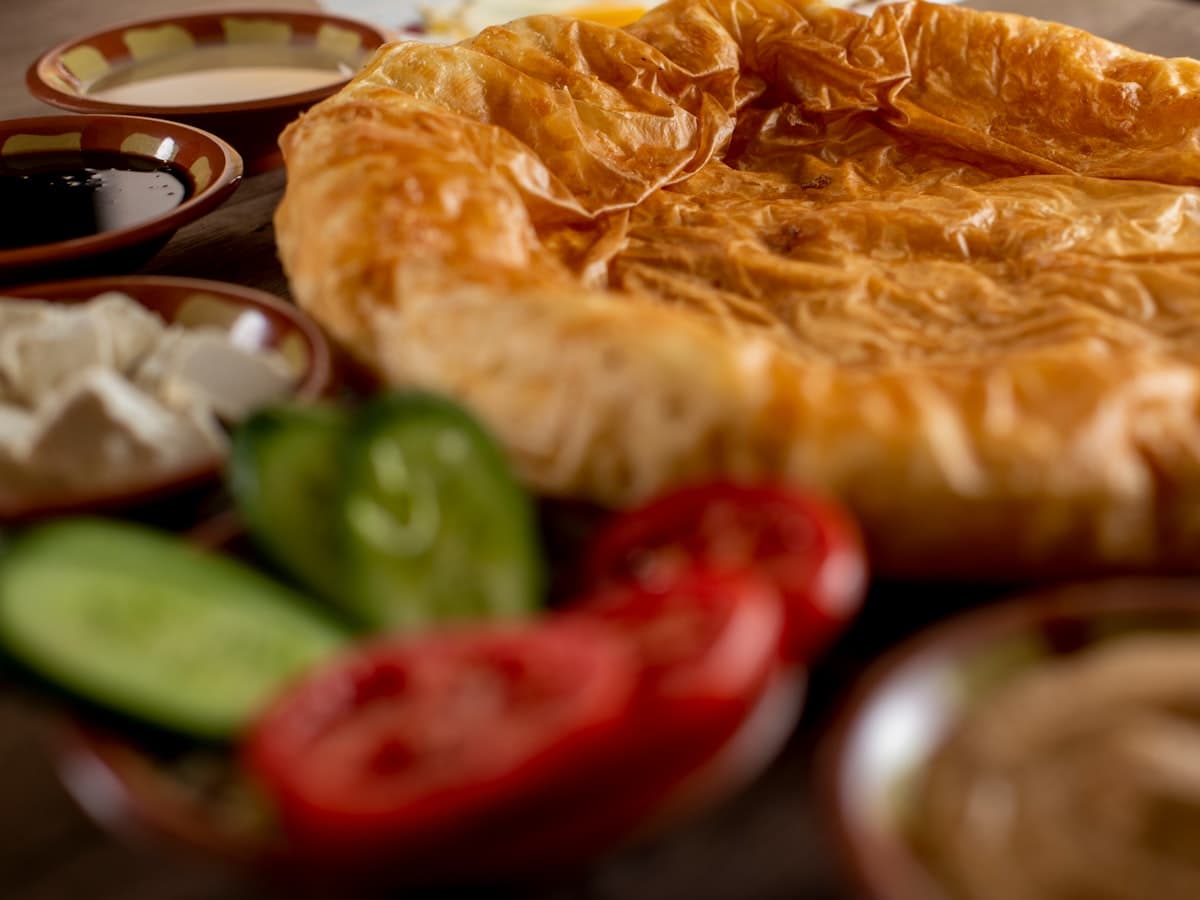
The food here deserves serious attention, and not only because it is good. Syrian cuisine in Cairo has not flattened into a generic Middle Eastern menu for Egyptian customers. The best restaurants in Dokki are still cooking for a Syrian clientele that would notice if the pomegranate molasses in the muhammara was wrong or if the kibbeh nayyeh, the raw lamb dish served with cracked wheat and onion, was made with the wrong cut. Kibbeh nayyeh is served raw, which requires either very good sourcing or a customer base confident enough to send it back. The Syrian restaurants in Dokki serve it raw. This is a quality signal.
The Aleppan restaurants are distinct from the Damascene ones if you know what to look for. Aleppo cooking uses more spice: the famous Aleppo pepper, a dried chili with moderate heat and an oily, almost fruity finish, appears in everything from the mezze to the grilled meats. Damascene cooking tends toward more sour notes, more pomegranate and tamarind, more saffron in the rice dishes. Cairo has both, on the same street, which is something neither Damascus nor Aleppo currently has in the same way.
One restaurant worth finding specifically: Abu Shaker on a side street off Sharia Tahrir in Dokki has no sign in English and the menu is handwritten in Arabic. It has been serving Aleppan food since approximately 2015 and the owner, whose family is from the old city of Aleppo, makes his own pomegranate molasses. Ask for the fattet makdous, a layered dish of fried bread, smoked eggplant, and yogurt that you will not find in this specific form in any Egyptian restaurant.
The Connections: From Mamluk Stone to Modern Street
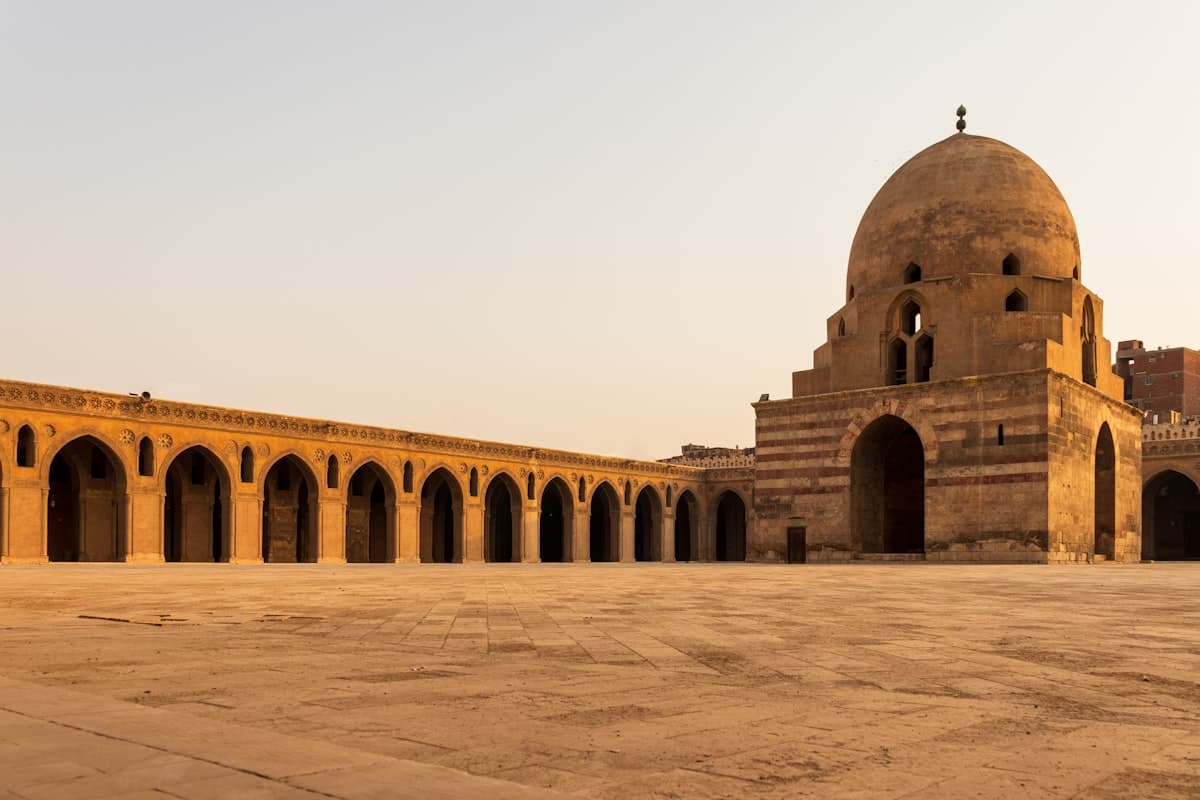
The Ibn Tulun Mosque, a short walk from the heart of Sayeda Zeinab, was built between 876 and 879 CE by Ahmad ibn Tulun, a Turk from Samarra in what is now Iraq who governed Egypt on behalf of the Abbasid caliphate and promptly declared his own dynasty. He brought Syrian and Iraqi craftsmen to build it. The mosque's spiral minaret is directly modeled on the minaret of the Great Mosque of Samarra, and the stucco ornamentation inside the arcade is Syrian in technique. The mosque was built on a hill that, according to tradition, was also the site where the Christian tradition placed Abraham's intended sacrifice of Isaac. A Pharaonic era defensive structure may have preceded the Byzantine-era fortification that preceded the mosque.
The Sultan Hassan Mosque, built between 1356 and 1363 CE, contains the ablaq stonework mentioned earlier. Its builder, Sultan Hassan, was a Mamluk of likely Circassian origin who was assassinated before its completion. His body was never placed in the mausoleum he built for himself, because the political situation after his death made it dangerous for his successors to honor him. The mosque was completed by craftsmen whose names are unrecorded, as was standard practice in Mamluk building projects, where the patron's name was everything and the workers' names were nothing.
The Syrian families now living in the neighborhoods around these mosques are, in a structural sense, repeating a very old pattern. Cairo has always been a city that absorbed skilled migrants from the Levant, put them to work, and eventually folded their contributions into something called Egyptian without fully erasing where it came from.
Common Mistakes

Treating this as a refugee tourism exercise. The Syrian community in Cairo is not a humanitarian exhibit. Some visitors arrive with a posture of charitable witness that is condescending and immediately obvious to anyone they speak to. Come because the food is serious, the history is layered, and the neighborhood is interesting. The people you meet will not perform their displacement for your benefit.
Going only to the Dokki restaurant belt and skipping Sayeda Zeinab. Dokki is more accessible and more obvious, but Sayeda Zeinab is where the longer history lives. The Syrian textile traders, the sweet shops that have operated for decades, the particular density of Levantine architectural influence on the neighborhood's older buildings: none of this is visible in Dokki.
Visiting on a Friday morning. The neighborhood slows almost to a stop before Friday prayers. If you want to see it at full operation, come Thursday evening or Saturday morning.
Ordering at Syrian restaurants in Dokki without asking what is made fresh that day. Most of the better restaurants have dishes that are prepared in limited quantities and run out by 2pm. The menu is aspirational; the reality is what arrived from the market that morning. Ask the waiter what is actually available, not what is listed.
Taking the organized "refugee neighborhood" tours offered by some NGO-adjacent operators. These tours cost EGP 600-900, last two hours, and show you a curated, sanitized version of three blocks. You will see more, and understand more, by walking in alone with this article and a willingness to ask questions in whatever Arabic you have.
Expecting the Syrian sweets in Sayeda Zeinab to be identical to what you would find in Damascus. They are not. They have adapted: less rosewater in some preparations, different pistachio sourcing, occasional substitution of ingredients that are hard to import. This is not a failure. It is what food does when it crosses a border. The result is its own thing.
Skipping the Ibn Tulun Mosque because you have already seen the big sites. Ibn Tulun is the oldest intact mosque in Cairo and one of the oldest in the world, and on most weekday mornings you can walk its courtyard in near-complete quiet. Its architecture contains more Syrian DNA than any other building in the city. It costs EGP 100 (about $3.25 USD) to enter and it is three minutes by foot from Sayeda Zeinab's main market street.
Practical Tips
Dress conservatively in Sayeda Zeinab: covered shoulders and knees for both men and women. This is not a formal rule enforced by anyone but it reflects the neighborhood's character and you will be more comfortable.
Arabic will open more doors than English here. Even a few phrases, "mumkin" (is it possible), "kam" (how much), "shukran" (thank you), and the Syrian greeting "ahlan wa sahlan" rather than the Egyptian "ahlan," will shift the quality of your interactions perceptibly.
For food, arrive hungry and plan to sit. Syrian meals are long by design. A proper lunch at a Dokki restaurant takes ninety minutes if you do it correctly, meaning you order mezze first, wait, order main courses, wait, finish with tea or Arabic coffee. Rushing this is both rude and self-defeating.
Cash is essential. Most Syrian-owned small businesses in Sayeda Zeinab do not take cards. ATMs are available near the metro station and on Sharia Port Said.
If you want to understand the legal and social situation of the Syrian community in Egypt more precisely before you go, the Egyptian Food Bank and the UNHCR Cairo office both publish updated figures. As of the most recent public data, Egypt hosts one of the largest Syrian populations outside Syria itself, with numbers that have remained above one million since 2015. The community is not temporary, and Cairo has begun to show that in its architecture, its food, and its daily street life in ways that will not reverse.
Frequently Asked Questions
The Weekly Dispatch
More on Egypt, every Friday.
Cultural depth and places most guides never mention.
No spam. Unsubscribe anytime.