The Italian Community of Alexandria: A Guide to Egypt's Lost Europe
At its peak, Alexandria held 100,000 Italians. By 1970, almost none remained. Their buildings still stand. Their cemeteries still hold names. Here is what survived.

Quick Facts
- Best time to visit
- October to April. Spring and autumn give mild temperatures ideal for walking between sites. August is humid and unpleasant for any extended outdoor time.
- Entrance fee
- Latin Cemetery EGP 20 (approx $0.60 USD). Cavafy Museum EGP 30 (approx $1 USD). Anfushi Tombs EGP 60 (approx $2 USD). Catholic Cathedral of St. Catherine free. Italian Cultural Institute events often free.
- Opening hours
- Cavafy Museum Saturday to Thursday 10am to 3pm. Latin Cemetery daily until 5pm. Anfushi Tombs daily 9am to 4pm. Italian Cultural Institute check website for programming calendar.
- How to get there
- Train from Cairo Ramses Station to Alexandria Misr Station: EGP 90 to 200 (approx $3 to $7 USD) depending on class. Microbus from Misr Station to Raml Station EGP 3. Taxis between downtown sites EGP 30 to 80 per trip.
- Time needed
- Minimum two full days. Day one for the Fouad Street architecture walk and the Cecil Hotel area. Day two for the Latin Cemetery, Anfushi Tombs, and Cavafy Museum.
- Cost range
- Budget EGP 400 to 700 per day including transport, entry fees, and meals. Mid-range EGP 1,200 to 2,000 per day with a local guide and sit-down restaurant meals.
At its peak in the 1920s, Alexandria was home to more than 100,000 Italian citizens, making it the largest Italian community in Africa and one of the largest outside Europe. They were not colonial administrators. They were bakers, architects, fishermen, jewelers, surgeons, and communists. They built the city's most enduring infrastructure, ran its most fashionable cafes, and were buried in graves that are still here, still readable, still grieving in Italian. Then Nasser nationalized their businesses in 1956 and 1961, and within a decade, most were gone.
What remains is not a museum exhibit. It is the city itself.
Quick Facts
Best time to visit: October through April. Alexandria's Mediterranean climate means summer (June to August) is humid and uncomfortably hot for walking between sites. Spring and autumn give you clear light and manageable temperatures.
Entrance fees: Villa Ambron (when open for events): free to low-cost entry, check the Italian Cultural Institute in Alexandria for programming Greek Orthodox Patriarchate Museum: EGP 50 (approx $1 USD) Antoniadis Gardens: free Cavafy Museum: EGP 30 (approx $1 USD), open Saturday to Thursday, 10am to 3pm Catholic Cathedral of St. Catherine: free, donations welcome Latin Cemetery: EGP 20 (approx $0.60 USD), open daily until 5pm
How to get there: Alexandria is 2.5 hours from Cairo by air-conditioned train. The Spanish train (Espani) runs from Ramses Station for EGP 90 to 150 (approx $3 to $5 USD) second class, EGP 200 (approx $7 USD) first class. From Alexandria's Misr Station, most Italian-linked sites cluster around the downtown corniche area, Raml Station, and the Anfushi district. Taxis within the city run EGP 30 to 80 (approx $1 to $2.50 USD) for most trips. A microbus from Misr Station to Raml runs EGP 3.
Time needed: Two full days minimum to do this properly. One day for the architecture walk along Fouad Street and the corniche. One day for the Latin Cemetery, Antoniadis Gardens, and the Cavafy Museum.
Cost range: Budget EGP 400 to 700 per day including transport, meals, and entry fees. Mid-range EGP 1,200 to 2,000 per day with a guide and nicer meals.
Why This Place Matters
The Italian presence in Alexandria did not begin with the 19th century. It begins, arguably, with the Crusades, when Genoese and Venetian merchants established trading posts along the Egyptian coast and negotiated access to the spice routes that ran through Alexandria's harbor. By the medieval period, Alexandrian customs records noted Italian merchants as the city's most frequent European traders, ahead of the French and the English.
But the community that built the city you can still walk through today arrived in waves after Muhammad Ali Pasha opened Egypt to European immigration in the 1820s and 1830s. Muhammad Ali, himself an Albanian-born Ottoman commander who had consolidated power in Egypt, understood that European expertise would accelerate his modernization program. He actively recruited Italian engineers, architects, doctors, and agronomists. He hired Italian military officers to train his army. The Mazzini brothers designed drainage systems. Pietro Avoscani built the Khedival Opera House in Cairo in 1869, which burned down in 1971 but whose design influenced Alexandrian theater architecture for decades.
Alexandria, more specifically, attracted a particular kind of Italian: not aristocrats but workers, artisans, and political exiles. After the failed Italian revolutions of 1848, a substantial number of Garibaldini republicans arrived, bringing anticlerical politics that would later produce a surprising density of Italian-language anarchist newspapers in a city nominally under British control.
The Italian community at its height ran hospitals, schools, churches, newspapers in multiple dialects, theater companies, and mutual aid societies divided by region of origin. Sicilians, Calabrians, Venetians, and Neapolitans each had their own social clubs. Their children often spoke Alexandrian Arabic, French, and Italian interchangeably, and considered themselves neither European nor Egyptian but something else entirely, something that no longer has a name.
What You Will Actually See
The Architecture Walk: Fouad Street and the Corniche
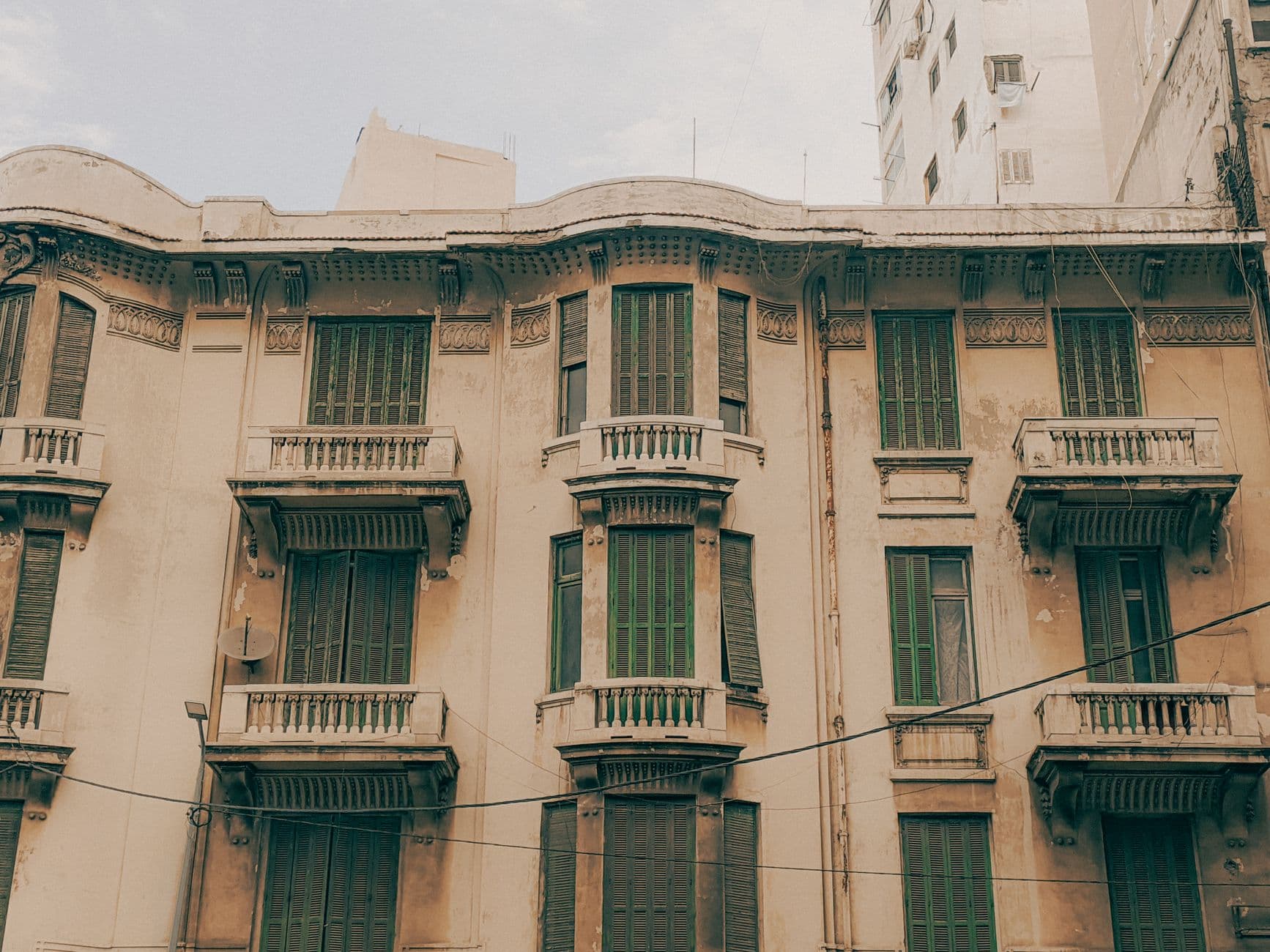
The downtown grid of Alexandria, the area Egyptians call wust al-balad, was largely designed and built by Italian architects under Khedive Ismail in the 1860s and 1870s. The model was explicitly Haussmann's Paris, and the man who executed most of it was an Italian engineer named Pietro Avoscani, who also drew up plans for the expansion of the corniche. Walk down Fouad Street (formerly Rue Fouad I, formerly Rue Rosette) from Raml Station toward the sea, and almost every building of substance you pass was designed or built by an Italian, funded by an Italian merchant bank, or named after an Italian family.
The most important stop is the Cecil Hotel, opened in 1929, which hosted everyone from Winston Churchill to Somerset Maugham and was managed for decades by the Metzger family, Austrian Jews who employed an almost entirely Italian staff. The lobby's proportions, the wrought-iron cage elevator, and the marble floors are all original. A room here costs EGP 2,500 to 4,000 per night (approx $80 to $130 USD), which is expensive by Egyptian standards but reasonable for sleeping inside a functioning piece of 1920s cosmopolitan history.
Two blocks from the Cecil, on the corner of Saad Zaghloul Square, stands the building that housed Pastroudis patisserie, founded in 1923 by a Greek Alexandrian but staffed and partly co-owned by Italians, where Lawrence Durrell wrote portions of "The Alexandria Quartet" and where Alexandria's polyglot intelligentsia argued about fascism over coffee and pastries. It still operates as a cafe, though the interior has been renovated into something blander than the original. The coffee is still good. Go before noon.
The Latin Cemetery: The City's Most Honest Document
If you read one thing before arriving in Alexandria, read the inscriptions in the Latin Cemetery on the eastern edge of downtown. The cemetery, which holds Catholic and some Protestant graves dating from the 1820s onward, is one of the few places where the social geography of the old Italian community is physically present. You can walk between the graves of a Sicilian fisherman who died in 1887 and a Milanese banker who died in 1931 and a teenage girl from Calabria who died in 1943 during the Second World War's North Africa campaign, when Alexandria was under blackout and German bombers were striking the harbor.
The Italian section alone contains over 3,000 graves. Many are maintained by the Italian government through an agreement with Egypt, which explains why some are cleaner than the Catholic sections maintained by families who no longer exist in the country. A few graves from the 1950s and 1960s show evidence of hasty inscription, families who left for Italy or Argentina or Australia and never returned to add a second name.
The cemetery's groundskeeper, whose family has worked the site for three generations, will walk you through it for a tip of EGP 50 to 100 (approx $1.50 to $3 USD). Accept. He knows which grave belongs to the Italian consul who refused to acknowledge Mussolini's racial laws and which one belongs to the anarchist printer who ran an underground press in Anfushi. This oral history is not written down anywhere.
The Cavafy Museum and the World He Described
Constantine Cavafy was Greek, not Italian, but his apartment museum on Lepsius Street (now Sharm el-Sheikh Street) is the single best surviving interior from the cosmopolitan Alexandria that the Italian community helped build. Cavafy lived here from 1907 until his death in 1933, and his poems documented a city of overlapping communities where identity was negotiated daily in four or five languages. The museum preserves his writing desk, his library, his letters, and a remarkable collection of photographs of Alexandria's mixed community in the early 20th century.
The fact worth knowing: Cavafy worked as a civil servant in the Egyptian Irrigation Office for thirty years while writing poetry that was mostly unpublished in his lifetime. His neighbors on Lepsius Street included Italian families, and his elegies for Alexandria's dying cosmopolitanism were being written precisely as that cosmopolitanism was at its height. He understood the ending before anyone else did.
The Connections
The Italian presence in Alexandria sits inside a much longer story about the city's relationship with the Mediterranean world. The harbor where Italian merchant ships docked in the 1880s is the same harbor where Julius Caesar pursued Pompey in 48 BC, where Napoleon landed in 1798 (his troops looted the city for antiquities that ended up in the Louvre), and where British naval bombardment in 1882 killed hundreds of Alexandrians and burned the old Arab quarter, which is why the city's downtown looks so European: it was rebuilt after the British bombardment largely by Italian contractors under Khedival supervision.
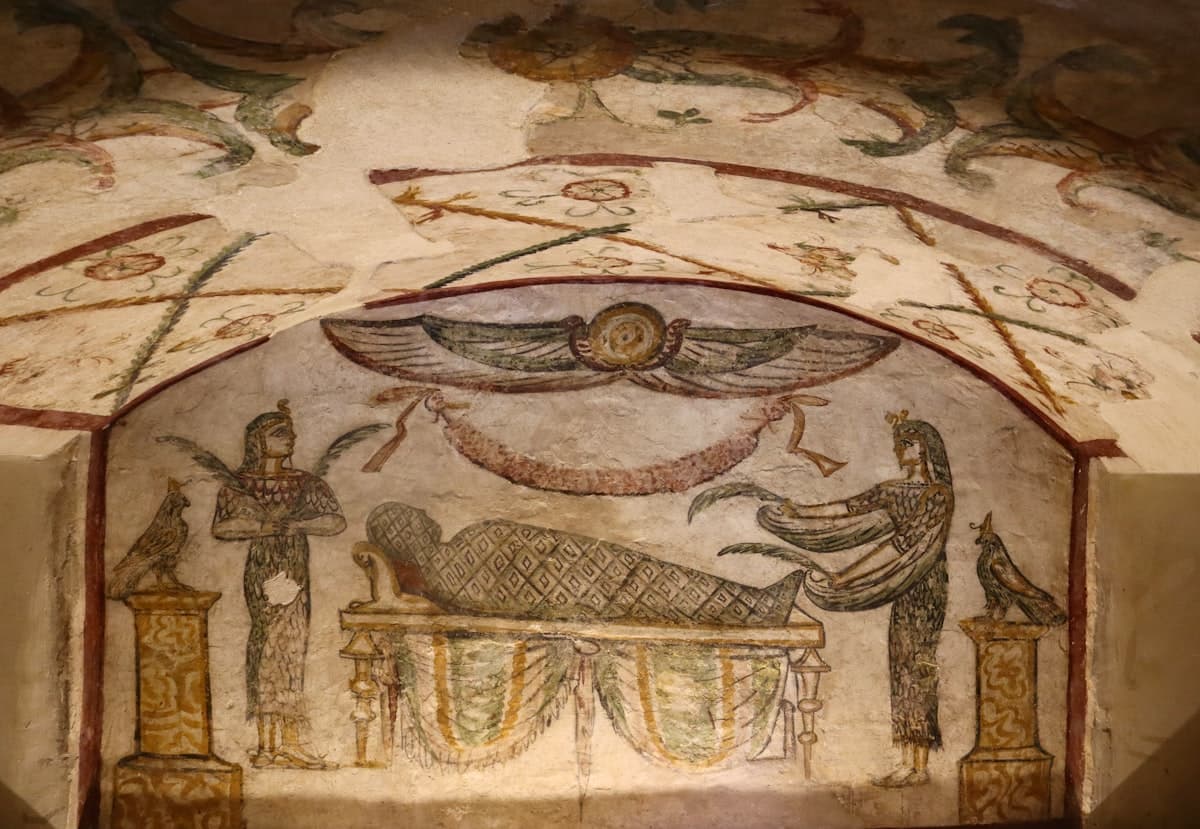
The Anfushi district, north of downtown, holds a different layer. The Anfushi Tombs, cut into the rock in the 3rd century BC, were used by Alexandrians who were already mixing Greek burial customs with Egyptian ones. The Italian fishermen who settled in Anfushi in the 19th century built their homes directly above these tombs, most of them unaware that the rock beneath their streets was hollow with Ptolemaic dead. The tombs are open to visitors (EGP 60, approx $2 USD) and are almost never crowded because they are not on the standard tour circuit.
The Bibliotheca Alexandrina, the modern library built on or near the site of the ancient one and opened in 2002, holds a substantial archive of Alexandrian Jewish, Greek, and Italian community records in its special collections. Access requires advance arrangement (email the library's manuscripts department), but for anyone seriously tracing the Italian community Alexandria Egypt history, these records, including school enrollment lists, mutual aid society membership rolls, and Italian-language newspaper archives from 1870 to 1960, are irreplaceable.
Common Mistakes
Following a standard Alexandria day tour. Most tours from Cairo cover Pompey's Pillar, the Catacombs of Kom el-Shoqafa, the new Library, and the fort. None of these are the best things in the city and none of them address the cosmopolitan layer at all. If you are here for the Italian community Alexandria Egypt history, book two days independently and walk.
Going to the Greco-Roman Museum without checking if it has reopened. The museum closed for renovation in 2005 and has been in a state of partial reopening and reclosing ever since. Check current status before building it into your itinerary. As of the most recent confirmed report, sections are open but the collection is not fully reinstalled. The collection is extraordinary but the experience is currently incomplete.
Eating at the restaurants on the corniche facing the sea. They are priced for tourists and the food is mediocre. Walk one or two blocks inland toward the downtown souqs for fish restaurants used by Alexandrians. The fish is the same fish. The price is roughly a third.
Taking the sound and light show at any Alexandria site. Skip every single one. They cost EGP 200 to 350, last an hour, and tell you nothing that reading this article and the signage at the site will not tell you. The money is better spent on a local guide for the Latin Cemetery.
Assuming the Italian Cultural Institute is only for Italians. The Istituto Italiano di Cultura in Alexandria on Saad Zaghloul Street runs public programming, lectures, film screenings, and occasionally opens Villa Ambron, the last surviving Italian community villa with its original garden, for events. Non-Italians are welcome. The calendar is on their website and events are often free.
Visiting in August. The humidity off the Mediterranean in August turns every outdoor walk into something unpleasant. The architecture walk along Fouad Street is two hours minimum on foot. Do it in October or March.
Expecting to find a living Italian community. There are perhaps a few hundred Italian citizens currently in Alexandria, mostly recent arrivals connected to business or the consulate. The community you are looking for exists in its buildings, its graves, and its paper records. Frame the visit accordingly, as an archaeology of recent history rather than a living encounter.
Practical Tips
Stay in the downtown area around Raml Station rather than along the eastern corniche hotel strip. The downtown hotels, including the Cecil, the Metropole (a 1902 Italianate building with original tile floors, rooms from EGP 800), and several smaller pensions on the streets behind Fouad, put you within walking distance of every Italian-linked site.
Hire a local guide for at least one day. Abdel Moneim Hassan, who advertises through the Bibliotheca Alexandrina visitor services, specializes in cosmopolitan Alexandria history and reads Italian well enough to translate cemetery inscriptions. His rate is approximately EGP 600 to 800 (approx $20 to $26 USD) for a half day. Worth every pound.
Bring water and wear shoes you can walk in for four or five hours. The Latin Cemetery and the Anfushi tombs involve uneven ground. The architecture walk covers approximately four kilometers.
The Italian Consulate General in Alexandria, on Azarita Street, maintains a small historical archive and occasionally hosts open days. It is worth contacting them before arrival if your interest in the Italian community Alexandria Egypt history extends to genealogical research.
Photography in the Latin Cemetery is permitted but treat it with appropriate respect. The groundskeeping staff will tell you if any sections are restricted. Tip before asking for access to locked areas.
Frequently Asked Questions
The Weekly Dispatch
More on Egypt, every Friday.
Cultural depth and places most guides never mention.
No spam. Unsubscribe anytime.