Best Time to Visit Egypt: A Season-by-Season Truth
Most guides say October to April. They're not wrong, but they're hiding something: July in Luxor tells you things about this civilization that January never will.

Quick Facts
- Best time to visit
- November and March for the most balanced conditions across the whole country. October for best value with good weather. Avoid late February through April if Khamaseen sand winds concern you.
- Entrance fee
- Varies by site: Karnak Temple EGP 450 (approx $9 USD), Valley of the Kings EGP 600 (approx $12 USD) for three tombs, Egyptian Museum Cairo EGP 450 (approx $9 USD), Pyramids of Giza EGP 600 (approx $12 USD)
- Opening hours
- Most major sites open 6am to 5pm in winter, 6am to 6pm in summer. Valley of the Kings closes at 4pm year-round. Egyptian Museum Cairo 9am to 5pm daily
- How to get there
- EgyptAir domestic flights Cairo to Luxor from EGP 800 (approx $16 USD) booked in advance. Watania Sleeping Train Cairo to Luxor nightly from EGP 2,800 per person (approx $56 USD) in a two-bed cabin including meals. Shared minibuses between Luxor and Aswan cost EGP 60 to 80.
- Time needed
- Cairo alone: 3 to 4 days minimum. Cairo plus Luxor plus Aswan: 10 days minimum, 14 days comfortable. Adding Abu Simbel, Siwa, or the White Desert requires adding 2 to 3 days per destination.
- Cost range
- Budget EGP 1,200 to 2,000 per day (hostels, local food, public transport). Mid-range EGP 3,500 to 6,000 per day (3-4 star hotels, guided site entries). Nile cruise adds EGP 6,000 to 20,000 for 4 to 7 nights depending on vessel grade.
Quick Facts
Best months overall: October through April, with November and March being the clearest for Upper Egypt Temperature range: Cairo winter averages 20°C (68°F); Luxor summer peaks at 45°C (113°F) Entrance fees: Vary by site. Karnak Temple: EGP 450 (approx $9 USD). Valley of the Kings: EGP 600 (approx $12 USD) for three tombs. Egyptian Museum Cairo: EGP 450 (approx $9 USD) How to get there: Cairo International Airport connects to most major hubs. EgyptAir domestic flights Cairo to Luxor cost EGP 800 to 1,800 (approx $16 to $36) depending on season and booking window. Cairo to Aswan overnight train: from EGP 200 in second class, EGP 700 in first class sleeper Time needed for Egypt overall: Two weeks covers Cairo, Luxor, Aswan, and Abu Simbel adequately. Ten days forces choices you will regret Cost range: Budget EGP 1,200 to 2,000 per day. Mid-range EGP 3,500 to 6,000 per day. Nile cruise adds EGP 6,000 to 20,000 for four to seven nights depending on vessel quality
---
Most people arrive in Egypt having optimized for comfort. They come in November or February, when Cairo is pleasantly cool and the tour buses still fit between each other on the Luxor corniche. They are not wrong to do this. But they are answering the wrong question. The real question is not when Egypt is most comfortable. It is what you want Egypt to do to you.
This country has a way of operating differently depending on when you arrive. The light in Upper Egypt during summer is not the same light as winter. The fellahin working the fields at dawn in October are harvesting sugarcane. By March they are burning the stalks, and the whole valley smells of char and green smoke. Ramadan Cairo sounds nothing like Christmas Cairo. These are not inconveniences to be avoided. They are the country.
So: the best time to visit Egypt depends entirely on which Egypt you are coming to see.
Why Timing Matters More Than You Think
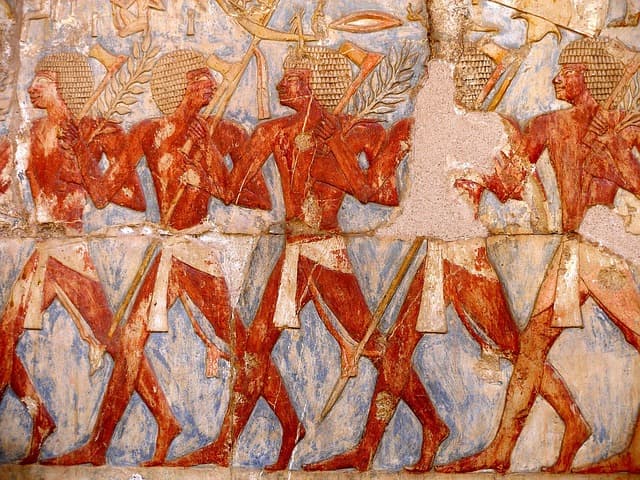
Egypt sits across two climate zones and experiences the full Mediterranean cycle in the north while the south operates under near-Saharan conditions. This is not a small country where weather is uniform. Cairo, sitting at 30° N latitude, can drop to 8°C (46°F) on a January night. Aswan, at 24° N, almost never falls below 14°C (57°F) in winter and routinely exceeds 48°C (118°F) in July. The 900 kilometers between them is not just distance. It is a different physical world.
The ancient Egyptians knew this. Their entire calendar was built not around temperature but around the Nile itself. The year divided into three seasons: Akhet (inundation, roughly July to October), Peret (growing, October to February), and Shemu (harvest, February to June). These were not agricultural suggestions. They were the structural logic of civilization. The flooding of the Nile, before the Aswan High Dam ended it permanently in the 1960s, deposited the black silt that made the Nile Valley one of the most fertile strips of land on earth. The dam solved one problem and created several others, including the slow salinization of agricultural land that now costs Egypt's farming sector billions annually.
When you visit Egypt, you are visiting a country that spent 5,000 years organized around a seasonal rhythm that no longer exists. It is worth knowing that.
October Through February: The Obvious Answer, and Why It Is Usually Correct
The consensus is correct. October through February is when most of Egypt's outdoor sites are genuinely comfortable to visit, when the light turns gold rather than white, and when you can walk the open courts of Karnak or the processional avenue at Luxor Temple for more than twenty minutes without feeling the particular despair that extreme heat produces in people who were not raised in it.
November is probably the best single month. The summer crowds at Aswan's Abu Simbel have thinned. The Nile cruise boats are full but not absurdly so. The air over Luxor is clear enough that the Theban hills glow amber at 6am in a way that genuinely makes you understand why the ancient Egyptians chose the west bank for their dead. The sun rises directly over the east bank and illuminates the cliffs in stages, and if you are standing at the Hatshepsut temple at Deir el-Bahari at that hour, which requires getting there before the first tour bus at 7am, the light arrives like a formal introduction.
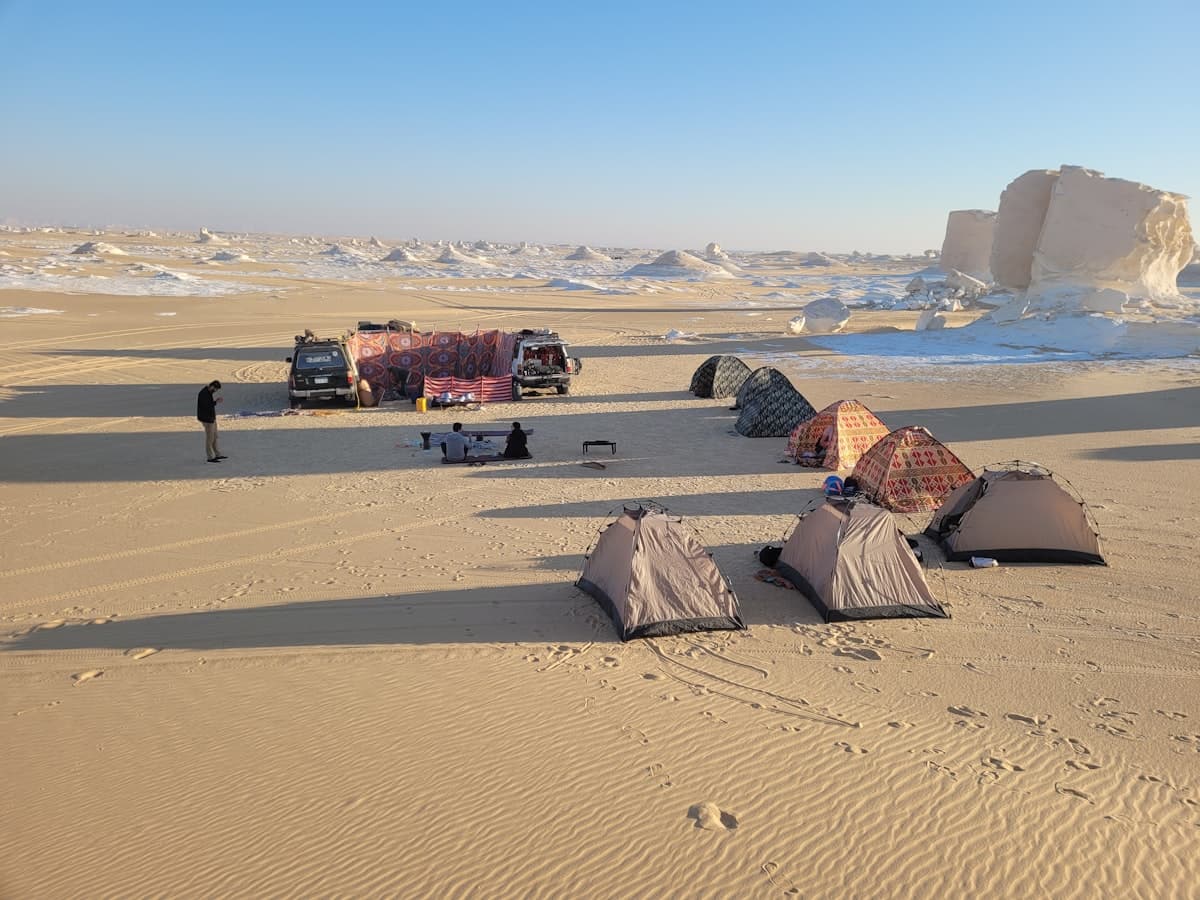
December and January are colder than most first-time visitors expect. Cairo at night in January requires a jacket. The Western Desert, which includes the White Desert and Siwa Oasis, can approach freezing at 2am, which is when you want to be awake and outside looking at stars over chalk formations that look like no other landscape on earth. The cold is the point. Bring a layer.
February brings the Khamaseen, the fifty-day wind season that begins around late February and blows sand across the whole country. The name comes from the Arabic word for fifty, though the winds do not actually blow for fifty consecutive days. They come in waves, sometimes for a day, sometimes three, reducing visibility in Cairo to a few hundred meters and coating everything, including your lungs, in fine desert dust. Plan accordingly.
The Crowd Problem Nobody Warns You About
High season also means high crowds, and Egypt's crowd concentrations are severe in ways that people do not fully grasp until they are standing in a queue outside Tutankhamun's tomb at 9am in December. The Valley of the Kings receives approximately 14,000 visitors per day during peak months. The main ticket includes three tombs. Most tourists, directed by guides with time constraints, visit Ramesses II, Ramesses III, and Tutankhamun. This means those three tombs are catastrophically overcrowded while tombs like Thutmose III, which requires climbing a vertiginous iron staircase to a chamber decorated with the complete Amduat in a style that looks like unrolled papyrus, receive perhaps a hundred visitors on the same day. The crowd problem is a routing problem. Arrive at 6am when the gates open and go directly to the less-visited tombs. You will have them nearly to yourself before the tour buses arrive at 8:30.
March Through May: The Underrated Window
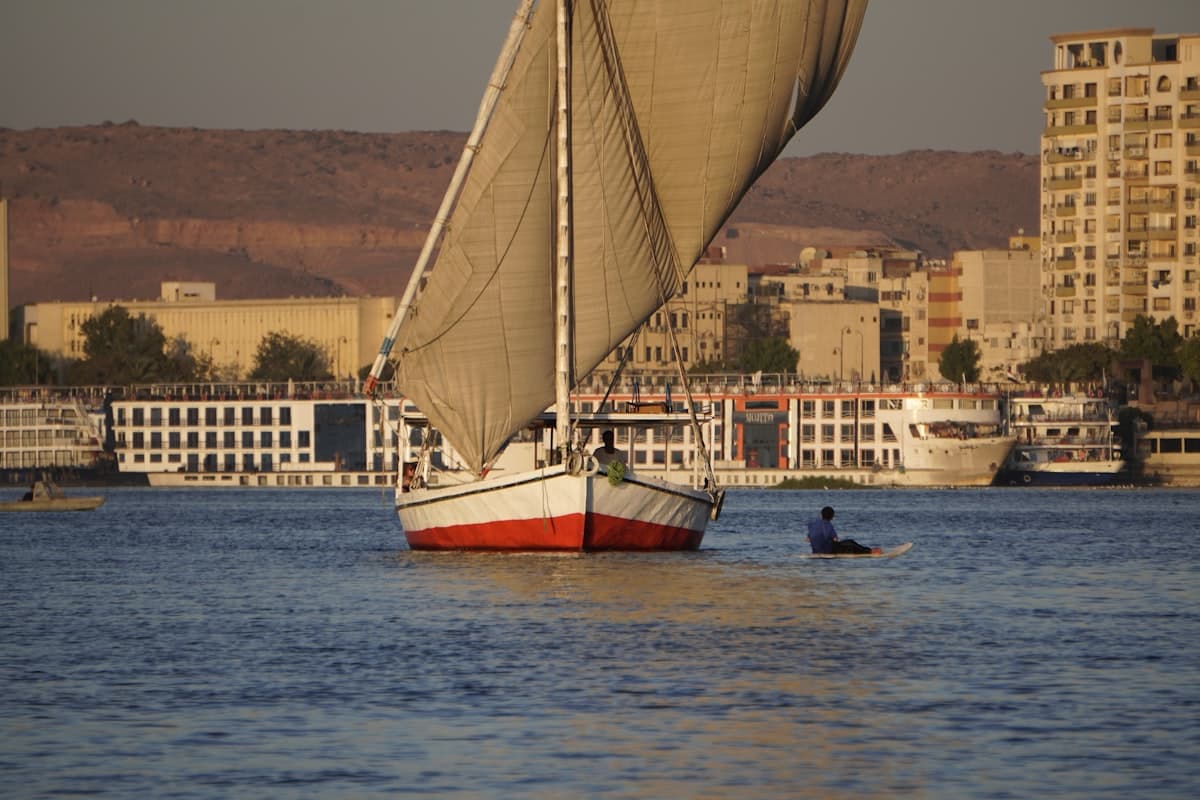
March is arguably better than November for one specific reason: the Nile. By March, the river is at its lowest, which means the felucca captains in Aswan are navigating shallower water with different skill, the islands around Elephantine are more exposed, and the whole landscape has a parched, concentrated quality that high-water season does not offer. The agricultural burning season in Upper Egypt fills the air with a particular haze by late afternoon that is either beautiful or annoying depending on your relationship to atmospheric ambiguity.
April is the last comfortable month before the heat becomes serious in Upper Egypt. Cairo in April is warm and occasionally dusty but entirely manageable. Luxor in late April is already pushing 38°C (100°F) by midday. The morning window, 6am to 10am, becomes essential rather than optional.
March also coincides with Sham el-Nessim, the ancient Egyptian spring festival that has been celebrated continuously for over 4,500 years and is the only pre-Islamic, pre-Christian holiday still observed by all Egyptians regardless of religion. It falls the day after Coptic Easter and involves eating feseekh (salted, fermented grey mullet), colored eggs, green onions, and lettuce. The smell of feseekh in a Cairo street market on Sham el-Nessim morning is either a formative experience or a reason to recalibrate your travel dates. It is not subtle.
June Through September: The Honest Case for Summer
The heat in Luxor in July is not a weather condition. It is a physical argument. At noon, standing in the open court of Karnak between the Third and Fourth Pylons, the temperature is above 43°C (109°F) and the sun reflects off limestone in a way that makes the air itself seem white. This is when most Western tourists have gone home, when the guides are sitting in their air-conditioned cars, and when the temples belong almost entirely to Egyptian families and Sudanese pilgrims.
This is also when you understand, in your body rather than your intellect, why the ancient Egyptians developed their entire solar theology. Ra was not a metaphor in this climate. He was the dominant fact of existence. The Egyptians did not worship the sun because it was beautiful. They worshipped it because it was overpowering and you had to be in right relationship with it to survive.
Summer Nile cruises are discounted by 40 to 60 percent. Hotels in Luxor that charge EGP 3,500 per night in November offer the same room for EGP 1,400 in July. The sites are empty in the sense that matters: the spaces between columns are your own. If you are going to visit the Hypostyle Hall at Karnak, which contains 134 columns across an area of 5,000 square meters and was decorated by both Seti I and Ramesses II in a deliberate theological argument rendered in stone, the argument is easier to hear when you are not surrounded by 300 other people.
The practical requirements are real: begin every outdoor activity before 7am, return to your hotel by 10am, rest until 4pm, return to sites from 4pm until closing. This is the schedule Egyptian workers follow. It is not a hardship. It is a different relationship with time.
Ramadan: The Month Most Guides Tell You to Avoid
Every package-tour operator will suggest you avoid Ramadan. They are wrong, and their reason for saying it (restaurants close during daylight, some sites have reduced hours) serves their logistics more than your experience.
Ramadan Cairo is the most alive version of the city. After iftar, roughly 6:30pm depending on the month, the streets fill in a way that has no equivalent in any other season. Khan el-Khalili at 10pm during Ramadan is a different world from the same space in November. The lanterns (fanous) that fill the market since the Fatimid period are sold everywhere. The smell of qatayef, small pancakes filled with nuts or cream, frying in enormous pans on street corners, defines the night air. People eat together outside in ways that the rest of the year does not produce.
Ramadan falls approximately eleven days earlier each Gregorian year, so its placement in the travel calendar shifts constantly. Check the Islamic calendar before booking. When Ramadan lands in March or April, you get the cultural experience layered on top of already good travel conditions. When it falls in August, you have the full summer heat plus fasting crowds plus the particular beauty of a civilization at prayer. Both are worth it.
The Connections
Egypt's seasons are not just meteorological. They are civilizational. The Coptic calendar, still used by Egyptian farmers, is a direct descendant of the ancient Egyptian calendar and retains the original three-season structure. When Coptic farmers in the Delta say they are in the month of Baramhat (corresponding to March), they are using a calendar system that functioned without interruption from the reign of Thutmose III to the present. The Islamic calendar runs on a pure lunar cycle with no solar correction, which is why Ramadan migrates through the Gregorian year. The tension between these two calendar systems, the solar agricultural one and the lunar religious one, is still felt in how Egyptian life is organized.
The best time to visit Egypt is also connected to its physical geography. The construction of the Aswan High Dam, completed in 1970, permanently ended the Nile's annual flood cycle and with it the natural soil renewal that the valley depended on for millennia. Visiting Upper Egypt now, you are seeing a landscape that has been hydrologically stable for about fifty years after approximately 5,000 years of annual transformation. This is a blink. The ecological consequences are still developing.
Common Mistakes
Treating the country as uniform. People plan a single two-week trip and discover, upon arrival, that Cairo in December requires completely different clothing and logistics than Aswan in December. Pack for both. Cairo needs a jacket at night. Aswan needs sun protection from 7am.
Booking a Nile cruise for the wrong season. Nile cruises between Luxor and Aswan are excellent in every season but their value proposition differs. High season means full boats and better evening programming. Low season means better prices, fewer crowds at dock stops, and more flexibility with captain scheduling. The cruise itself is not better or worse. Your preference for solitude or social atmosphere should determine your timing.
Skipping the October shoulder period. The first two weeks of October are genuinely excellent. Summer prices have not yet shifted to winter rates, crowds are minimal, and temperatures in Upper Egypt have dropped from peak summer but retain enough warmth to make dawn felucca rides in Aswan ideal rather than chilly.
The sound and light show at Karnak. It costs EGP 350 and takes ninety minutes to tell you facts available in any decent guidebook while playing dramatic orchestral music and projecting colored lights on columns. You will learn nothing. You will not feel anything except mild impatience. Skip it entirely and use that evening to walk the Luxor corniche or hire a calèche driver to take you to Luxor Temple at night, when it is lit from below and the tourists have mostly gone, for EGP 100 round trip.
Underestimating April. April is still excellent in Cairo and Alexandria. It is already marginal in Luxor for midday activity. People book April assuming uniform conditions and then abandon afternoon plans in Upper Egypt. Build the 10am to 4pm rest period into your April itinerary from day one.
Missing the Alexandria difference. Alexandria operates on a Mediterranean climate with no relation to Upper Egypt. It is cooler in summer, wetter in winter, and at its best in late spring and early autumn when the sea is clear and the city's particular mix of Greek, Jewish, Egyptian, and Italian architectural ghosts is most accessible without the summer crowds of Egyptian holiday-makers from Cairo.
Over-planning the first Cairo day. Arrival days in Cairo are lost to jet lag, traffic, and sensory recalibration. Every traveler who plans four sites on day one loses day one and most of day two. Plan nothing the first afternoon. Walk one street. Drink one coffee. Let the city introduce itself.
Practical Tips
Domestic flights in Egypt are cheap and reliable enough. EgyptAir runs Cairo to Luxor and Cairo to Aswan multiple times daily. Book at least three weeks in advance for winter travel; last-minute fares in October through February can triple. In summer, you can book the day before without penalty.
The sleeper train from Cairo to Luxor and Aswan runs nightly and is operated by Watania Sleeping Trains. A two-person cabin costs approximately EGP 2,800 per person (about $56 USD) and includes dinner and breakfast. It arrives at Luxor around 7am, which is exactly the right time to go directly to the west bank before the heat builds. Book through the official Watania website or through your hotel concierge. Do not book through third parties at stations.
For temperature management in summer, the traditional Egyptian galabiyya, available at any Khan el-Khalili vendor for EGP 150 to 300, is genuinely better than Western hiking clothing for outdoor site visits. Loose cotton that covers arms and neck manages shade and sweat more effectively than technical fabrics designed for lower temperatures.
Sunscreen in Egypt is available but expensive. Bring your own from home. Water at major sites costs EGP 30 to 50 per bottle inside the gates. Buy a large bottle outside before entering.
For the absolute best light photography at Karnak, the winter sun enters directly through the eastern gate at the equinoxes, which the ancient Egyptians almost certainly calculated deliberately. The spring equinox, around March 21, produces the most direct axial illumination through the temple complex. Budget photographers who want that alignment should time their Luxor visit accordingly.
Frequently Asked Questions
The Weekly Dispatch
More on Egypt, every Friday.
Cultural depth and places most guides never mention.
No spam. Unsubscribe anytime.