Greco-Roman Alexandria: Egypt's Lost World Beneath the City
Alexandria was the largest city on earth for 300 years. Almost none of it survives above ground. The real history is under your feet, and under the sea.

Quick Facts
- Best time to visit
- October to April. Mediterranean climate makes summers humid and busy with domestic tourism. October and March offer the best balance of mild weather and manageable crowds.
- Entrance fee
- Catacombs of Kom el-Shoqafa: EGP 180 (approx $3.50 USD), students EGP 90. Pompey's Pillar and Serapeum: EGP 120 (approx $2.50 USD). Alexandria National Museum: EGP 160 (approx $3 USD). Greco-Roman Museum: check current reopening status.
- Opening hours
- Most sites daily 9am to 5pm. Catacombs last entry 4:30pm. Some sites adjust Friday hours. Closed on certain national holidays.
- How to get there
- High-speed Talgo train from Cairo Ramses Station: EGP 120 to 280, approx 2 to 2.5 hours. Within Alexandria, taxis from Misr Station to key sites cost EGP 40 to 60. Uber operates citywide. Tram available for EGP 2 to 5 but slow.
- Time needed
- Two full days minimum. One day for the Catacombs, Pompey's Pillar, and Kom el-Dikka. Second day for the National Museum, the Corniche, and Qaitbay Citadel for context on the ancient Lighthouse.
- Cost range
- Budget EGP 600 to 900 per day including basic accommodation. Mid-range EGP 1,800 to 3,000 per day. Site entry fees for all major Greco-Roman sites total approximately EGP 460 per person.
Three hundred years after its founding, Alexandria held a population of roughly one million people, making it the largest city on the planet. The Pyramids were already ancient history to Alexandrians. Cleopatra VII, often imagined as the embodiment of ancient Egypt, was more Greek than Egyptian, spoke nine languages including Egyptian as a matter of political strategy, and was the first ruler of her dynasty in nearly three centuries to bother learning the language of the people she governed. The Egypt you think you know almost certainly begins somewhere else. The Egypt that remade the ancient world is largely invisible, buried under a modern city of five million, submerged in the Mediterranean, or sitting unlabeled in museum basements. This guide is about finding what remains, understanding what is missing, and knowing why the absence matters as much as what survives.
Quick Facts
Best time to visit: October through April. Alexandria's Mediterranean climate means summers are humid and crowded with Egyptian tourists escaping Cairo's heat. Spring and autumn give you mild temperatures and thinner crowds at the major sites.
Key sites and entrance fees: Greco-Roman Museum (currently under renovation, check reopening status): EGP 100 (approx $2 USD) when open Catacombs of Kom el-Shoqafa: EGP 180 (approx $3.50 USD), students EGP 90 Pompey's Pillar and Serapeum site: EGP 120 (approx $2.50 USD) Royal Jewelry Museum (housed in a former royal palace, adjacent to Greco-Roman context): EGP 100 Alexandria National Museum: EGP 160 (approx $3 USD)
Opening hours: Most sites open daily 9am to 5pm. The Catacombs close at 4:30pm last entry. Friday hours at some sites shift to accommodate prayers.
How to get there: From Cairo, the most practical option is the Spanish-run high-speed train from Ramses Station (EGP 120 to 280 depending on class, roughly 2 to 2.5 hours). Within Alexandria, taxis from Misr Station to Pompey's Pillar cost around EGP 40 to 60. The tram network is cheap (EGP 2 to 5) but slow. Uber operates in Alexandria and is generally reliable.
Time needed: Two full days to do this seriously. One day for the major sites, one day for the Corniche, the underwater archaeology context at the National Museum, and the neighborhoods that preserve fragments of the old city's street plan.
Cost range: Budget EGP 600 to 900 per day including accommodation. Mid-range EGP 1,800 to 3,000 per day.
Why This Place Matters
Alexander the Great founded over twenty cities named Alexandria during his campaigns. The Egyptian one was different from the beginning. Chosen personally by Alexander in 331 BC after he reportedly walked the site himself, the city was designed by the architect Dinocrates of Rhodes on a grid plan oriented to catch the prevailing sea breeze. It was a rational city, literally laid out by an engineer.
What Alexandria became was something else entirely. The Ptolemaic dynasty that ruled Egypt after Alexander's death understood that knowledge was power in a way that almost no other ancient government grasped so explicitly. The Library of Alexandria was not simply a large book collection. It was a state-funded research institution where the geographer Eratosthenes calculated the circumference of the Earth to within 2 percent accuracy using shadow angles and the distance between Aswan and Alexandria, around 240 BC. Euclid formalized geometry here. Herophilus of Chalcedon performed the first recorded systematic dissection of human bodies, discovering that the brain, not the heart, controls the nervous system. The Library was, for roughly three centuries, the closest thing the ancient world produced to a modern research university.
None of it survives above ground. This is the central fact of any Greco-Roman Egypt Alexandria history guide worth reading: the city that housed the ancient world's greatest intellectual infrastructure has left almost no physical trace that you can visit and touch.
What You Can Actually See
The Catacombs of Kom el-Shoqafa
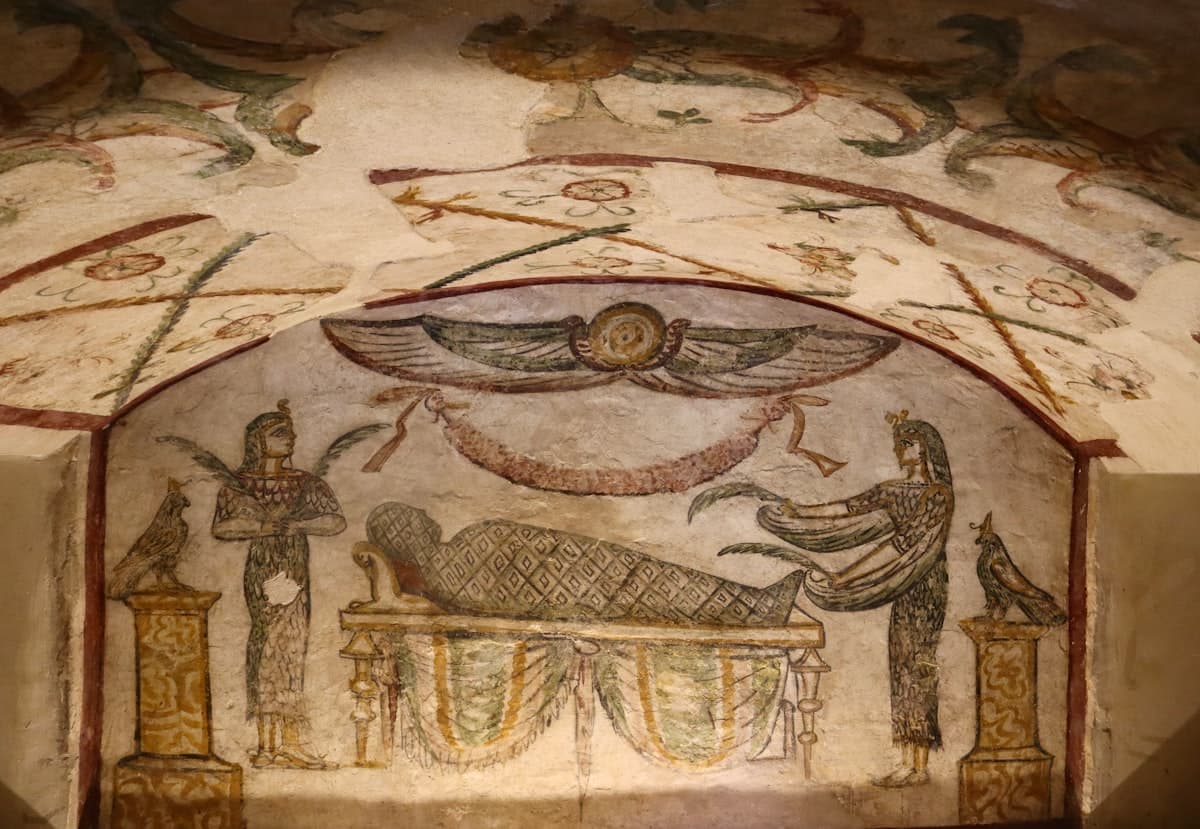
This is the single most important Greco-Roman site still accessible in Alexandria, and it is significantly undervisited relative to what it contains. Discovered in 1900 when a donkey fell through the ground into an underground chamber, the catacombs were a private family tomb that expanded, over generations spanning roughly the 1st through 4th centuries AD, into a multi-level complex mixing Egyptian, Greek, and Roman visual languages in a way found nowhere else on earth.
The triclinium, a funerary banquet hall carved from the rock, contains niches for mourners to recline and eat ritual meals near the dead. The main tomb chamber shows Egyptian gods rendered in Roman armor. Anubis wears a Roman legionary breastplate. Sobek the crocodile god stands in Greek contrapposto. These are not accidents or corruptions of tradition. They are a deliberate theological synthesis made by a community that was simultaneously Egyptian, Greek, and Roman, and saw no contradiction in that.
The catacombs descend three levels, though only the first two are currently open to visitors. Bring a light layer; the underground temperature is a consistent and sometimes startling cool against Alexandria's humidity. The site is genuinely eerie in the right light, and authentically so.
Pompey's Pillar and the Serapeum
The pillar was never Pompey's. The Roman general who was assassinated in Egypt in 48 BC has nothing to do with this 30-meter granite column, which was erected in 297 AD in honor of the Emperor Diocletian after he put down a revolt in Alexandria and, reportedly, generously agreed to feed the starving population afterward. Medieval Arab travelers named it for Pompey based on a misunderstanding, and the name stuck across European cartography.
The pillar itself is impressive, but what surrounds it is more interesting. The Serapeum beneath the pillar's platform was one of the ancient world's great temple complexes, home to a daughter collection of the Library of Alexandria. When Bishop Theophilus led the destruction of the Serapeum in 391 AD, acting on the orders of Emperor Theodosius who had banned pagan worship across the empire, whatever scrolls remained here were destroyed. The underground galleries, called the Serapeion crypts, are partially accessible and genuinely atmospheric: long dark corridors carved from limestone where the scrolls were once stored.
The sphinxes on the site were brought from elsewhere in Egypt, another reminder that Alexandria recycled ancient material as readily as any other civilization.
The Alexandria National Museum
The Greco-Roman Museum has been under renovation for years and its reopening has been announced and delayed repeatedly. Until it opens, the Alexandria National Museum on Tariq al-Hurriyya carries much of the interpretive weight. Three floors cover pharaonic, Greco-Roman, and Islamic periods. The underwater archaeology section is worth the visit alone: objects recovered from the submerged Royal Quarter and the harbor, including fragments that likely belonged to the palace complex where Cleopatra received Julius Caesar.
The harbor excavations led by the French archaeologist Franck Goddio beginning in 1996 identified the site of the ancient Royal Quarter beneath the eastern harbor. Among the recovered objects were statues, sphinxes, and architectural elements. None can be displayed in situ, but the national museum places them in enough context to make the harbor itself look different when you walk the Corniche afterward.
The Connections
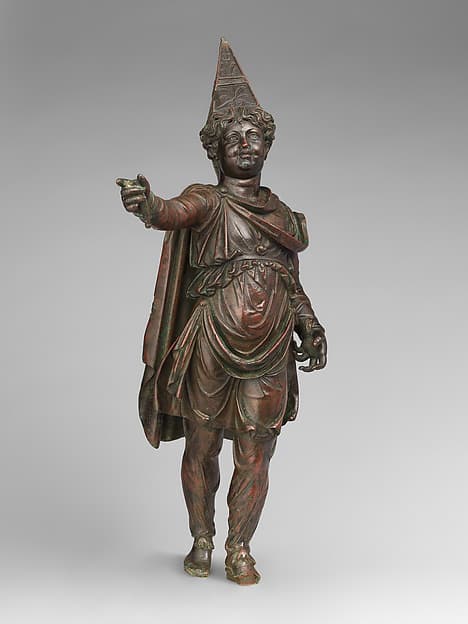
Alexandria has always been a place where civilizations talked to each other, sometimes peacefully and sometimes not. The city's Jewish community, established by the Ptolemies, produced Philo of Alexandria, a philosopher who spent his life trying to reconcile Greek philosophy with Jewish scripture and whose methods were later adopted almost wholesale by early Christian theologians. The first complete Greek translation of the Hebrew Bible, the Septuagint, was produced here around the 3rd century BC, according to tradition by seventy-two Jewish scholars working in separate chambers who all produced identical translations. The story is unlikely. The translation's significance is not.
The early Christian church in Alexandria, traditionally founded by Saint Mark the Evangelist, produced the Catechetical School of Alexandria, which ran from roughly the 2nd century AD and trained theologians who shaped Christian doctrine. Origen, one of its directors, produced the Hexapla, a six-column comparison of different versions of the Old Testament that was the most ambitious work of biblical scholarship produced before the printing press.
When the Arab general Amr ibn al-As took Alexandria in 641 AD, he wrote to the Caliph Omar describing a city of four thousand palaces, four thousand baths, four hundred theaters, and twelve thousand sellers of green vegetables. Whatever the accuracy of those numbers, the letter captures the shock of encountering a city of such density and complexity. The Arab city that replaced the Greek one eventually shifted its center toward Cairo, and Alexandria shrank to a small Mediterranean port before the 19th century restored it to importance.
The French excavations at Kom el-Dikka, begun in the 1960s, uncovered the only surviving above-ground Greco-Roman structures: a small Roman theater, or odeon, and a series of lecture halls, the auditoria, that some archaeologists believe were part of the Mouseion, the research institution associated with the Library. If that identification is correct, and it is contested, you can sit in a room where some of the most consequential scholarship in the ancient world was conducted.
Common Mistakes
Treating the Catacombs as a quick stop. Most tour groups spend forty minutes here. You need ninety minimum to move slowly through the levels, read the iconographic detail, and sit in the triclinium long enough to understand what you are looking at. The synthesis of religious traditions visible in that one chamber is one of the most sophisticated things in Egypt.
Visiting Pompey's Pillar without entering the underground galleries. Many visitors photograph the pillar and leave. The Serapeion crypts beneath the platform are included in the same ticket and are where the intellectual history actually happened. The pillar is a monument to a misidentification. The galleries are real.
Booking a half-day Alexandria day trip from Cairo. These tours exist and they are a waste of your time and money. Six hours, including three hours of travel, gets you a rushed walk past two sites with no room to absorb what you are seeing. If you cannot give Alexandria two days, give it one proper day and stay the night.
The sound and light show at any site. Skip it. The EGP 250 to 400 ticket buys you dramatized history you could get from reading this article, played over speakers of mediocre quality to an audience largely indifferent to the narration.
Expecting a Greek city. The mistake most visitors make approaching any Greco-Roman Egypt Alexandria history guide is assuming they will see something that looks like Athens. Alexandria was always a hybrid city, Ptolemaic, then Roman, then Jewish and Christian, then Arab. The distinctiveness of what survives is precisely its mixture. Visitors who come looking for one civilization leave confused. Visitors who come looking for the conversation between civilizations leave understanding why this city mattered.
Skipping the Corniche walk entirely. The eastern harbor, now pleasant and unremarkable, sits directly over the submerged Royal Quarter. Qaitbay Citadel on the western promontory stands on the foundations of, and was literally built using stones from, the Lighthouse of Alexandria, one of the Seven Wonders of the Ancient World. No sign tells you this with sufficient force. The fortress you are looking at is made from a wonder that fell in an earthquake in 1303 AD.
Going to the Cairo Egyptian Museum for Alexandrian context. The best surviving Ptolemaic material, including objects from the royal tombs and the harbor excavations, is in Alexandria, not Cairo. Do the Alexandria National Museum before the Greco-Roman Museum (when it reopens) to build a genuine visual framework.
Practical Tips
Alexandria's street plan partially preserves the ancient grid, which is useful to know before you navigate. The modern street al-Nabi Danial roughly follows the ancient Canopic Way, the main east-west axis of the Greek city. Walking this street from Misr Station toward the sea gives you the original orientation of the Ptolemaic capital.
For guides, the Egyptian Tourist Authority has licensed guides at the major sites. A private licensed guide for a full day costs approximately EGP 1,200 to 2,000 and is worth it specifically for the Catacombs, where the iconographic detail requires explanation to mean anything.
Alexandria's seafood is genuinely good. The fish market near the eastern harbor, called the Fish Market on most maps, lets you select fresh fish to be cooked to order. A full meal with mezze costs EGP 300 to 500 per person and has nothing to do with the ancient world but everything to do with why people have lived in this city for 2,300 years.
For accommodation, the Cecil Hotel on the Corniche is historically significant (Somerset Maugham, Noel Coward, and the World War Two Allied Command all passed through) and has been renovated to mid-range comfort at approximately EGP 2,500 to 4,000 per night. Budget options cluster near Misr Station at EGP 500 to 900.
Bring water, wear comfortable shoes, and carry a small torch for the Catacombs even if the electric lighting is working. It is not always working.
Frequently Asked Questions
The Weekly Dispatch
More on Egypt, every Friday.
Cultural depth and places most guides never mention.
No spam. Unsubscribe anytime.