Islamic Golden Age Cairo: A History Guide to Medieval Egypt
Cairo's medieval quarter contains 600 Islamic monuments in a single square kilometer. Most tourists walk through it in two hours. That is the wrong way to do this.

Quick Facts
- Best time to visit
- October to April. Temperatures between 15 and 25°C make walking the lanes comfortable. Ramadan is atmospherically extraordinary after sunset but several sites adjust their hours unpredictably.
- Entrance fee
- Al-Azhar free. Ibn Tulun EGP 100 (approx $2 USD). Qalawun Complex EGP 100. Sultan Hassan Mosque EGP 100. Citadel full ticket EGP 450 (approx $9 USD). Student discounts 50% with valid ID.
- Opening hours
- Most mosques daily 9am to 5pm. Al-Azhar closed to non-Muslim visitors Friday 11am to 2pm. Citadel open daily 8am to 5pm (winter), 8am to 6pm (summer).
- How to get there
- Metro Line 1 to Sadat Station, then microbus toward Bab al-Futuh (EGP 5). Uber or Careem from downtown EGP 60 to 90. Taxi EGP 80 to 120. No reliable parking near Al-Muizz Street.
- Time needed
- Al-Muizz Street plus Al-Azhar: full day. Adding Ibn Tulun and Gayer-Anderson: second morning. Citadel: separate half-day. Minimum two days for serious coverage.
- Cost range
- Budget EGP 300 to 600 per day (entry fees plus street food). Mid-range EGP 1,200 to 2,000 including private guide and restaurant lunch.
Quick Facts
Best time to visit: October to April, when the temperature in the narrow lanes of Islamic Cairo drops below 25°C and the light through the mashrabiyya screens is angled enough to photograph properly.
Entrance fees: The Al-Azhar Mosque is free. The Qalawun Complex costs EGP 100 (approx $2 USD). The Ibn Tulun Mosque is EGP 100. The Citadel complex is EGP 450 (approx $9 USD) for the full ticket including the National Military Museum. Students with valid ID pay half price at all Ministry of Tourism and Antiquities sites.
Opening hours: Most mosques open daily from 9am to 5pm, though Al-Azhar closes during Friday prayer for non-Muslim visitors between approximately 11am and 2pm. The Citadel opens at 8am.
Getting there: Take the Cairo Metro Line 1 to Sadat Station, then a microbus east toward Bab al-Futuh (EGP 5, roughly $0.10). Taxis from downtown cost EGP 80 to 120 depending on traffic. Ride-hailing apps like Uber and Careem are more reliable and typically price the same journey at EGP 60 to 90.
Time needed: A serious walk through Al-Muizz Street, Ibn Tulun, and the Qalawun Complex requires a full day. Adding the Citadel means two days minimum.
Cost range: Budget EGP 300 to 600 per day covering entry fees and street food. Mid-range EGP 1,200 to 2,000 including a guide and sit-down lunch at Naguib Mahfouz Café.
---
Why This Place Matters
At its peak in the 12th and 13th centuries, Cairo was the largest city in the world outside of China. This is not rhetorical. The population of Fatimid and Ayyubid Cairo exceeded that of Paris, London, and Constantinople combined. The scholars, merchants, mathematicians, and physicians who moved through its streets during the Islamic Golden Age were doing something that has no clean modern parallel: building a civilization that ran, simultaneously, on trade, theology, medicine, and astronomical observation.
What survives is not a ruin. It is a functioning neighborhood. People pray in the mosques, sell fabric in the khanqahs, and sleep above the wikala courtyards that once hosted merchants traveling from Timbuktu to Samarkand. The continuity is the point. When you walk through the Bab al-Futuh gate, built in 1087 by three Armenian brothers who were the chief architects of the Fatimid Caliph Al-Mustansir, you are walking through a structure that has been in continuous use for nearly a thousand years.
For a proper Islamic Golden Age Cairo history guide, the mistake is treating this as a district of monuments. It is better understood as a palimpsest: every layer visible, none of them erased.
---
The Fatimid Foundation: What Was Built and Why
The Fatimid dynasty founded Cairo in 969 CE, not as a commercial city but as a royal enclosure. The name Al-Qahira, from which Cairo derives, translates roughly as "The Victorious" and was chosen because the planet Mars, known in Arabic as Al-Qahir, was in ascendance at the moment the city's foundations were laid. An astrologer named Ibn Yunus made the calculation. He later wrote the Hakimi Tables, one of the most precise astronomical almanacs of the medieval world, accurate enough that European navigators were still using corrected versions of it in the 16th century.
Al-Azhar Mosque, completed in 972 CE, was built three years after the city itself. It is now the oldest continuously operating university on earth. When it was founded, its curriculum covered not just Quranic studies but mathematics, astronomy, and rhetoric. The library attached to it during the Fatimid period held 1.6 million manuscripts, a number that exceeds most national libraries of the time by an order of magnitude. The Crusaders burned a significant portion of it in the 12th century. What survived became the foundation of the institution that still operates today, where 90,000 students from 100 countries are currently enrolled.
Walk east from Al-Azhar into the Khan el-Khalili bazaar and you are inside what was once the burial complex of Fatimid Caliphs. The Mamluk Sultan Barquq demolished the tombs in the 14th century to build a wikala, a commercial caravanserai. The dead Caliphs were quietly relocated. Nobody knows exactly where.
---
The Mamluk Centuries: Architecture as Political Argument
The Mamluks, who ruled Egypt from 1250 to 1517, were not Egyptians. They were enslaved soldiers, mostly Circassian and Kipchak Turk, purchased as boys by Ayyubid sultans and trained as an elite military caste. When the last Ayyubid sultan died, they simply kept the country. What followed was one of the most productive periods of architectural patronage in Islamic history, driven by a specific political logic: a sultan who could not claim dynastic legitimacy had to claim it through stone.
The Qalawun Complex on Al-Muizz Street, built between 1284 and 1285 in a single year, is the clearest example of this logic made physical. Sultan Qalawun built a hospital, a madrasa, and a mausoleum simultaneously, all facing the street. The hospital, known as the Bimaristan, was free to all patients regardless of religion or income, funded by a waqf (religious endowment) that Qalawun attached to surrounding properties. It operated continuously for 700 years, treating patients until the 19th century. The building is currently undergoing restoration but the facade, with its Gothic-influenced pointed arches borrowed directly from Crusader churches Qalawun had conquered in Syria, is visible from the street.
That Gothic detail is not accidental and not imitation. Mamluk architects stripped architectural elements from their military victories and incorporated them into religious buildings as trophies. The pointed arches of Jerusalem's Crusader churches appear in Cairo mosques built by the men who defeated them. Knowing this changes what you see when you stand in front of the Qalawun Complex.
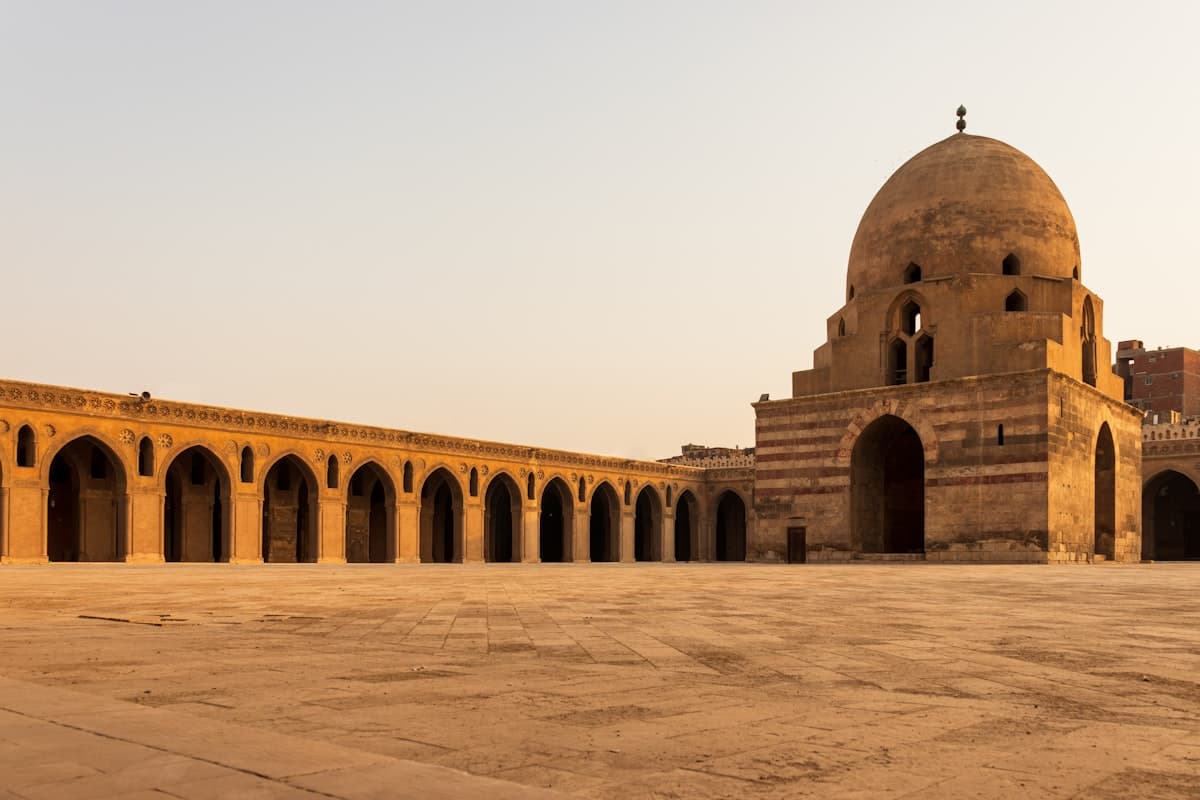
Further south, the Ibn Tulun Mosque predates all of this by four centuries. Built in 876 CE by Ahmad ibn Tulun, an Abbasid governor who made himself effectively independent, it is the oldest mosque in Cairo to survive in its original form. The spiral minaret, modeled on the Great Mosque of Samarra in Iraq, is the only one of its kind in Egypt. Ibn Tulun reportedly said he built it in a moment of boredom, wrapping a scrap of paper around his finger and telling his architect: make the minaret look like this. The story is probably apocryphal. The minaret is real.
---
The Connections: Layers Nobody Points Out
The street called Al-Muizz li-Din Allah runs for roughly one kilometer through the heart of Islamic Cairo. It follows, almost exactly, the route of the ancient Via Regia, the royal road of Roman and Byzantine Alexandria's subsidiary capital in this region. Beneath the Mamluk paving stones are Byzantine cisterns. Beneath those are Pharaonic-era canals feeding off the Nile's eastern branches. The geography dictated the path; every civilization that came after simply built on top of the same logic.
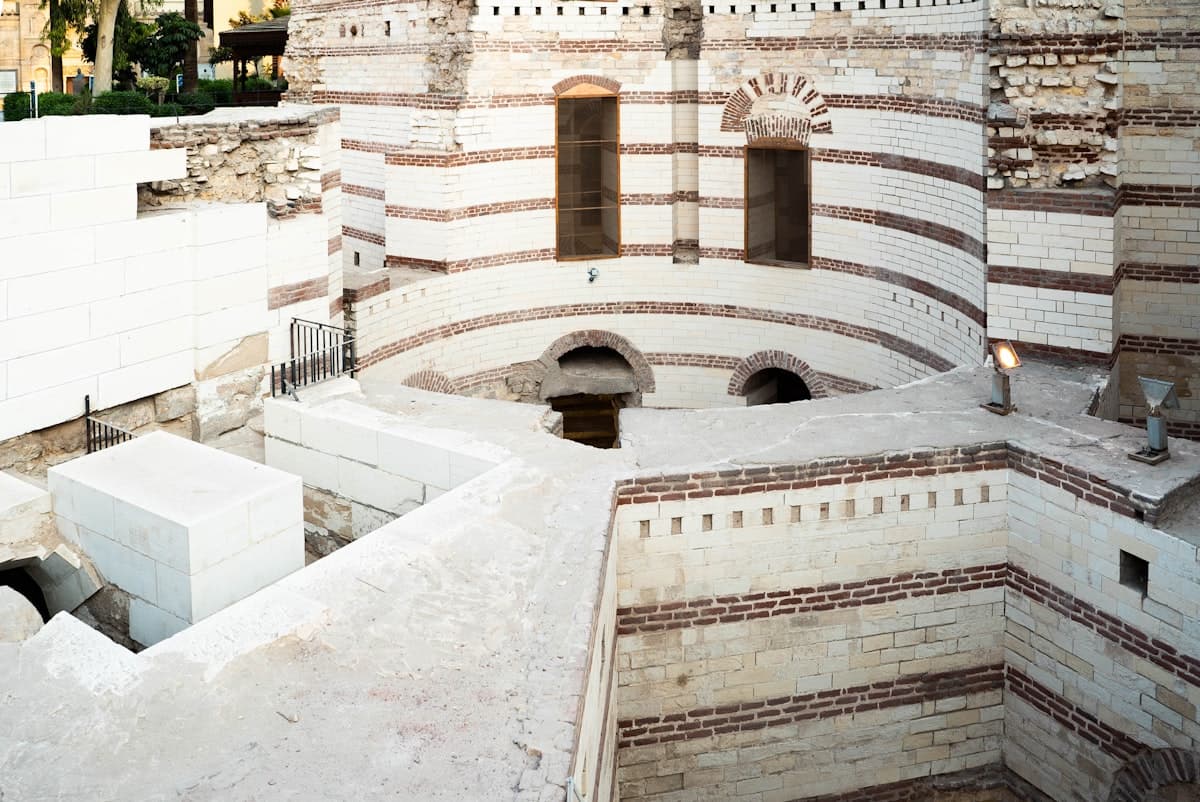
The Coptic quarter, just two kilometers south of Al-Azhar, makes this layering literal. The Hanging Church, the oldest Coptic church in Cairo, is built over a Roman gatehouse that itself sits over the edge of a Pharaonic fortification. Islam did not replace these layers. It joined them. Al-Azhar's scholars in the 11th century regularly debated with Coptic physicians. The Fatimid Caliph Al-Aziz bi-Allah had a Coptic wife and two Coptic brothers-in-law who were patriarchs of the Coptic Church. His vizier was Jewish. The Golden Age worked partly because it was not mono-cultural.
This is the connection the standard Islamic Golden Age Cairo history guide usually skips: the Golden Age was not exclusively Islamic. It was a civilization that happened to be led by Islamic dynasties and enriched by everyone living inside it.
---
Common Mistakes
Booking a group tour of Islamic Cairo. Most group tours spend 45 minutes at Al-Azhar, 20 minutes at Khan el-Khalili, and call it done. This is architecturally equivalent to visiting Rome and only seeing the gift shop at the Vatican. Go independently or hire a private guide specializing in Fatimid and Mamluk history. The Egyptian Center for Documentation of Cultural and Natural Heritage can connect you with licensed specialists.
Visiting Khan el-Khalili as a cultural experience. Khan el-Khalili is a bazaar. It has been a bazaar since the 14th century. It sells things. Some of those things are beautiful. Most are not. The actual souq culture worth experiencing is in the parallel streets: Sharia al-Khayamiyya (the tentmakers' street south of Bab Zuwayla) where artisans still do appliqué work by hand, and Sharia al-Nahhasin, the coppersmiths' street, where the sound is part of the experience. Skip the tourist-facing portion of Khan el-Khalili unless you want a papyrus print and a persistent salesman.
Doing the Citadel on the same day as Al-Muizz Street. Both deserve full attention. Combining them means you will give shallow attention to both. The Citadel's Mohammed Ali Mosque, an Ottoman structure built between 1830 and 1848 in the Turkish Baroque style, is a different historical register entirely from the Mamluk and Fatimid buildings below it. Mixing them confuses the chronology.
Skipping Ibn Tulun because it is "out of the way." It is a 15-minute walk from Al-Muizz Street. The mosque contains one of the most peaceful interior courtyards in Cairo, a space of roughly 2.5 acres almost always uncrowded. The Gayer-Anderson Museum, housed in two 17th-century Ottoman houses directly adjacent to the mosque, is among the best-preserved domestic interiors in the city and costs EGP 100 to enter. These two sites together justify a separate morning.
Wearing shorts. This is not a dress code tip. Islamic Cairo is a living religious neighborhood, not an open-air museum. Women should bring a scarf. Men in shorts will be offered a robe at mosque entrances. This is not a problem, but it slows you down. Dress appropriately and the interaction with the neighborhood changes substantially.
Believing the sound and light show at the Citadel adds context. It costs EGP 350, runs 45 minutes, and tells a version of Cairo's history so compressed and dramatized that it actively flattens what you have spent the day understanding. Skip it. Read the exhibition notes inside the Al-Gawhara Palace instead. They are better written and free with your Citadel ticket.
Arriving at Al-Azhar between 11am and 2pm on a Friday. The mosque closes to non-Muslim visitors during Friday prayer. This is obvious in retrospect and almost never mentioned in advance. Plan your Al-Azhar visit for Thursday morning or any weekday before 10:30am.
---
Practical Tips
The best light on Al-Muizz Street occurs between 8am and 10am, when the sun cuts through the mashrabiyya lattice windows at an angle that makes the dust in the air visible. By noon, it is flat and hot. By 3pm in summer, the lane is difficult.
Water is available everywhere for EGP 5 to 10 per bottle from corner shops. Do not pay café prices for water you will drink while walking.
Several sections of Al-Muizz Street are closed to vehicles during certain hours, but enforcement is inconsistent. The crowds thin considerably if you start before 9am.
If you read Arabic, the inscriptions on the Qalawun Complex and the Sultan Hassan Mosque are worth deciphering or photographing to look up later. They contain specific legal language about the waqf endowments: who is entitled to income from which property, in what order of inheritance. These inscriptions are essentially legal documents carved in marble, and they tell you more about how medieval Cairo actually functioned than most interpretive signs.
For food, the best option near Al-Muizz Street is the small fuul and falafel shops on Sharia al-Azhar that open at 7am. Lunch at one of the sit-down restaurants inside the Khan el-Khalili complex costs EGP 400 to 800 per person. The food is mediocre. The location is convenient. Make that choice consciously.
Frequently Asked Questions
The Weekly Dispatch
More on Egypt, every Friday.
Cultural depth and places most guides never mention.
No spam. Unsubscribe anytime.