Pharaonic Egypt History Guide for Travelers: The Full Picture
Pharaonic civilization lasted 3,000 years. The Romans were closer in time to us than to the builders of the Step Pyramid. Here is what that actually means on the ground.

Quick Facts
- Best time to visit
- October to February. Temperatures are manageable (18-28°C), and the light is low enough in early morning to make the temples photogenic. March to May is shoulder season with rising heat. June to August is genuinely punishing at interior sites like the Valley of the Kings.
- Entrance fee
- Giza Plateau EGP 540 (approx $11 USD); Great Pyramid interior EGP 900 extra; Karnak EGP 450; Valley of the Kings EGP 360 (3 tombs); Tutankhamun's tomb EGP 300 extra; Seti I tomb EGP 1,800 extra; Egyptian Museum Cairo EGP 400; Royal Mummies Hall EGP 600 extra
- Opening hours
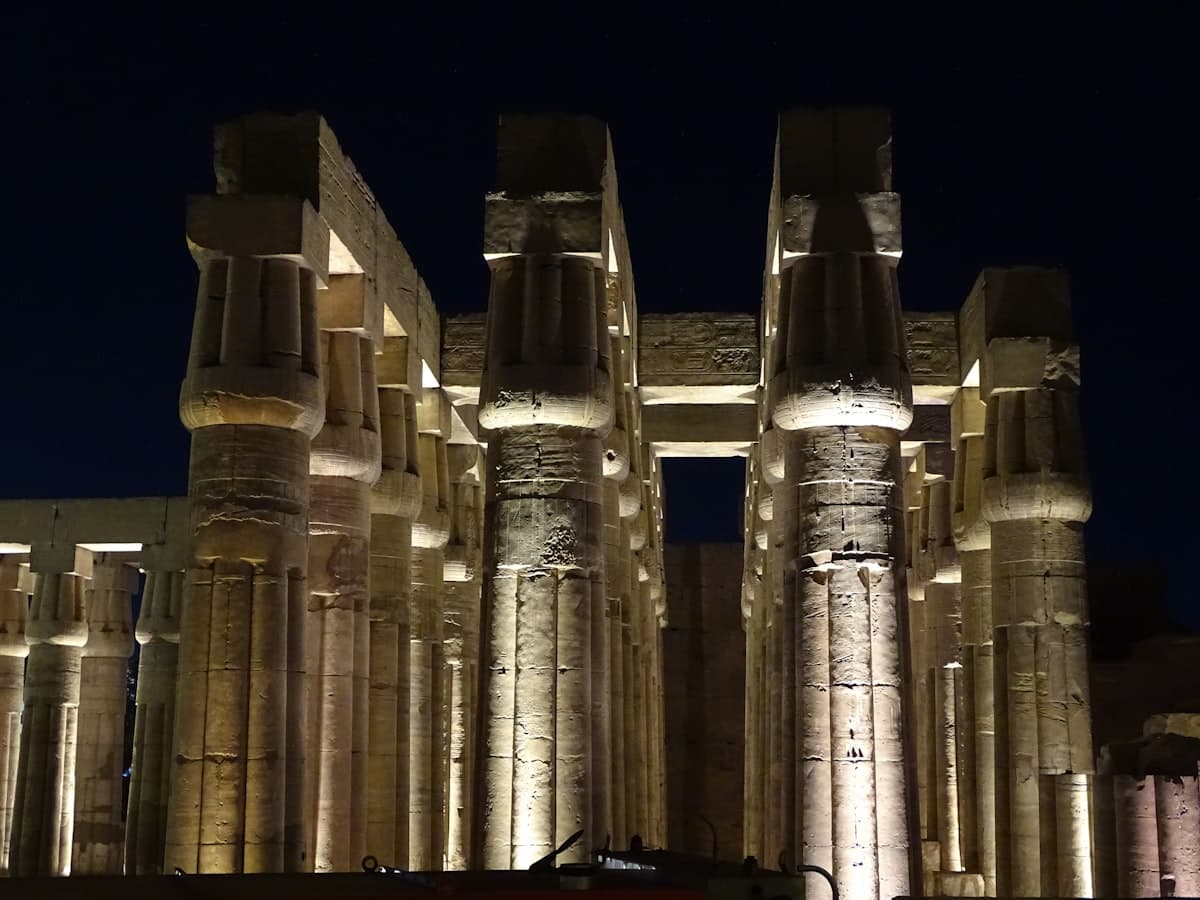
- Most sites daily 6am to 5pm (winter), 6am to 4pm (summer). Egyptian Museum Cairo 9am to 5pm daily. Luxor Temple open until 9pm and lit at night.
- How to get there
- Cairo to Luxor: overnight sleeper train EGP 700-1,100 (book via Egyptian National Railways website or at Ramses Station). Flights on EgyptAir EGP 1,500-3,500. Luxor to Aswan: train EGP 150-300. Local ferry at Luxor west bank EGP 5. Taxi from Luxor train station to Karnak EGP 40-60.
- Time needed
- Giza half to full day. Karnak 3-4 hours minimum. Valley of the Kings 3-4 hours. Full Luxor east and west bank: 2 full days. Aswan with Philae: 1-2 days. Abu Simbel: add 1 day from Aswan. Full Pharaonic circuit: 10 days.
- Cost range
- Budget EGP 800-1,200 per day (hostel, local transport, site tickets). Mid-range EGP 2,500-4,500 per day (3-star hotel, private driver for west bank, licensed guide). High-end EGP 6,000 and up with Nile cruise accommodation.
Quick Facts
Best time to visit: October to February, when temperatures at Luxor and Aswan drop to a manageable 20-25°C. Avoid July and August: the Valley of the Kings sits in a limestone bowl that retains heat, and internal tomb temperatures can reach 38°C before noon.
Key entrance fees: Giza Plateau: EGP 540 (approx $11 USD); Great Pyramid interior: EGP 900 extra (approx $18 USD) Karnak Temple Complex: EGP 450 (approx $9 USD) Valley of the Kings: EGP 360 (approx $7 USD) covers three tombs; Tutankhamun's tomb is an additional EGP 300 Egyptian Museum, Cairo: EGP 400 (approx $8 USD); Royal Mummies Hall: EGP 600 extra Luxor Temple: EGP 260 (approx $5 USD)
Opening hours: Most Pharaonic sites open daily 6am to 5pm in winter (October to April) and 6am to 4pm in summer. The Egyptian Museum in Cairo opens at 9am and closes at 5pm; arrive before 10am or after 2pm to avoid tour group peaks.
Getting there: Cairo to Luxor by overnight train costs EGP 700-1,100 for a sleeper berth (approx $14-22 USD), departing Ramses Station nightly around 9pm. The sleeper is safe, reasonably clean, and puts you in Luxor at dawn, which is exactly when you want to be there. Flights on EgyptAir run EGP 1,500-3,500 one-way. Aswan is three hours south of Luxor by train, EGP 150-300.
Time needed: Giza alone needs half a day minimum, a full day if you enter the pyramid. Luxor's east bank (Karnak plus Luxor Temple) needs four to five hours. The west bank (Valley of the Kings, Hatshepsut's temple, the Colossi of Memnon) needs another four. Aswan and Philae add two days. This is a ten-day subject, not a weekend.
---
Why Pharaonic Civilization Still Demands Your Full Attention
The most disorienting fact about Pharaonic Egypt, the one that reshapes everything once you absorb it, is this: Cleopatra VII lived closer in time to the Moon landing than to the construction of the Great Pyramid. When she walked through Giza in the first century BC, those pyramids were already 2,500 years old. She was, in a sense, a tourist.
This is what makes Egypt different from every other ancient civilization a traveler encounters. You are not dealing with a single period or a single culture. You are dealing with thirty dynasties, roughly 3,000 years of continuous state-level civilization, with its own internal revolutions, dark ages, reformations, and renaissances. The New Kingdom pharaohs who built the Valley of the Kings regarded the Old Kingdom pyramid builders the way we regard medieval architects: earlier, rougher, not quite understood.
The pharaonic Egypt history guide for travelers that actually serves you is not one that strings sites together chronologically. It is one that tells you which sites carry the weight of that full span, and which are overrated shorthand for something more complex underneath.
Coptic Egypt did not erase Pharaonic Egypt. Islamic Egypt did not erase Coptic Egypt. At Luxor Temple, you can stand in a single courtyard and see a Pharaonic sanctuary, a Roman imperial cult chapel built within it, a Coptic church painted over the Roman walls, and a thirteenth-century mosque built on top of the church, its floor three meters above the original Pharaonic ground level. That is not four civilizations in sequence. That is four civilizations occupying the same cubic meter of air, simultaneously, right now.
---
The Sites That Actually Tell the Story
Giza: What You Think You Know Is Incomplete
The Great Pyramid of Khufu was the tallest structure on earth for 3,800 years, until Lincoln Cathedral in England was completed in 1311 AD. That record is staggering not because of the height but because of what it implies: nothing humans built for nearly four millennia surpassed what was done here in the Old Kingdom, around 2560 BC, by a workforce that Egyptologists now estimate at roughly 20,000 people, not the 100,000 slaves reported by Herodotus, who was writing two millennia after the fact and had never visited a building site.
The workers were Egyptian. They were paid, housed, and given medical care, which we know because their settlement has been excavated south of the plateau by Zahi Hawass and Mark Lehner. The workers who died on the job were buried nearby, with grave goods. This is not slave labor archaeology. It looks more like a national project, possibly tied to flood-season employment when farming was impossible.
What most visitors walk past: the mastaba fields east and west of the Great Pyramid, low rectangular tombs belonging to court officials and family members of the Fourth Dynasty. These are often empty of tourists. They contain some of the finest Old Kingdom relief carving in existence, including detailed scenes of daily life, butchery, bread-making, and fishing, in tombs that predate the New Kingdom by a thousand years. Entrance is sometimes included in the plateau ticket; sometimes a small additional fee applies. Ask at the gate.
Skip the camel rides at the road in front of the pyramids. The price is not fixed, the animal welfare is poor, and you will spend more energy arguing over the dismount fee than you will gain in perspective. The viewing plateau at the southwest corner, accessible by foot in twenty minutes, gives you the classic three-pyramid alignment with no vendor pressure.
Luxor: The Site That Rewards Patience
Luxor was ancient Thebes, capital of Egypt during the New Kingdom (1550 to 1070 BC), the period that produced Tutankhamun, Ramesses II, Hatshepsut, and Akhenaten. The city had, at its peak, a population of around one million people, making it one of the largest urban centers on earth at the time.
Karnak Temple is not one temple. It is a 2,000-year construction project, added to by successive pharaohs the way European cathedrals accumulated chapels and chapels accumulated donor plaques. The Hypostyle Hall alone contains 134 columns, the tallest of which reach 23 meters. The original paint survives in patches near the ceiling, blue and red and ochre, in places where the column tops were never exposed to sunlight. If you arrive at 6am when the gates open, before the tour groups, and walk into the Hypostyle Hall in the low-angle morning light, the columns cast shadows across each other in a geometry that feels deliberate, as if the architects understood exactly what that light would do at that angle, which they almost certainly did.
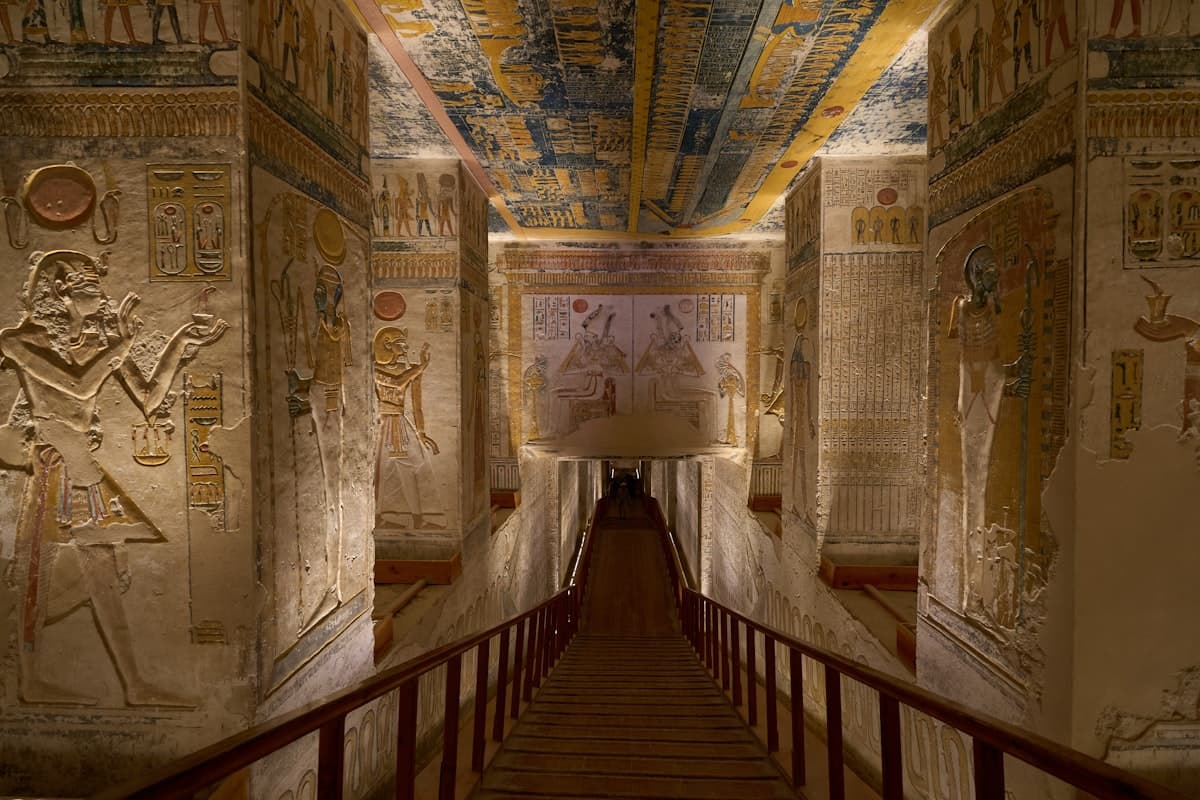
The Valley of the Kings on the west bank holds 63 known tombs, with recent radar surveys suggesting more remain unexcavated. The average tourist sees two. Your ticket covers three, and you can purchase add-ons for significant tombs like Seti I (EGP 1,800, the most expensive single tomb in Egypt and worth every pound) or Tutankhamun (EGP 300). The tomb of Ramesses III, KV11, is consistently undervisited and contains one of the longest decorated corridors on the west bank, roughly 125 meters, with intact scenes of the pharaoh's wars against the Sea Peoples, a mysterious confederation that attacked Egypt and the eastern Mediterranean around 1175 BC and contributed to the Bronze Age Collapse.
Abydos and Dendera: The Sites Most Travelers Skip and Shouldn't
If your pharaonic Egypt history guide for travelers has one honest contrarian recommendation, it is this: the temples at Abydos and Dendera, both accessible on a day trip from Luxor (roughly 2.5 hours by car, EGP 800-1,200 for a private driver round trip), are better preserved, less crowded, and in many ways more emotionally direct than Karnak.
The Temple of Seti I at Abydos contains the Abydos King List, a carved sequence of 76 royal cartouches spanning from the first dynasty to Seti I himself, essentially a dynastic family tree etched in stone around 1280 BC. Egyptologists used this list to reconstruct the sequence of pharaohs before Champollion had finished deciphering hieroglyphs. Note who is missing from the list: Hatshepsut, Akhenaten, and Tutankhamun were all omitted, deliberately erased from official history for political reasons that varied by case.
At Dendera, the Temple of Hathor contains the Dendera Zodiac, a circular astronomical ceiling carving. The original is now in the Louvre (taken by Napoleon's expedition in 1820 and replaced with a plaster cast). What remains in situ is still extraordinary: a complete late-period temple complex so well preserved that the color on interior ceilings has survived in sections, and the underground crypts, accessible on some visits, contain some of the finest carved reliefs in Egypt, never exposed to outdoor weathering.
---
The Connections You Won't Hear on a Group Tour
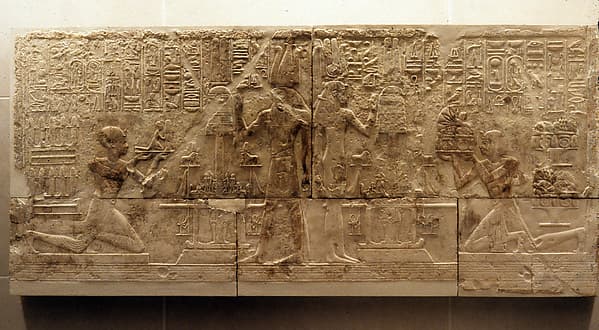
Pharaonic Egypt did not end cleanly. It blurred, incorporated, and survived in fragments through every subsequent civilization. The Romans did not merely conquer Egypt. They adopted its theology. Emperors from Augustus to Diocletian had themselves depicted in Egyptian temples in the full regalia of a pharaoh, cartouche and all, making offerings to Isis and Horus. The temple of Augustus at Philae was carved in Hieroglyphic script by Roman-era priests who had maintained the tradition long after it ceased to function as a civic language.
The Copts, Egypt's Christian community, used Coptic script derived directly from the Greek alphabet with additional letters borrowed from Demotic, the late stage of the Egyptian writing system. When Egyptologists in the nineteenth century needed to understand how ancient Egyptian vowels sounded, the answer came partly from Coptic liturgical texts still sung in Coptic Orthodox churches every Friday morning across Egypt. The language of the pyramid builders survived, in fragmented form, in the liturgy of a Christian minority, into the present day.
Under Cairo's medieval Islamic city, Roman infrastructure runs below Pharaonic earthworks. The Fatimid city of Al-Qahira was laid out in 969 AD over a Roman fortress, Babylon, which was itself built over a Pharaonic canal connecting the Nile to the Red Sea, a canal later recut by Trajan and referenced by Arab geographers as late as the eighth century AD. Nothing here sits on neutral ground.
---
Common Mistakes Made by First-Time Visitors
Booking the wrong Cairo day: The Egyptian Museum is closed Fridays before noon for Friday prayers. Many visitors arriving Thursday evening plan a Friday morning museum visit and lose half the day standing outside.
Entering the Great Pyramid without preparation: The ascending passage inside is 1.2 meters high and climbs at a 26-degree angle for 47 meters. It is hot, close, and not recommended for anyone with claustrophobia or knee problems. The Grand Gallery that follows is tall and dramatic. Know what you are buying before you pay EGP 900 for the interior ticket.
Doing Luxor in one day from Cairo: Every budget tour offers this. It results in Karnak plus the Valley of the Kings, rushed, in August heat, with no time for the west bank temples, no early morning light, and no memory except exhaustion. Two full days in Luxor is the minimum for an experience that makes sense.
Paying for the Sound and Light Show at Karnak: It costs EGP 450, runs about 75 minutes, narrates history you already know if you have read anything at all before arriving, and uses colored lighting that actively makes the temple harder to see. Skip it. Spend that evening at Luxor Temple instead, which is lit at night in warm gold and free of the theatrical narration.
Ignoring the Islamic Cairo connection to Pharaonic sites: Several major Islamic monuments in Cairo, including parts of the Citadel's foundations and some mosque columns, incorporate ancient Egyptian stone. The Mosque of Amr ibn al-As in Fustat contains columns that may originate from Heliopolis, the Pharaonic city of the sun, which once held an obelisk now standing in Central Park, New York. The connections are not incidental. They are architectural.
Assuming Tutankhamun's tomb is the best in the Valley of the Kings: It is the most famous because Howard Carter found it largely intact in 1922. As a tomb, it is one of the smallest in the valley, and the mummy, which remains in situ, is displayed in a way that can feel more forensic than illuminating. The tombs of Ramesses VI (KV9) and Merenptah (KV8) are larger, better decorated, and nearly always walkable without queuing.
Hiring a guide at the gate: The unlicensed guides who approach at site entrances vary enormously in quality. A good licensed Egyptologist guide, booked in advance through a reputable agency, costs EGP 1,500-3,000 for a full day and is worth every pound. An impromptu gate guide is a gamble that usually results in a 45-minute site visit and a carpet shop.
---
Practical Tips
The overnight train from Cairo to Luxor (Train 81 or 85, operated by Abela Egypt) should be booked at least a week in advance in high season. Carry Egyptian pounds in cash for all site tickets; card machines exist at some sites but fail regularly. The Nile corniche in Luxor is walkable between Luxor Temple and the ferry dock; a local ferry to the west bank costs EGP 5 per person, while tourist boats charge EGP 100 or more. Take the local ferry.
Water is essential. Carry at least 1.5 liters per person for any site visit between March and October. Temples offer no shade except inside the inner sanctuaries, which are often cordoned off. Pharmacies in Luxor city are well-stocked; rehydration salts cost EGP 25.
For the Giza plateau in Cairo, go on a weekday if possible. Fridays and Saturdays (the Egyptian weekend) bring local visitors in significant numbers, which changes the atmosphere considerably but also, honestly, makes it feel more like a living place and less like a heritage exhibition.
Frequently Asked Questions
The Weekly Dispatch
More on Egypt, every Friday.
Cultural depth and places most guides never mention.
No spam. Unsubscribe anytime.