Mohamed Ali Pasha: Albania's Son Who Rebuilt Egypt
He arrived in Egypt as a foreign soldier and died as its ruler. Mohamed Ali Pasha was Albanian, spoke no Arabic, and redesigned a civilization anyway.

Quick Facts
- Best time to visit
- October through March for comfortable temperatures. Early morning visits before 9am avoid tour group congestion at the mosque courtyard.
- Entrance fee
- EGP 450 (approx $9 USD) for the full Citadel complex including the Mohamed Ali Mosque. Students EGP 225 with valid ISIC card.
- Opening hours
- Daily 8am to 5pm in winter, 8am to 6pm in summer. Mosque closes briefly for Friday midday prayers.
- How to get there
- Metro to Sadat Station then taxi or ride-share to Salah Salem Road gate, roughly EGP 50 to 80. Uber or Careem from central Cairo costs EGP 60 to 100. Cairo Bus Route 174 from Midan Ataba stops near the entrance.
- Time needed
- 2 to 3 hours for the Citadel alone. Half a day if combining with Sultan Hassan Mosque and al-Rifa'i Mosque below the hill.
- Cost range
- Budget EGP 600 to 800 per person including entry, transport from central Cairo, and a local lunch nearby.
Mohamed Ali Pasha spoke Albanian at home, corresponded in Turkish, and governed in a language he learned after the age of thirty. He was not Egyptian by birth, not Arab by culture, and not Ottoman by loyalty. He arrived in Alexandria in 1801 as a junior officer in an Albanian regiment sent to expel Napoleon, and within four years he had outmaneuvered every Ottoman, Mamluk, and French interest in the country to become its effective ruler. He would hold power for forty-three years. The Egypt you see today, its bureaucracy, its military architecture, its agricultural canals, its cotton economy, its central mosque on the Cairo skyline, is largely his construction.
This is the story most visitors to the Citadel miss entirely. They photograph the mosque, admire the alabaster, and leave. They do not ask who built it, where he came from, or what it cost.
Quick Facts
Best time to visit: October through March, when midday heat is manageable and the Citadel's elevated position does not punish you. Avoid Friday mornings when the mosque fills for prayer.
Entrance fee: The Citadel complex (Salah al-Din al-Ayyubi Citadel) costs EGP 450 for foreigners (approx $9 USD). The Mohamed Ali Mosque is included in this ticket. Students pay EGP 225 with valid ISIC card.
Opening hours: Daily 8am to 5pm in winter, 8am to 6pm in summer. The mosque closes briefly for Friday prayers around midday.
How to get there: From Tahrir Square, take the metro to Sadat Station then a taxi or ride-share to the Citadel gate on Salah Salem Road. The taxi ride costs roughly EGP 50 to 80. Alternatively, Cairo Bus Route 174 from Midan Ataba stops near the entrance. Uber or Careem from central Cairo runs EGP 60 to 100 depending on traffic.
Time needed: 2 to 3 hours for the Citadel complex. Add another hour if you visit the Military Museum inside. Half a day if you plan to walk down to the Sultan Hassan Mosque and al-Rifa'i Mosque immediately below.
Cost range: Entry plus transport from central Cairo, budget EGP 600 to 800 per person. Add lunch at a nearby koshary shop on Salah Salem for EGP 40.
Why This Place Matters
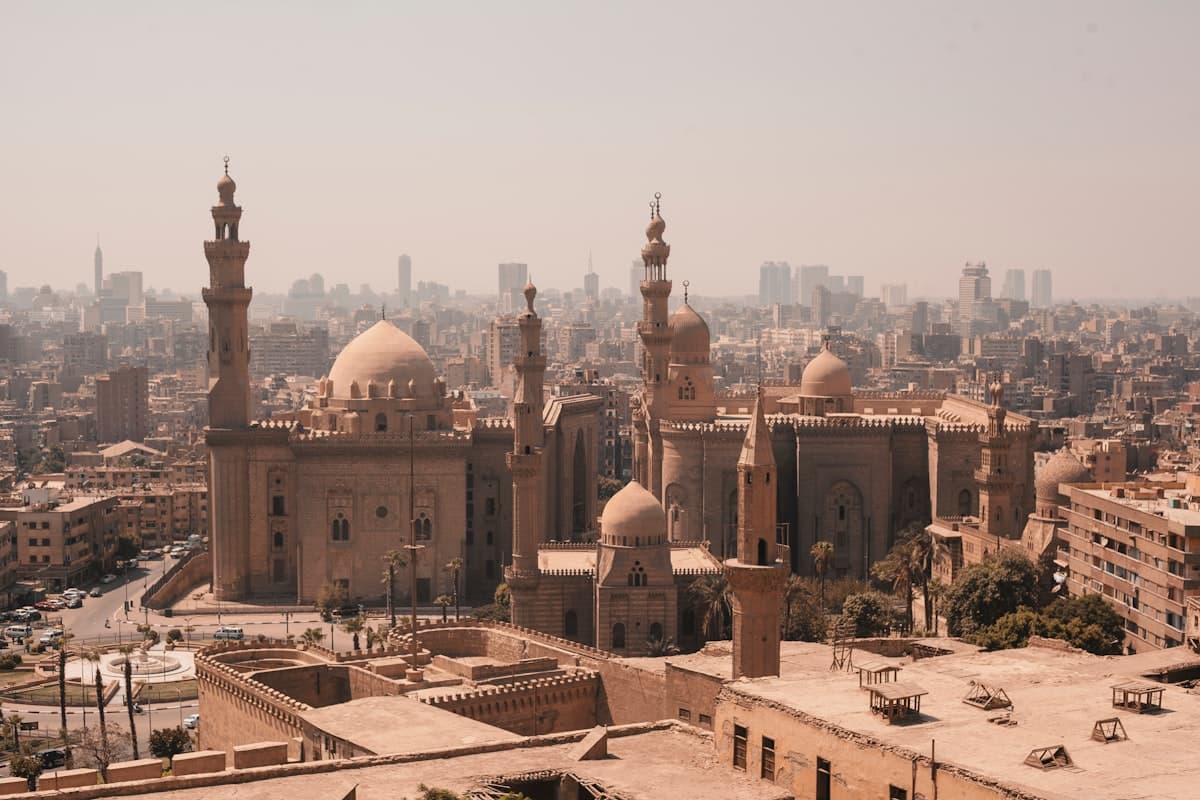
The Citadel of Cairo has been occupied continuously since Salah al-Din began building it in 1176 CE. That is nearly 850 years of military and political power concentrated on a single limestone spur overlooking the city. The Mamluks expanded it. The Ottomans modified it. Mohamed Ali demolished most of what the Mamluks had built and replaced it with something that announced a new kind of Egypt.
His mosque, completed in 1848 and modeled closely on the Blue Mosque in Istanbul, was a deliberate political statement. Mohamed Ali wanted Egypt to look like a regional power, not a provincial backwater. He imported the design vocabulary of the imperial Ottoman capital and planted it on Cairo's highest visible point. The alabaster cladding on the mosque's interior walls was quarried from Hatnub in Middle Egypt, the same quarry that supplied stone to pharaonic builders four thousand years earlier. The site itself sits on ground that was occupied by a Fatimid palace complex before Salah al-Din cleared it. Every layer you stand on in this place belongs to a different civilization.
What most guides do not tell you: Mohamed Ali's Albanian heritage was not incidental to his rule. He brought Albanian and Circassian officers into his new military, distrusting the Ottoman janissary system that had made Egypt ungovernable for decades. His ethnic network was a deliberate governance strategy. And his Albanian origin made him, in some ways, more willing to experiment with European-style reforms because he had no stake in preserving any existing Egyptian power structure. He was nobody's incumbent.
The Albanian Officer Who Outmaneuvered Everyone
Mohamed Ali was born around 1769 in Kavala, a port town in what is now northern Greece but was then part of the Ottoman province of Macedonia. His family was Albanian, part of a community that had settled in the region over centuries. He worked in tobacco trading before joining the military, and he arrived in Egypt at roughly thirty years old with no particular plan beyond the campaign.
What he found was a power vacuum. The French had left. The Mamluks, who had ruled Egypt as a military caste for five centuries, were weakened but not gone. The Ottoman garrison was internally divided. Mohamed Ali played every faction against the others with patience that bordered on cold-blooded. In 1805, the ulema of Cairo, the religious scholars who held significant popular authority, petitioned the Ottoman sultan to appoint Mohamed Ali as wali, governor, of Egypt. It was an unprecedented move: a popular religious institution endorsing a foreign soldier. Mohamed Ali had cultivated them carefully.
The Mamluks remained the one serious obstacle. He solved this on March 1, 1811, by inviting their leaders to a celebration at the Citadel for his son's appointment to lead a military campaign. Between 470 and 500 Mamluk beys attended. On their way out through the Citadel's narrow gate corridor, Mohamed Ali's soldiers opened fire from the walls above. Almost none escaped. The event is known as the Massacre of the Citadel, and the corridor where it happened still exists. You can walk through it. Most tourists do not know what occurred there.
After the massacre, Mohamed Ali moved quickly. He abolished Mamluk land holdings, nationalized agricultural land, forced Egyptian peasants into state-controlled cotton production, and built the first modern Egyptian army using French military advisors. By the 1830s, his son Ibrahim Pasha had led Egyptian forces to military victories against the Ottomans in Syria and Anatolia, coming close enough to Istanbul that European powers intervened diplomatically to stop him. Egypt, under an Albanian-born ruler who spoke no Arabic, briefly threatened to replace the Ottoman Empire entirely.
What You Will Actually See
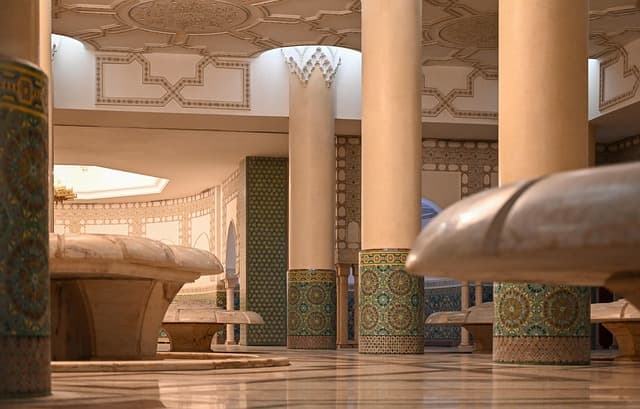
Enter the Citadel from the Bab al-Gadid gate on the northern side if you want to approach the mosque the way it was intended to be seen: across a large courtyard, with the twin minarets rising against the sky and the city spread below you to the northwest.
The mosque's exterior is Turkish Ottoman in every detail. The half-domes cascading from the central dome, the pencil-thin minarets, the symmetrical courtyard with its ablution fountain in the center: Mohamed Ali commissioned the design from a Greek-Turkish architect named Yusuf Bushnak, and the resemblance to Sinan's great mosques in Istanbul is intentional and total. Inside, the alabaster walls glow a pale amber when the light comes through the upper windows in the morning. The mosque was not finished during Mohamed Ali's lifetime. He died in 1849, one year after its completion, in Alexandria, having lost his mental faculties in his final years.
His tomb is inside the mosque, in a small white marble enclosure to the right of the entrance. It is easy to walk past. Visit it. Mohamed Ali requested burial in Egypt, the country he governed for four decades despite never fully mastering its primary language. The tomb is modest relative to the building surrounding it, which tells you something about how seriously the mosque functioned as political theater rather than personal devotion.
The Citadel also contains the Gawhara Palace, built by Mohamed Ali in 1814 as his residential quarters. It is now a museum holding some of his personal effects, period furniture, and portraits. The portrait collection is genuinely interesting: Mohamed Ali had himself painted in both Ottoman and quasi-European style, adjusting his visual presentation depending on which audience the painting was for.
Skip the National Military Museum inside the Citadel complex. It is poorly lit, the exhibits have minimal English labeling, and the content is heavily weighted toward twentieth-century Egyptian military history, which you can learn better elsewhere.
The Connections
Standing on the Citadel terrace, you can see the Ibn Tulun Mosque to the southwest, built in 879 CE by another non-Arab ruler, Ahmad ibn Tulun, who was of Turkic origin and also served as an Ottoman-era governor before establishing autonomous control. The pattern of non-native rulers building Egypt's most ambitious monuments is not coincidence. It is what outsiders with power tend to do: construct legitimacy in stone because they cannot claim it by lineage.
Immediately below the Citadel, the Sultan Hassan Mosque, built between 1356 and 1363, is one of the finest examples of Mamluk architecture in existence. The Mamluks whom Mohamed Ali massacred in 1811 were the descendants of the same caste that built Sultan Hassan. The physical proximity of the two buildings, one celebrating Mamluk power at its peak, the other built on the site where that power was finally liquidated, is not accidental geography. It is the compressed history of a city that never fully cleared its own past.
Mohamed Ali's Albanian heritage connects Egypt to a broader Mediterranean story that most visitors do not consider. The Albanian diaspora spread through the Ottoman military across Egypt, Libya, Syria, and the Balkans. Kavala, his birthplace, still has a restored house identified as his childhood home. The Mohamed Ali Pasha Albanian heritage Egypt connection is celebrated there with a small museum and an annual commemoration. Egypt and Albania maintain it as a point of cultural diplomacy.
His modernization program also borrowed heavily from France. He sent Egyptian students to Paris starting in 1826, including Rifa'a al-Tahtawi, who returned to translate French Enlightenment texts into Arabic and became one of the founding figures of modern Arab intellectual thought. Mohamed Ali's Albania-to-Egypt trajectory set in motion a cultural chain that ran through Paris and came back transformed.
Common Mistakes
Arriving after 10am on weekends. Tour groups from Nile cruise ships and organized Cairo day tours typically arrive between 10am and noon. The courtyard in front of the mosque becomes genuinely difficult to move through. Come before 9am and you will have the courtyard largely to yourself.
Taking a guide from outside the Citadel gate. The men who approach tourists at the entrance offering guided tours are not licensed. They are persistent, sometimes informative, and consistently overpriced. Agree on a price in advance if you want one, and know that EGP 200 to 300 for an hour is reasonable. EGP 800 is not.
Skipping the Massacre Corridor. This is the single most historically significant spot in the Citadel for understanding Mohamed Ali, and it has almost no signage. Ask at the ticket booth which gate leads to the area of Bab al-Azab. The narrow descending passage where the Mamluk leaders were killed is accessible and rarely visited.
Doing the sound and light show. The Citadel sound and light show costs EGP 400 and delivers a narration you will hear in a slightly different form from every guide in the complex. It adds nothing to a visit built around actual reading and walking. Spend those two hours at the Gawhara Palace instead.
Missing the view from the northern terrace. Most visitors photograph from the main mosque courtyard facing west. Walk around to the northern terrace overlooking the city toward Heliopolis. On a clear winter morning, you can see from the Muqattam Hills to the flat northern delta. This is the view that made the Citadel militarily irreplaceable for eight centuries.
Conflating Mohamed Ali Pasha with Mohamed Ali the boxer. This is not a mistake tourists make consciously, but it is worth naming because several search algorithms surface Muhammad Ali Cassius Clay content when you research this site. The Egyptian Mohamed Ali Pasha died in 1849. His legacy is in the buildings, not the ring.
Rushing to finish the Citadel and then heading to Khan el-Khalili. The Sultan Hassan Mosque directly below the Citadel is one of the greatest medieval buildings in Africa, and it is almost always less crowded than what you just came from. The entrance fee is EGP 100 for foreigners. Spend forty minutes there before you do anything else.
Practical Tips
Dress code is enforced at the mosque. Shoulders and knees must be covered. Shoes come off at the entrance. Abayas and scarves are available for loan at the door at no charge, but bringing your own scarf is more comfortable.
The Citadel sits on the Muqattam limestone plateau at roughly 75 meters above the surrounding city. In summer, the elevation does not save you from heat but the breeze helps. Bring water. There is a small cafe near the mosque entrance selling tea and soft drinks at approximately EGP 20 to 30.
Photography inside the mosque requires no special permission and no additional fee. The interior light is best between 9am and 11am when the upper windows catch the eastern sun directly.
If you are interested in following the Mohamed Ali Pasha Albanian heritage Egypt thread more deeply, the Egyptian Museum in Tahrir Square holds portraits and personal items from his era in its upper floor collections. Pairing the Citadel visit with two hours at the Egyptian Museum the next morning gives you the physical and documentary record together.
For the walk down to Sultan Hassan and al-Rifa'i mosques, use the pedestrian descent on the western face of the Citadel hill. It takes about fifteen minutes on foot and passes through a neighborhood where the stone walls are visibly medieval. A taxi back to central Cairo from this point costs EGP 60 to 80.
Frequently Asked Questions
The Weekly Dispatch
More on Egypt, every Friday.
Cultural depth and places most guides never mention.
No spam. Unsubscribe anytime.