Mohamed Ali Pasha: Albania's Unlikely Gift to Egyptian History
An Albanian soldier who couldn't read Arabic built Egypt's most recognizable mosque and made Cairo a 19th-century industrial powerhouse. The Ottomans never forgave him.

Quick Facts
- Best time to visit
- October to March. Cairo heat in summer makes the Citadel's exposed hilltop genuinely difficult between 10am and 3pm. Winter mornings offer clear air and the best chance of seeing the pyramids from the terrace.
- Entrance fee
- EGP 450 (approx $9 USD) for the full Citadel complex. Students EGP 225 with valid ID.
- Opening hours
- Daily 8am to 4pm (winter), 8am to 5pm (summer). Mosque interior closes approximately 11:30am to 1:30pm on Fridays for prayer.
- How to get there
- Taxi from Downtown Cairo: EGP 40 to 70. Careem or Uber: similar. Microbus 72 from Ataba: EGP 5, drops at base of hill. No direct Metro access. Main entrance at Bab al-Gadid gate, accessed via Salah Salem Road.
- Time needed
- 1 hour for the mosque alone. 3 to 4 hours for the full Citadel complex. Combine with Ibn Tulun Mosque nearby for a full half-day covering 900 years of Cairo's architectural history.
- Cost range
- Budget EGP 600 to 900 per day including entry, transport, and street food. Mid-range EGP 1,800 to 2,500 with a licensed guide and lunch in Islamic Cairo.
Quick Facts
Best time to visit: October to March, when Cairo's air is tolerable and the alabaster interior glows without the punishing summer heat.
Entrance fee: The Citadel complex (which includes the Mohamed Ali Mosque) costs EGP 450 for foreigners (approximately $9 USD). Students with valid ID pay EGP 225. Entry covers all Citadel museums.
Opening hours: Daily 8am to 4pm in winter, 8am to 5pm in summer. Friday prayers close the mosque interior from approximately 11:30am to 1:30pm. Plan around this.
How to get there: From Tahrir Square, take the Metro to Sadat Station, then a taxi to the Citadel for roughly EGP 30 to 50. From Downtown Cairo, a Uber or Careem typically runs EGP 40 to 70 depending on traffic. The 72 microbus from Ataba covers it for EGP 5 but drops you at the base of the hill, a ten-minute walk to the main gate. No Metro station serves the Citadel directly.
Time needed: The mosque alone needs an hour. The full Citadel complex, including the Military Museum and the Gawhara Palace where Mohamed Ali received foreign dignitaries, requires three to four hours.
Cost range: Budget EGP 600 to 900 per day (entry, transport, street food). Mid-range EGP 1,800 to 2,500 if you add a guide and lunch in Islamic Cairo.
---
Why This Place Matters
Mohamed Ali Pasha could not read or write Arabic when he arrived in Egypt in 1801 with an Ottoman contingent sent to expel Napoleon's retreating forces. He was roughly 32 years old, born in Kavala, a port city in what is now northern Greece, to an Albanian family that made its living from tobacco and small-scale trade. By 1805 he had outmaneuvered every Ottoman official, Mamluk warlord, and French-influenced Egyptian notable to become Egypt's de facto ruler. He would govern for 43 years. His descendants ruled Egypt until 1952, when Nasser's Free Officers removed his great-great-grandson Farouk in a bloodless coup.
This is the Mohamed Ali Pasha Albanian heritage Egypt remembers, though not always accurately. He is frequently taught in Egyptian schools as a proto-nationalist modernizer, which misreads him almost entirely. He was an Ottoman imperial opportunist who happened to industrialize Egypt because it made his army stronger, not because he loved the country. He built cotton textile factories, sent Egyptian students to Paris, invited European engineers, and drafted Egyptian peasants into a modern conscript military, all in service of a dynastic ambition that eventually terrified Istanbul.
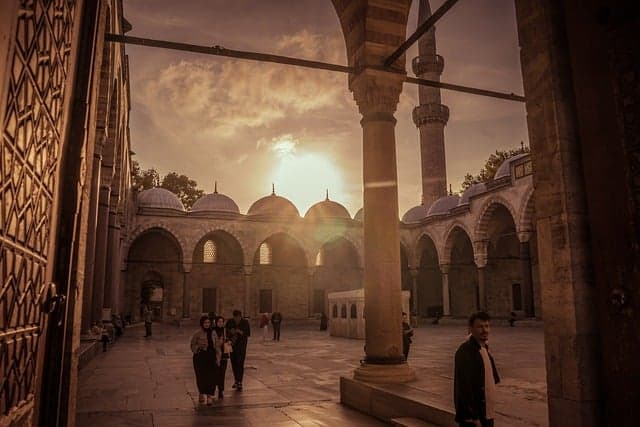
The mosque he built on the Cairo Citadel is the clearest expression of that ambition: not a local statement, but a direct visual challenge to the Ottoman imperial mosques of Istanbul. He hired a Greek architect, Yusuf Boshna, who modeled it on the Sultan Ahmed Mosque. The resemblance is not coincidental and was not subtle.
---
The Alabaster Mosque and the Man Who Commissioned It
The interior of the Mohamed Ali Mosque is sheathed in alabaster quarried from Beni Suef, a town roughly 120 kilometers south of Cairo, which has supplied Egyptian construction projects with translucent stone for at least 4,000 years. The same quarries provided alabaster to Pharaonic tomb builders. The material gives the mosque its local name: the Alabaster Mosque. In afternoon light, the walls emit a pale honey glow that no photograph reproduces accurately. This is worth saying because it surprises people who have only seen pictures.
The mosque was begun in 1830 and not completed until 1848, the year Mohamed Ali died in a state of advanced dementia, no longer capable of recognizing his family. He is buried inside the mosque, in a marble tomb to the right of the entrance. The French clock tower in the courtyard was a gift from King Louis-Philippe in 1846, given in exchange for an Egyptian obelisk now standing in the Place de la Concorde in Paris. The clock has never worked reliably. Egyptians find this poetically appropriate.
Mohamed Ali's Albanian identity did not fade as he accumulated power. He continued to speak Albanian and Turkish in private, learned Arabic functionally but never fluently, and staffed his household and early military command with Albanian soldiers he trusted over everyone else. The community he brought with him seeded a small Albanian Egyptian presence that persists quietly in Cairo to this day, concentrated in families that still carry Albanian surnames adapted into Arabic spelling.
---
The Citadel Beneath the Mosque
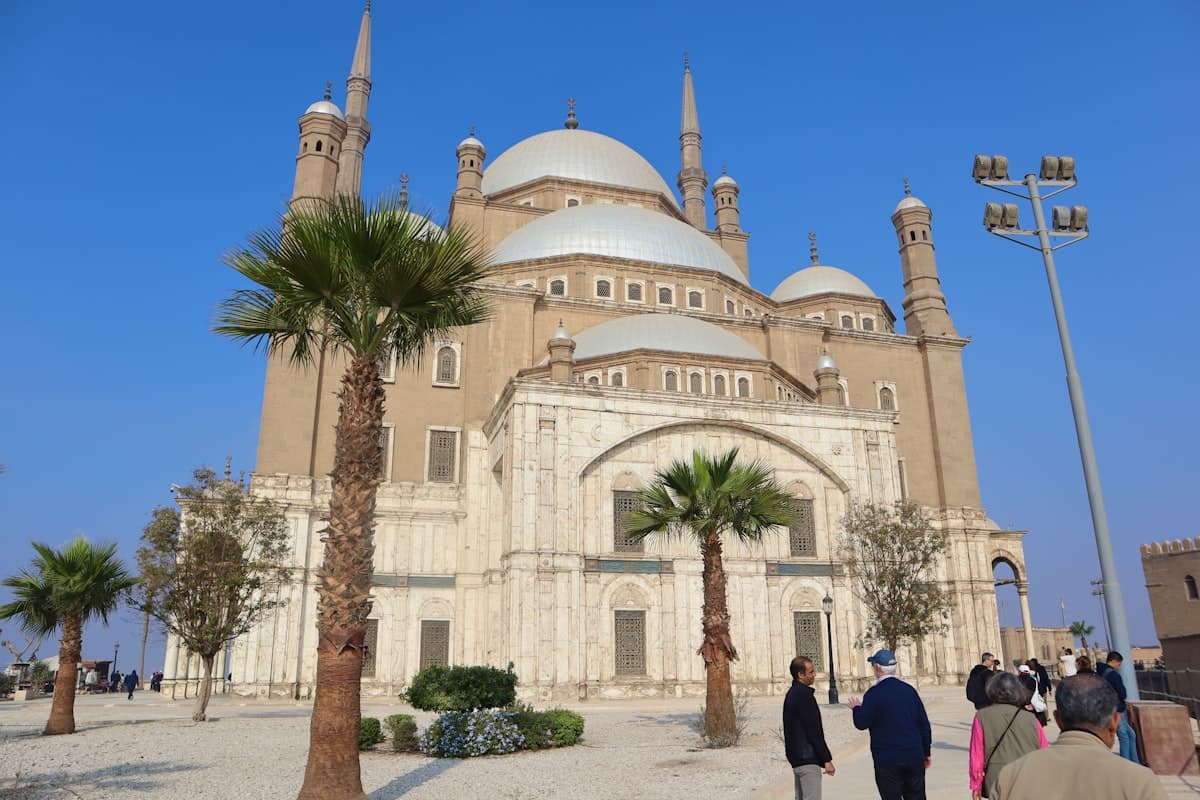
Mohamed Ali did not build the Citadel. Saladin began it in 1176, using stones quarried from the smaller Giza pyramids, which is verifiable from contemporary accounts and explains certain peculiarities in the Citadel's lower walls. The complex was expanded by subsequent Mamluk sultans, particularly al-Nasir Muhammad, who built a mosque inside the Citadel in 1318 that still stands, though it is rarely visited because it sits in the shadow of Mohamed Ali's more theatrical construction.
To reach the Citadel's hilltop site, look east from the mosque's courtyard on a clear morning and you will see the Muqattam Hills, from which the limestone that built medieval Cairo was extracted. The Citadel sits on a spur of these hills, a position Saladin chose because it commanded unobstructed views of the Nile to the west and the approach routes from the desert to the east. It was a military calculation that remained valid for seven centuries.
Mohamed Ali understood the Citadel's symbolic value perfectly. In 1811 he invited the Mamluk beys, his remaining rivals for power, to a celebration at the Citadel marking his son's appointment to lead a military campaign. Between 470 and 500 Mamluk leaders arrived. None left alive. Their escort was slaughtered in the narrow passage known as the Bab al-Azab, which you pass on the way in. The gate is still there. Most visitors walk through it without knowing what happened at that spot.
The massacre effectively ended Mamluk political power in Egypt after 267 years. One Mamluk leader, Amim Bey, allegedly escaped by jumping his horse from the Citadel wall. Historians argue about whether this actually happened. The wall in question is high enough that the story seems improbable. Egyptians tell it anyway, because it is a good story and the man deserves the dignity of an escape.
---
The Connections
Mohamed Ali's Albanian origins place him in a larger Ottoman story that Egypt tends to compress or ignore. The Ottoman Empire drew its military and administrative elite disproportionately from the Balkans: Albanians, Bosnians, Circassians, and Greeks filled positions that Arab and Turkish Muslims frequently did not. The Mamluks whom Mohamed Ali destroyed were themselves almost entirely Caucasian by origin, purchased as children in the slave markets of the Black Sea region, converted to Islam, and trained as soldiers. The Egypt that Mohamed Ali inherited was already governed by people from everywhere except Egypt.
This matters for understanding the Mohamed Ali Pasha Albanian heritage Egypt carries, because it was not an anomaly. It was the operating system of the Ottoman world. What made Mohamed Ali unusual was not that he was Albanian but that he successfully converted an Albanian soldier's opportunism into a hereditary dynasty that outlasted the Ottoman Empire itself.
The connections run deeper into the city around the Citadel. The Ibn Tulun Mosque, a 15-minute walk from the Citadel, was built in 879 by Ahmad ibn Tulun, a Turkic-origin governor who also decided to stop remitting taxes to his caliphal overlords and essentially founded an independent Egyptian state. The parallel with Mohamed Ali is direct and not coincidental: both were outsiders deployed by a distant imperial power who recognized Egypt's independent potential and acted on it. Ibn Tulun's mosque has survived 1,145 years; it is structurally more interesting than Mohamed Ali's and has almost no crowds.
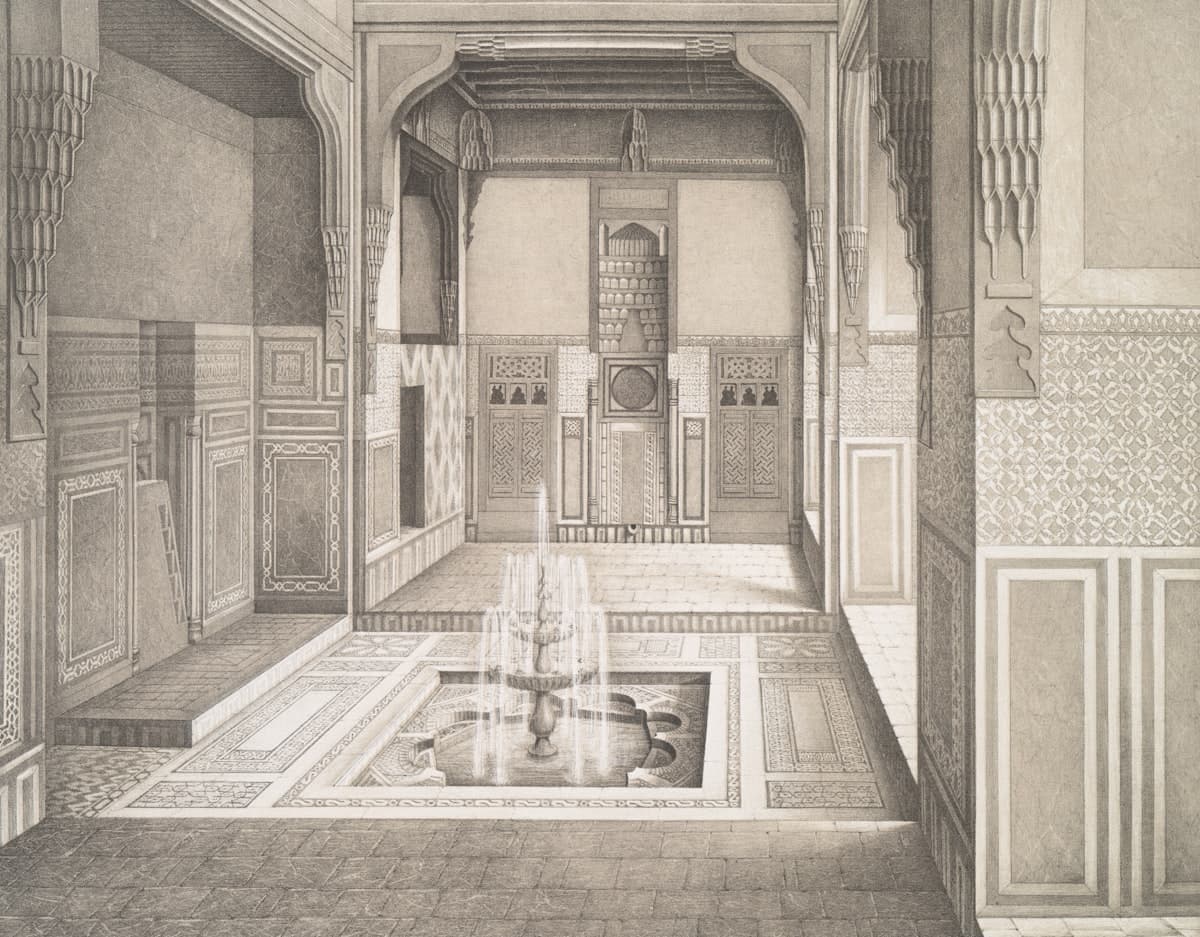
The Gawhara Palace inside the Citadel complex, built by Mohamed Ali in 1814, holds a collection of 19th-century furniture and personal effects that most visitors skip. It should not be skipped. The rooms show exactly what an Albanian-origin Ottoman pasha who governed Egypt for four decades considered a suitable domestic environment: French Empire furniture, European oil paintings of Nile landscapes, and an audience chamber where he received visitors in a context designed to signal both Ottoman legitimacy and European sophistication simultaneously. The contradiction is the whole story of Mohamed Ali in one room.
---
Common Mistakes
Treating the mosque as the only reason to come. The Citadel complex contains the Gawhara Palace, the al-Nasir Muhammad Mosque (1318, almost no visitors, genuinely worth your time), and the Military Museum, which is overlit and poorly labeled but contains scale models of Egypt's major historical battles that clarify the geography of conflicts you have been reading about abstractly.
Arriving without knowing about Friday prayer closures. The mosque interior closes for roughly two hours on Friday midday. Tourists who arrive at 12:30pm on a Friday find the door shut and are rarely told why or how long the wait will be. Check the time before you go.
Paying for a guided tour at the Citadel gate. The licensed guides clustering at the entrance range from excellent to indifferent. If you did not book a specific guide in advance through a verified agency, you have no way to distinguish between them. Reading this article and the relevant chapters of Galal Amin's "Whatever Happened to the Egyptians" will teach you more than most gate-sourced guides.
Skipping the view from the outer terrace. This is where the Citadel's military logic becomes physical. You can see the Nile, the pyramids on clear days, the full span of Islamic Cairo's minarets, and the desert beginning immediately beyond the city's eastern edge. Five minutes here reorients everything you have seen at ground level.
The sound and light show at the Citadel costs EGP 400 and delivers a heavily dramatized version of Egyptian history that mistakes compression for insight. It tells you Mohamed Ali was a great modernizer and skips the 1811 massacre entirely. Skip it. The Citadel at night, viewed from outside the walls along Salah Salem Road, is more affecting and costs nothing.
Confusing the two mosques inside the Citadel. Mohamed Ali's mosque dominates visually, but the al-Nasir Muhammad Mosque, built two centuries earlier by a sultan who ruled Egypt three separate times (deposed twice, restored twice, which is its own story), has minarets covered in Maghrebi tilework that are unique in Egyptian Islamic architecture. It receives perhaps ten percent of the visitor attention it deserves.
Going between 10am and 1pm in summer. The Citadel's hilltop position gives it no shade and full exposure to Cairo's summer heat. The alabaster mosque interior offers some relief, but the courtyard and terraces are genuinely brutal from June through August before late afternoon.
---
Practical Tips
Dress modestly and bring a scarf or wrap if your shoulders are bare: the mosque requires both shoe removal and covered shoulders for all visitors. Shoe bags are available at the entrance. The floor is cold marble, which is actually pleasant in summer and less pleasant in January.
A legitimate licensed Egyptologist guide, booked in advance through an established Cairo agency, typically charges EGP 500 to 800 for a two to three hour Citadel tour. This is worth the money specifically for the Mamluk history and the architectural connections between the buildings inside the complex. For the Mohamed Ali Mosque's Ottoman architecture specifically, a guide who knows Istanbul as well as Cairo will give you the most useful comparative context.
Combine the Citadel with Ibn Tulun Mosque and the Gayer-Anderson Museum (attached to Ibn Tulun, entry EGP 100) on the same afternoon. All three are within walking distance if you descend the Citadel's western side. This sequence, starting at the Citadel around 8am and finishing at Gayer-Anderson around 2pm, covers roughly 1,400 years of Egyptian history without requiring any transport between sites.
The Khan el-Khalili bazaar is a 15-minute taxi ride from the Citadel and is frequently recommended as a natural pairing. It is not a natural pairing. The bazaar is a tourist market that requires significant resistance to extraction. If you want to eat after the Citadel, the restaurants along Souq al-Silah Street on the descent toward Ibn Tulun serve better food at lower prices than anything near the Citadel's main gate.
Frequently Asked Questions
The Weekly Dispatch
More on Egypt, every Friday.
Cultural depth and places most guides never mention.
No spam. Unsubscribe anytime.